

XRP’s short-term setup is facing renewed pressure after a sharp burst of currency inflows into Binance, with on-chain data showing the move was driven mainly by large holders. The spike is important because it signals a sudden increase in potential supply on the sell side at a time when broader market momentum remains weak.
CryptoQuant contributor Darkfost marked the move in a post on “BTC continues to fluctuate, offering limited directional clarity in the near term. This lack of momentum is weighing on the broader market, with altcoins continuing to underperform in the absence of a clear trend,” Darkfost wrote.
Are XRP whales being sold?
That context is important for XRP. In a market with limited follow-through, large currency deposits can carry more weight than during a strong risk phase, especially when flows are concentrated in whale-sized cohorts.
The chart shared by Darkfost, titled ‘XRP Ledger: Exchange Inflow – Value Bands – Binance’, shows a clear outlier on February 21. Total inflows rise to over 31 million
Related reading
Darkfost immediately summarized the move: “This week was particularly marked by significant XRP inflows to Binance, which remains the go-to exchange for large transactions thanks to its high liquidity. Yesterday, more than 31 million XRP were transferred to the exchange in one day.”
The chart also suggests that this was not a broad-based retail event. Smaller cohorts contributed relatively little to the spike, while large holders accounted for almost all of the movement. That pattern is consistent with Darkfost’s central argument that the event poses short-term risks because it represents a concentrated, potentially market-moving supply arriving in a highly liquid location.
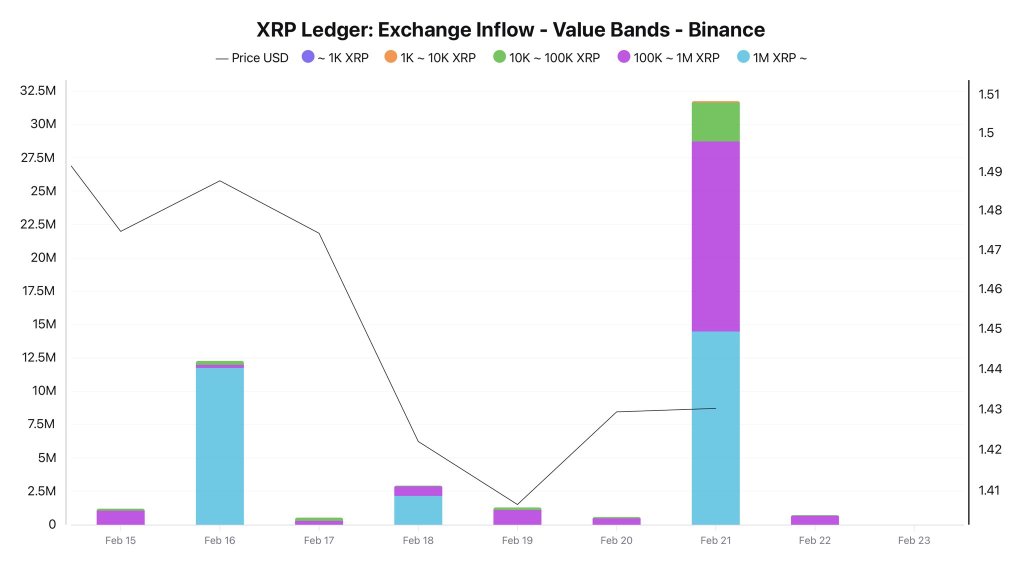
According to the breakdown shared in the post, the inflows were led by the two largest cohorts: 14,236,825 XRP from wallets in the 100k-1M band and 14,494,865 XRP from whale wallets holding over 1 million XRP. Mid-size wallets in the 10,000 to 100,000 range added 2,938,809 XRP, while the sub-10,000 segments contributed only a small portion of the total.
Related reading
Taken together, the spread reinforces that the event was whale-led rather than diffuse. In practice, this is important because the inflow of large investors is often seen as an indicator of the potential intention to sell, even if the inflow itself does not confirm execution.
Darkfost summarized the risk in dollar terms, writing: “All told, this represents a sudden potential selling pressure of almost $45 million that should be closely monitored. Should this selling pressure continue, XRP may struggle to recover from the ongoing correction in the near term.”
The price line displayed on the chart shows that XRP traded lower for much of the same period, falling from the top of the range shown around February 15-16 before bottoming out around February 19 and then recovering only modestly. By the time the large inflow hit Binance on February 21, the price had recovered somewhat but remained below the previous level of the week. However, the recovery was completely erased during the early European morning session, as XRP fell to a low of $1.33.
At the time of writing, XRP was trading at $1.3947.
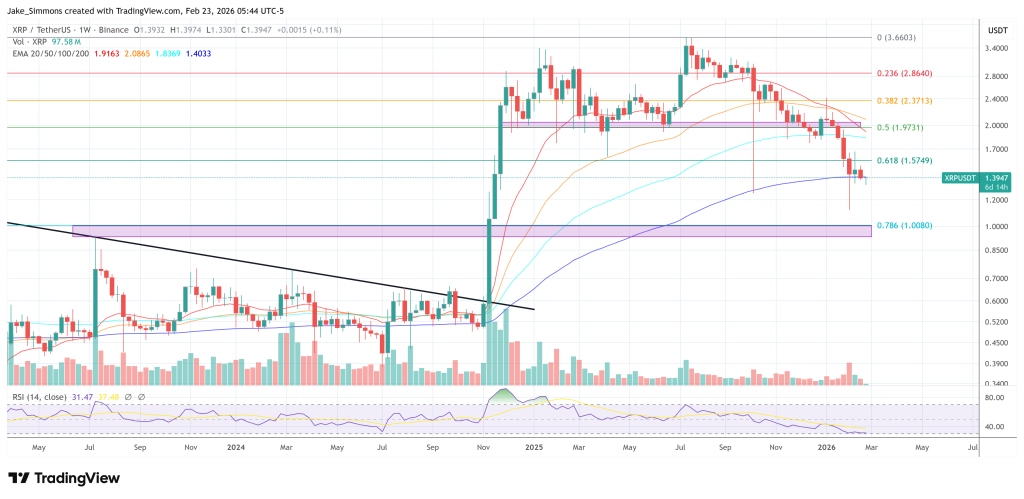
Featured image created with DALL.E, chart from TradingView.com