

The weekly structure of XRP is coming under increasing scrutiny as the price consolidates within a historically sensitive range. Rather than signaling an end, one prominent XRP enthusiast suggests this phase could lay the groundwork for a major structural pivot. Understanding this setup is key to seeing how historical consolidation phases define XRP’s expansion framework.
Historical consolidation phases define XRP’s expansion framework
In a recent review on X (formerly Twitter), XRP market commentator @Austin_XRPL marked the historical price behavior of the asset as evidence of a recurring structural process. According to a chart he posted, every major valuation cycle has been consistent preceded by long-term consolidationwith the award carefully building acceptance before moving forward.
Related reading
He points to the $0.15-$0.30 range as the earliest modern base, where XRP spent about two years forming fundamental support before you go higher. Similar behavior occurred between $0.30 and $0.50, establishing a new two-year launch pad that allowed accumulation to occur efficiently. As the price rose, the consolidation periods became shorter but remained critical: $0.50–$0.75 saw about 18 months of structured interaction, followed by almost a year of basing between $0.75–$1.30. Even the higher macro range of $1.80–$3.40, often interpreted through a distribution lens, recorded more than a year of economic growth. sustainable trade and accumulation.
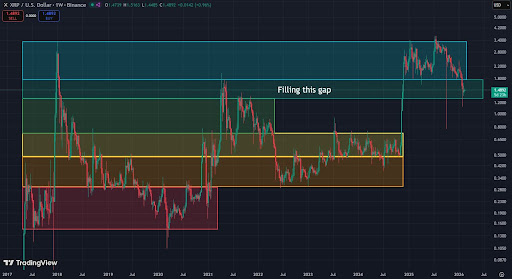
Austin’s framework emphasizes that expansions only follow extensive structural preparations disciplined accumulation. If XRP is now building a “definitive base” at current levels, the implication is clear: adequate consolidation could lay the necessary foundation for the next major and potentially long-term markup phase.
Building the final base: $1.30 – $1.80 in focus
Austin identifies the $1.30 to $1.80 range as the one major zone on XRP’s macro chart that has never formed a good base. His chart shows that price moved quickly through this corridor during previous rallies, leaving minimal consolidation.
Related reading
He classifies the area as an inefficient area, where prices do not increase creating sustainable support. Structurally, markets often revisit such zones to stabilize liquidity and build equilibrium where trading activity was previously sparse. Recent weekly price action shows that XRP is trading within this corridor rather than rejecting it. Austin interprets this as structural recovery and describes the behavior as gap filling: the price rotates within the range to achieve acceptance.
If this process continues, he considers it a basic formation. Converting this historically underdeveloped corridor into aid would close what he sees as the last structural gap on the macro map, leaving all lower zones with established consolidation history. The implication is reduced resistance above. Because XRP has spent limited time consolidating outside this range in previous cycles, the supply overhead may be smaller once expansion begins.
Within this framework, completing a base means late-stage preparation. With the inefficiencies resolved and support established, XRP would be structurally positioned for the transition from consolidation to expansionwith each breakout reflecting the completed market structure rather than sentiment-driven momentum.
Featured image of Peakpx, chart from Tradingview.com