
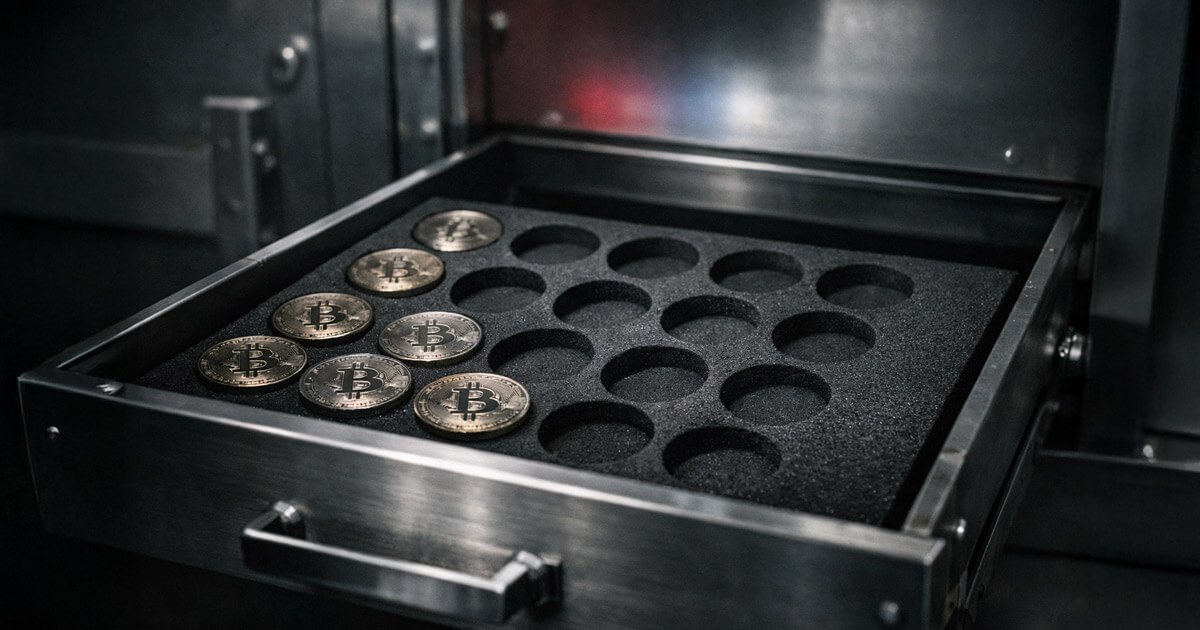
The US Strategic Bitcoin Reserve could lose almost 30% of its holdings in a single legal move, even if the government does not sell any coins.
Last year, President Donald Trump signed an executive order establishing a strategic Bitcoin reserve. The order directed the Treasury Department to consolidate government-held BTC into a reserve account and promised that the United States would not sell those coins.
Still, the headline figure for the reserve may be an overestimate of how much BTC the government can actually treat as a permanent strategic asset.
Facts of Bitcoin Treasuries estimates that the US government controls approximately 328,372 BTC. This makes it the largest known state holder in the world. At Bitcoin’s current price of about $65,842, that supply is worth about $21.6 billion.

However, here lies the complication. Much of that U.S. holdings includes government-owned BTC, but not government-owned in a strategic sense.
The executive order expressly authorizes dispositions pursuant to a court order from a competent jurisdiction. A specific exception is made for assets that must be returned to identifiable, verifiable crime victims.
That exception matters because approximately 94,643 BTC, about 30% of the government’s holdings, is linked to the 2016 Bitfinex hack.
If those coins are returned as a refund, the reserve number would mechanically drop to around 234,000 BTC.
The spare number is real, but the question of ownership is still open
The Strategic Bitcoin Reserve is often discussed as if it were a clean, sovereign balance sheet. In practice it is a legal and accounting mix.
Some of the BTC attributed to the government has been completely forfeited and is clearly under US control.
However, some are still involved in criminal cases, restitution claims or procedural steps that can take years.
That gap is now at the center of the debate over the American reserve.
The 94,643 BTC linked to Bitfinex is the clearest example. These coins are visible in government-linked custody and the markets count them.
However, if a court rules that they should be returned to the victims, they were never really a permanent strategic reserve in the first place.
This is why both sides of the public debate can miss the point.
The bullish version exaggerates the sustainability of the reserve if every government-controlled currency is considered permanently strategic. The bearish version exaggerates the impact on the market if it views a refund transfer as a sale of government bonds.
The legal distinction matters for price, for sentiment, and for how investors interpret the Strategic Bitcoin Reserve itself.
Why the Bitfinex coins remain frozen
The Bitfinex theft involved the theft of 119,754 BTC in August 2016, one of the largest BTC thefts in crypto history.
In February 2022, US authorities recovered approximately 94,643 BTC linked to that hack, a seizure notable for both its size and timing.
The next question was always refund.
In January 2025, prosecutors asked a federal court to approve the return of the recovered assets to Bitfinex as in-kind restitution, meaning the BTC would be returned as Bitcoin instead of first being sold and converted into dollars.
That distinction is important for the market structure.
A government sale or auction would create a visible supply event, the timing and magnitude of which are known in advance. An in-kind return shifts the next decision downstream to the recipients.
That could be Bitfinex, its former users, or both, depending on how the court handles competing claims.
The US forfeiture procedure is intended to delay this phase. Third parties claiming an interest in forfeited property may file a petition in ancillary proceedings. In the case of Bitfinex, that process has become the main battleground.
Some customers claim that the stolen assets belonged to them individually. On the other hand, Bitfinex claims that it ultimately bore the economic loss after socializing the losses and later reimbursing users through internal mechanisms.
So the outcome of this is much more important than this case, as it could impact how refunds are handled in future exchange hacks.
Until the court resolves these claims or the parties reach a settlement, the coins remain effectively immobilized.
That is why the reserve in the chain may appear stable, while in legal terms it remains uncertain.
LEO acts as a market proxy for the court’s outcome
The legal process remains slow, but traders are trying to determine the outcome through UNUS SED LEO (LEO), the exchange token for Bitfinex and iFinex.
Bitfinex has stated that if it receives the recovered BTC, it plans to use 80% of the net amount to buy back and burn LEO within 18 months.
The company noted that this process could include over-the-counter transactions such as direct BTC-for-LEO swaps.
This policy essentially turns a federal court decision into a massive buyback pipeline. It gives the market a mechanism to speculate on the timeline well in advance of a legal resolution.
In light of this, Vetle Lunde, head of research at K33 Research, said: models LEO with two primary value drivers. These include ongoing buybacks funded by Bitfinex trading revenue and the expected future burn associated with the recovered bitcoin.
Based on a baseline of approximately 95,000 BTC recovered, Lunde estimates that the 80% allocation would equal approximately 75,000 BTC. At today’s prices, that pool is worth about $5 billion.
Meanwhile, he calculates that the buyback of trading proceeds alone represents a fair value of about $125 million.
However, trading in this catalyst is very volatile.
Data from CoinMarketCap shows that LEO has a market cap of around $8 billion, but a 24-hour trading volume of just $7.1 million. That thin liquidity profile can seriously magnify price movements.
Meanwhile, the huge market cap also shows that LEO is trading at a premium of around 60% to implied fair value.

This is the highest premium since the prolonged period of high prices that followed the first seizure announcement in 2022.
According to Lunde, the current premium remains noisy because LEO is highly illiquid and has concentrated ownership, meaning a small number of participants can seriously skew the market.
As a result, traders can be at the forefront of a judicial transfer, or simply rely on momentum in an environment where fair value takes a back seat.
Ultimately, LEO’s illiquidity will amplify the bottom line. A confirmed transfer could further boost valuations in the short term.
Conversely, modest or delayed supply distribution could quickly depress premiums.
Why headlines can hit harder than actual BTC flows
The broader macro background explains why this story is likely to influence sentiment before the court decides anything.
Bitcoin traded on a risk-free regime in early 2026.
For context, spot Bitcoin ETFs have seen sharp capital outflows of more than $4.5 billion this year, amid a five-week streak of outflows.
In that environment, traders are already sensitive to supply news reports, especially when it comes to matters related to state-owned BTC.
So a headline saying the US is transferring about 95,000 BTC would be intended to shock the markets.
If the coins leave government custody, they would be a refund, not a government sale.
And if Bitfinex receives the coins and follows the established buy-and-burn plan, the resulting BTC flow will likely be distributed over time rather than dumped into the market all at once.
Even in the rougher, rounded version of the math, about 75,000 BTC over 18 months equates to about 139 BTC per day.
That could impact LEO’s price, but it doesn’t represent a significant supply shock compared to the much greater distribution pressure Bitcoin has already absorbed from long-term holders and ETF outflows over the past five months.
So the real impact on the market may come from narrative framing rather than coin flow.
This is because the Strategic Bitcoin Reserve represents more than a simple supply of BTC. It acts as a political and market signal that traders can read as bullish or bearish, even though the legal status of those coins remains unresolved.
That’s why the ‘US loses 30% of its bitcoin reserves’ is likely to cause volatility. It’s emotionally clean. It fits in a cup. It also takes away the legal content.
However, the legal content is the story.
The SBR was built to coexist with restitution. If the Bitfinex tranche leaves state custody, the reserve number on trackers will drop and the markets will react.
But the deeper point will remain unchanged. The United States would not retreat from its reserve policy. It would follow the rule of law, which is exactly what the reserve cadre said it would do.