

Macro trader plur daddy (@plur_daddy) argues that bitcoin’s 2026 setup is less about crypto-specific catalysts and more about whether U.S. liquidity conditions normalize after what he described as an unusually tight few months in terms of risk.
Its central claim is that the repo “plumbing” is being squeezed by a shortage of bank reserves as the debt burden in the economy grew faster than the Fed’s balance sheet, and that the resulting stress has manifested itself in broader markets – “very choppy and rotating dynamics in equities” – alongside “a pretty unfavorable environment for crypto.” As we enter the new year, he expects a series of incremental shifts that could return conditions from tight to neutral, even if they don’t create a new “loose” regime.
4 Macro Themes Will Be Critical for Bitcoin
The first lever is the Fed’s reserve management purchases (RMPs). “Since the December FOMC where they announced $40 billion per month in RMPs for three months (and an unspecified lower amount thereafter), this liquidity has flowed in. The Fed has already bought $38 billion of the first month’s allocation,” he wrote. “So far we have not seen a huge impact as this has been offset by year-end liquidity factors as brokers and dealers close their books and reduce risk before year-end, but this should change.”
Related reading
He emphasizes that the program is intended to ease financing pressure, and not to fuel a risk of melt-up. “I will add in the disclaimer that this is not QE, this is a targeted tool to unclog a clogged pipe in the financial plumbing matrix, so don’t get too carried away with the impact this could have,” he wrote. “It can help bring a tight environment back to normal, but it won’t turn a normal environment into a loose one.”
As for sizing, he calls it imprecise but meaningful: “Measuring the deficit is more of an art than a science, but gut instincts are probably around $100 to $200 billion (which is in line with the announced size of the RMP), so one month of RMPs won’t solve the entire problem, but it should have a meaningful impact.”
Secondly, there is budgetary incrementality. He expects a modest increase in the budget deficit: “My work suggests an expansion of $12 to $15 billion/month from January 1 due to the OBBBA effects,” he said, adding: “We are in a regime of fiscal dominance.”
The analyst links the recent softness to the opposite momentum, arguing that the deficit contraction – which he attributes to tariffs – has weighed on markets, and that even a partial reversal matters: “$12-15 billion/month is not enough to overcome the impact of tariffs, but it is incremental compared to November/December, and I believe incrementality is what matters.” He also marks the eSLR change coming into effect on January 1 for early adopters as a smaller tailwind, with broader banking deregulation “on deck for 2026.”
Third, there is disinflation and the policy trajectory. He points to falling market-based inflation expectations, citing the one-year inflation change, and describes the mix as a “Goldilocks.” “The disinflationary environment is creating a Goldilocks,” he wrote. “The economy is weak, but not too weak, and softer inflation allows the Fed to continue limiting air cover.” He notes that markets are currently conservative – “a cut in January of only 13%” and “a total of two cuts priced into the curve for the full year” – and then lays out his own baseline: “I would expect something closer to four cuts assuming orthodox policy, and more than that under a Trump takeover.”
Related reading
Finally, he argues that politics can matter through the chairman of the Fed. “Trump will ultimately value loyalty above all else,” he wrote, because he believes Trump “felt betrayed by Powell.” He adds: “The Fed chairman is especially important in this regard because Trump does not have the authority to fire him, unlike other positions.” According to him, Kevin Hassett is “very likely” given that relationship. He also outlines market sensitivity: “Gold in particular will benefit from a Hassett nomination. Shares may initially have some heartburn, but also think they will eventually rise.”
For bitcoin, his conclusion is cautious but directionally constructive if these macro pieces align. “In terms of crypto, this should theoretically all be for the better,” he wrote. “I probably won’t play it because I prefer gold here, and crypto is becoming increasingly difficult when you take into account the pressure on mental capital.” Still, he leaves out a timing note: “There’s something to be said, though: If you want to be bullish, here’s the right time somewhere. Don’t be a hero, look for character changes and a positive response as liquidity conditions improve.”
At the time of writing, BTC was trading at $87,053.
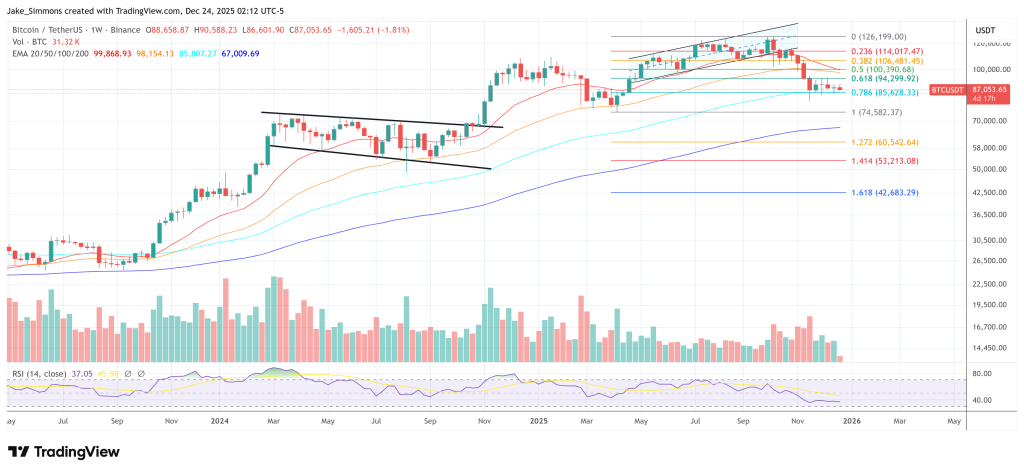
Featured image created with DALL.E, chart from TradingView.com