

Bitcoin’s decline to the $60,000-$70,000 zone has lit up the usual “bottom” dashboards: extreme fear, faded positioning, and a cluster of indicators that many traders view as capitulation signals. But Mignolet, a CryptoQuant contributor, says the market is missing the one thing that ultimately matters: a visible bid from dominant buyers.
“What I highlighted in the $80,000 – $90,000 range still remains the same,” he says wrote on February 18. “Many indicators that market participants are tracking point to a bottom and extreme fear. However, we don’t see dominant players (whales) actually taking advantage of this situation.”
Mignolet’s core argument is simple: a bottom isn’t a sentiment measure, it’s an event, and he doesn’t see the kind of forced absorption that typically marks a sustainable turn. “No matter how many indicators suggest a bottom, if real purchasing power doesn’t intervene, we have no way of knowing where the real bottom will be,” he said. “That’s why I don’t make price predictions lightly.”
Related reading
He contrasted the current tape with the 2024 bull cycle, when fear could still dominate headlines even as big allocators quietly took the other side. During that period, he argues, the market had a measurable backstop: institutional demand emerged through U.S. spot Bitcoin ETFs, particularly BlackRock’s IBIT and Fidelity’s FBTC, which “clearly absorbed the selling pressure.”
The “key point” in his formulation is that the same mechanisms no longer emerge. Mignolet says that the accumulation pattern that FBTC has maintained for about a year has “already broken down,” and that IBIT, previously described as a cushion during heavy selling pressure, is “now on a downward trend, unlike last year.”
That shift is why he keeps the bottom decision “on ice” even if the price ultimately holds the current region. According to him, Bitcoin is still at a stage where traders should be “cautious of further shocks,” and even a successful defense would likely take time before it can be considered confirmed.
When everyone reads the same Bitcoin data
In addition to flow, Mignolet also warns of a structural change in the way market stories are formed. He argues that the proliferation of analytics in the chain has made the space more information-rich, but not necessarily more insightful and in some cases even more dangerous.
Related reading
“The problem is that everyone looks at the same data and often comes to similar conclusions,” he wrote. “In many cases, even the people producing the data don’t fully understand it. When information becomes too general, it pushes expectations in one direction.”
He describes today’s well-packaged on-chain dashboards as “clean and compelling, almost like an answer sheet,” which can strengthen belief especially when flexibility is required. The downstream risk, he suggests, is that widespread agreement on “obvious” bottoms could keep investors anchored through deeper declines or longer periods of turmoil.
In the short term, Mignolet’s base case is not a pure trend reversal, but a “sideways move without clear direction,” with enough volatility to create opportunities for short-term traders. For his own positioning, he described the period as “waiting,” taking a step back to look at “liquidity flows, supply and demand conditions and overall market sentiment,” then “resetting” his framework.
The bigger picture, he said, is still bearish and potentially more expansive than he expected last year. His closing warning is that this down cycle is “unlikely to end on a mild note,” with plausible outcomes being a bigger-than-expected decline, a longer-than-expected sideways phase, or both.
At the time of writing, Bitcoin was trading at $67,889.
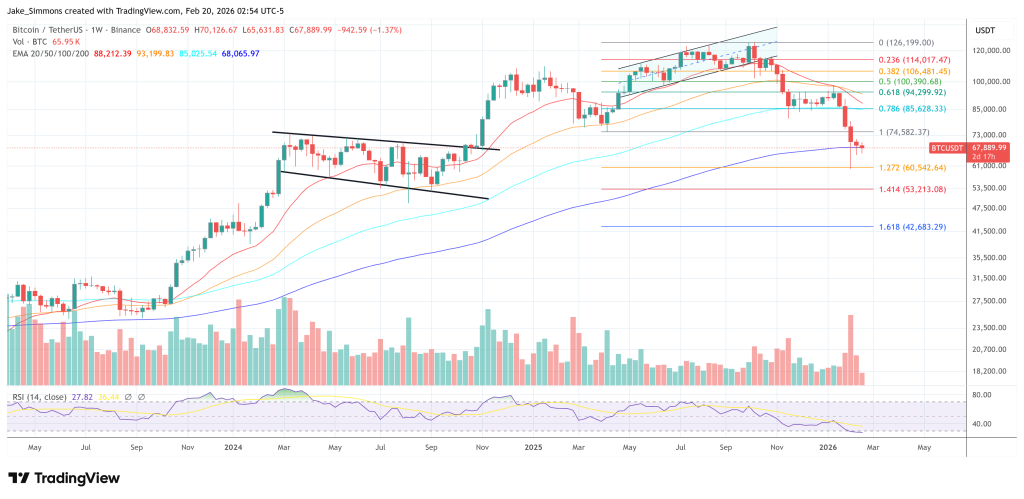
Featured image created with DALL.E, chart from TradingView.com