

Bitcoin has been consolidating since late November, struggling to establish a clear directional bias as the market looks for stability ahead of the next wave of volatility. After failing to maintain momentum above the October 2025 highs, price action has shifted to a wide range, reflecting growing uncertainty among investors. While some market participants interpret this pause as a potential basis for continuation, others remain cautious and point to historical bear market behavior for context.
Related reading
According to one report According to top analyst Axel Adler, Bitcoin’s current decline from its October peak remains historically shallow. The Bitcoin Bear Market Correction Drawdowns chart, which compares the depth of drawdowns since 2011, shows how different this cycle has been so far. In the current 2025+ cycle, the decline is about −27%, with the maximum correction being about −33%.

In contrast, previous bear markets have been much more severe: the 2011 cycle collapsed by −92%, both the 2013–2015 and 2017–2018 cycles saw declines of almost −82%, and the 2021–2022 bear market bottomed out at around −75%.
This relative resilience may indicate a structural shift in Bitcoin market dynamics. The growing presence of spot ETFs and institutional capital could dampen volatility and reduce the magnitude of corrections. Still, Adler warns that the current bear phase is relatively young. As a result, it remains too early to conclude that Bitcoin has definitively entered a new regime where deep declines are no longer part of the cycle.
Adler continues explains that the Bitcoin Cumulative Value Days Destroyed (CVDD) model provides crucial context for evaluating where the market currently sits within the broader cycle. CVDD is a long-term on-chain valuation framework, derived from ‘destroyed’ coin days, that captures periods when older, long-held coins are issued. Historically, this behavior has been closely associated with major market transitions and macro bottoms.

The CVDD chart shows the price of Bitcoin against various valuation bands, including the base CVDD level and its 5x and 10x multiples. Currently, Bitcoin is trading around $91,000, which puts it about 2x above the base CVDD, which is currently valued at around $46,600. This zone has historically been aligned with the bottom formation phases of the bear market, rather than complete capitulation events. In previous cycles, deep undervaluations and panic selling typically occurred when the price approached or briefly undershot the base CVDD level.
The fact that Bitcoin remains well above this fundamental support suggests that the market has not yet entered a true capitulation regime. Instead, long-term holders appear largely intact and selling pressure from older coins remains relatively limited. As Adler notes, the base CVDD level continues to act as a structural floor for the asset over the long term.
Taken together, Bitcoin’s slight downside profile and position above key CVDD valuations indicate that the ongoing correction is real, but still consistent with an early bear cycle, rather than a fully developed market bottom.
Related reading
BTC is consolidating as its structure remains weak
Bitcoin price continues to trade within a tight consolidation range after the sharp sell-off from October highs, with the chart showing BTC hovering around $90,000-$91,000. This zone has acted as a short-term equilibrium following the aggressive collapse above $100,000, but the broader technical structure remains weak. The price is still trading below the 100- and 200-day moving averages, both of which are sloping downward, reinforcing the idea that the dominant trend has shifted from bullish to corrective.
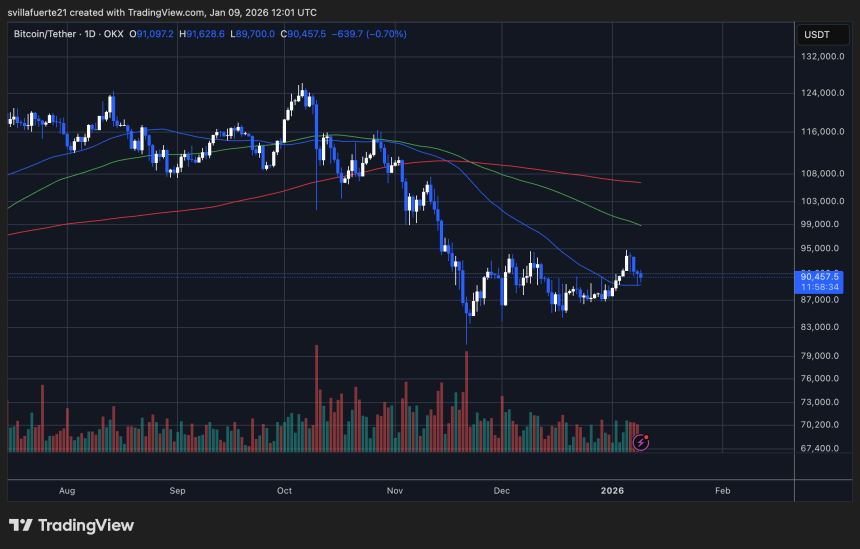
The recent rebound from the December low of around $86,000 failed to materialize, suggesting demand remains cautious rather than aggressive. While buyers have managed to defend higher near-term lows, any upside attempt has been capped near the declining moving averages, highlighting continued overhead supply.
Related reading
Volume has also fallen during the consolidation phase, indicating a lack of conviction on both positive and negative factors.
From a market structure perspective, Bitcoin appears to be forming a basic pattern rather than initiating a reversal. Staying above the $88,000-$90,000 support zone is crucial to avoid a deeper retrace towards the mid-$80,000s.
However, a sustained recovery would require a decisive recovery from the region between $95,000 and $98,000, where the major moving averages converge. The current price action is best interpreted as consolidation within a broader correction phase and not the start of a new uptrend.
Featured image of ChatGPT, chart from TradingView.com