

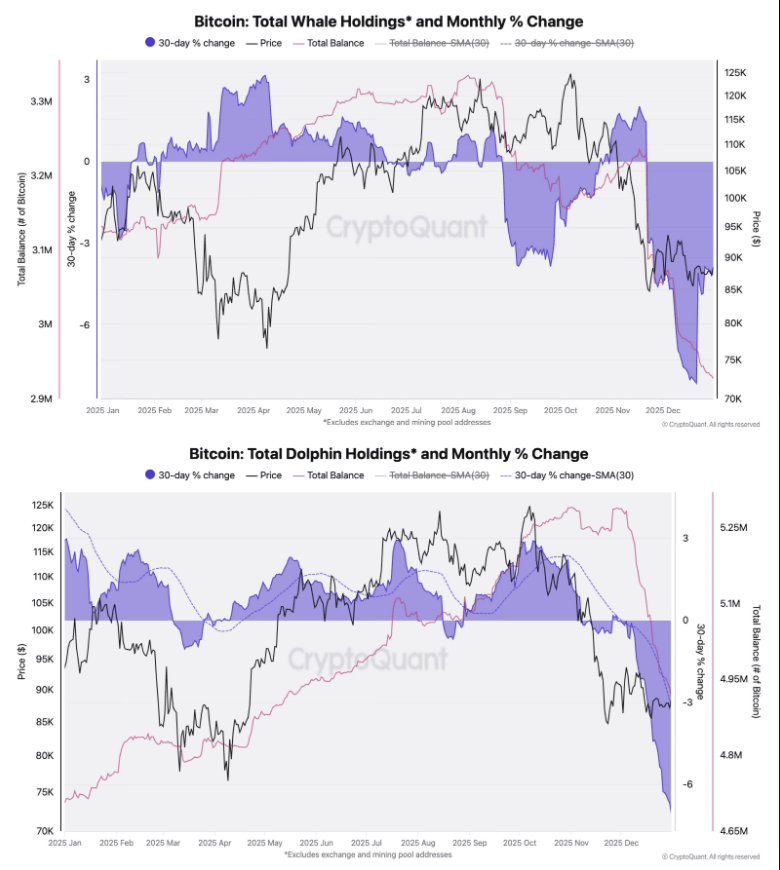
According to onchain data from CryptoQuant, claims that large holders are re-accumulating Bitcoin en masse are exaggerated. The numbers shared by many on social media may be skewed by exchange movements, not new purchases. That distortion matters because large transfers associated with exchanges can give the impression of one entity accumulating, when the action is often internal accounting.
Related reading
Whale portfolio totals can be misleading
Exchange houses often pool money from many small accounts into fewer large wallets for operational or compliance reasons. When that happens, onchain trackers may consider these consolidated addresses as “whales,” inflating the apparent number of very large holders.
According to Julio Moreno, head of research at CryptoQuant, once these exchange-related shifts are removed from the data, real large holders’ balances still decline. Balances at addresses holding between 100 and 1,000 BTC have fallen, a trend in line with outflows from spot ETFs.
No, whales are not buying huge amounts of Bitcoin.
Most of the Bitcoin whale data out there is ‘influenced’ by exchanges that consolidate much of their holdings into fewer addresses with larger balances. This is why whales seem to have collected a lot of coins lately.
We… pic.twitter.com/dk9XqqckIX
— Julio Moreno (@jjcmoreno) January 2, 2026
Long-term holders who become buyers
Reports have suggested that another group has done so shifted his behavior. Matthew Sigel, head of digital asset research at VanEck, says long-term holders have been net accumulators over the past 30 days, following what was their biggest sell-off since 2019.
That change could ease a major source of selling pressure. It doesn’t guarantee a rally, but it does mean that at least one key cohort has stopped contributing to the sell side. Markets respond to who buys and who sells, and this move by long-term holders softens the argument that a single group is driving down prices.
Price action shows mixed signals
Bitcoin hovered around $90,000 during lean holiday trading. At the time of reporting, the price was around $89,750 on Saturday, with a 24-hour volume of almost $52 billion.
The token is about 2.8% below its recent day high of $90,250 and has a market cap of about $1.75 trillion, based on a circulating supply of nearly 20 million BTC. Trading has seen sharp moves up and down, but volume has been weak, meaning moves lack the support needed for a clear breakout or collapse.
Market movements depend on ETF flows
Since American place Bitcoin ETFs became active in early 2024, the ownership picture has changed. ETFs now have a lot of on- and off-chain demand, which can change where Bitcoin is stored and how flows appear on the on-chain charts. Reports indicate that ETF outflows have contributed to lower balances in the 100 to 1,000 BTC range, while at the same time some long-term holders are quietly buying.
Related reading
What this means for investors
Taken together, the evidence points more to consolidation than another bull run or major crash. Claims of a massive whale reaccumulation wave were exaggerated because they did not take into account exchange rate consolidation.
Yet the story is not one-sided. Long-term owners have shown interest in buying, even as major off-market addresses continue to shed some of their holdings. Future price direction will likely depend on whether ETF flows return in size and whether trading volume increases enough to confirm a move.
Featured image from Unsplash, chart from TradingView