
SWIFT is preparing for a major structural change in the global payment system. The shift will bring an end to an older messaging framework and a>Discover how London’s neobanks are becoming wealthtech on fmls25
On November 22, 2025, SWIFT will complete the migration to the ISO 20022 CBPR+ standard. The network connects more than 11,000 banks and financial institutions in more than 200 countries. The move will retire the long-standing MT format for core payment instructions and replace it with a unified framework built for richer, more consistent data.
SWIFT has also been testing connections to blockchain networks to explore cross-border transfers, CBDC payments and asset tokenization.
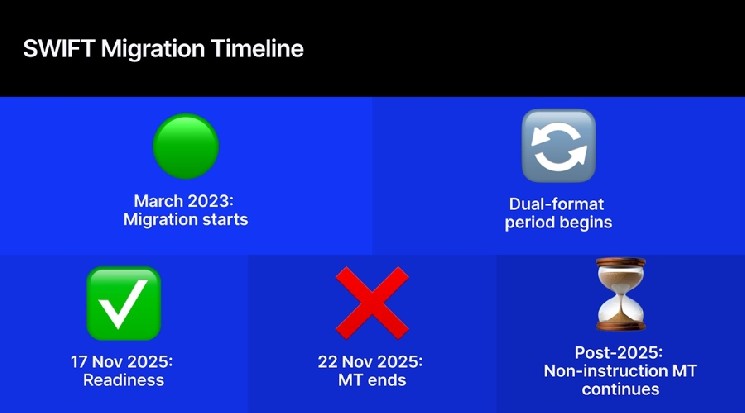
The transition has been underway since March 2023, when SWIFT entered a coexistence period that allowed for both MT and MX formats. This period ends on November 22, 2025. After that date, payment instructions may only be sent from financial institution to financial institution in ISO 20022.
[#highlighted-links#]
Institutions that continue to use MT for important cross-border payments risk delays, rejections or forced conversions via emergency services, which increases costs and reduces transparency.
Connected blockchains
SWIFT has been testing connections between its ISO 20022 framework and several blockchain networks. Ripple has been used for interbank settlements and CBDC payments. Stellar has supported cross-border transfers and stablecoins.
Algorand has been tested for asset tokenization and digital bonds. Hedera has been applied to corporate and government registers. Quant functions as a gateway between banks and blockchains.
Industry observers expect further integration of CBDCs and tokenized assets to occur by January 2026, potentially supporting new models of digital monetary transactions and interoperability between networks.
Operational benefits
Murthy Maddali, Managing Director at Techwave
Murthy Maddali, Managing Director at Techwave, emphasizes that “ISO 20022 enables better compliance with regulations such as AML and GDPR through enriched data.”
He adds that “automation reduces costs and errors while accelerating processing speed,” noting that the “API-driven integration provides scalability, improved customer transparency, and robust encryption-based data security.”
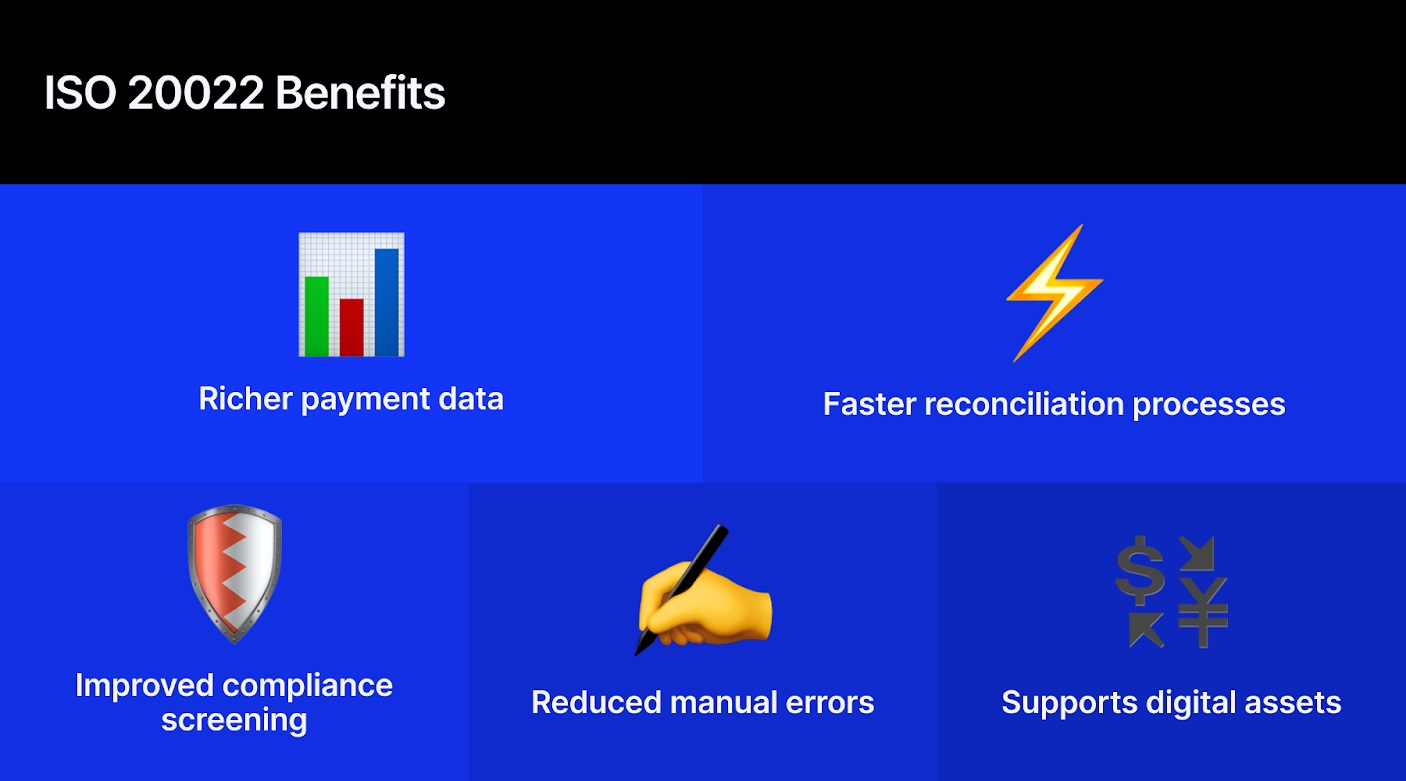
The standard is also designed to reduce fraud and human error, improve traceability and support cross-border commerce, while allowing all participants to communicate using a consistent messaging framework for cross-border payments under CBPR+.
Final migration timeline
SWIFT has divided the final phase into three phases. ISO 20022 will be fully operational on November 17, 2025. Between November 17 and 24, banks and market infrastructures across Europe, Asia and the United States will carry out synchronized migration steps. The full switchover on November 22 marks the point where MT payment instructions will no longer be supported for live traffic.
Citibank leads the ISO 20022 migration for SWIFT. Every bank will follow, this is the new standard for global payments.
ISO 20022 fixes messages, not settlements. That’s the gap. #XRP is the bridge that enables real-time value transfer.https://t.co/4RHx9A7CtV pic.twitter.com/H0HuerdH7Y
– Black Swan Capitalist (@VersanAljarrah) September 10, 2025
Scope of change
The switch mainly applies to payment instruction messages, which are crucial for correspondent banking transactions. Some other MT categories, such as reporting and investigations, will remain in place after 2025, according to a phased roadmap. However, the most important effect is significant: the most important cross-border payments will move to a single modern standard for the first time.
Purpose of adopting ISO 20022
ISO 20022 provides richer and more structured data, improving automation, reconciliation, compliance screening and processing efficiency. More detailed data reduces manual work and the chance of errors. Regulators see the increased granularity as useful for transparency and monitoring of financial crime.
Connection with market innovation
The standard is in line with developments in the field of tokenization, programmable payments and digital currency initiatives of the central bank. SWIFT has been running trials linking its interface to distributed ledger networks to test how tokenized assets, or CBDCs, can move between different systems.
These tests are exploratory, not full production deployments, but indicate how the messaging shift can support future interoperability.

Industry expectations after the transition
Observers expect attention to shift to experiments with tokenized securities, on-chain settlement models and early CBDC interoperability frameworks in early 2026. ISO 20022’s structured data model is seen as a prerequisite, allowing traditional institutions to interact with digital asset systems via standard fields and consistent formats.
Operational readiness and risks
Banks still preparing face increasing urgency. SWIFT has warned that missing the November deadline could result in operational disruptions, higher processing costs and reduced efficiency. Central banks and industry groups in several regions have launched preparedness programs to support testing and training.
Industry participants believe the move will create a more standardized environment for important cross-border payments. They expect improvements in data quality, operational efficiency and the ability to accommodate emerging payment technologies.
The full implications of the transition will become clearer once ISO 20022 is fully implemented and market participants have adapted their systems and processes.