

Anatoly Yakovenko, CEO of Solana Labs, said he wants Solana to be a constantly evolving network, constantly updated to meet the changing needs of users, which contrasts with Vitalik Buterin’s vision of Ethereum as a self-sustaining blockchain.
“Solana should never stop iterating. It shouldn’t have to rely on a single group or individual to do this, but if it ever stops changing to meet the needs of its developers and users, it will die,” Yakovenko said in a message to X on Saturday.
His comments were in response to a post from Buterin, who said Ethereum needs to reach a point where it passes the ‘walkaway test’, meaning it becomes self-sustaining in the coming decades without the influence of developers.
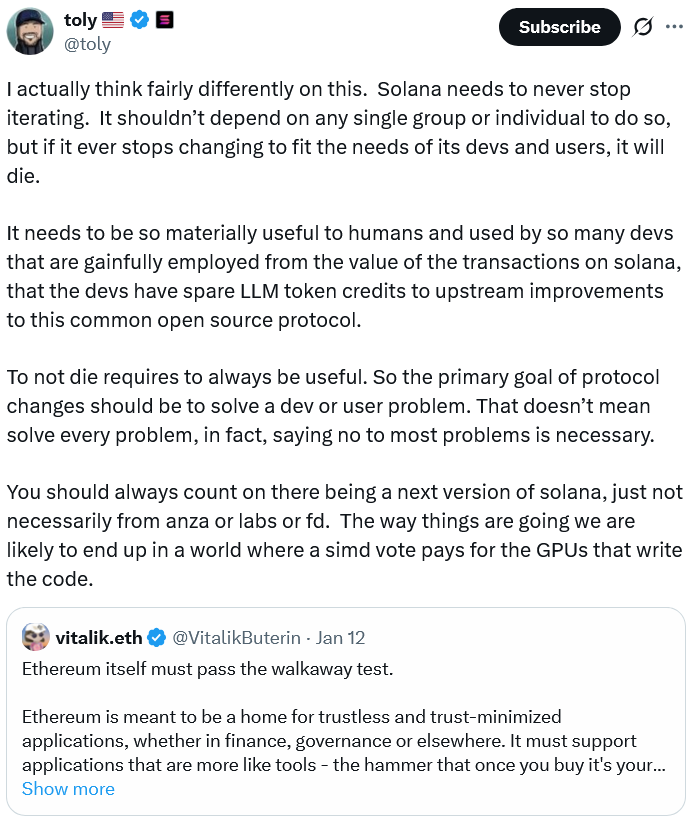
Source: Anatoly Yakovenko
Ethereum and Solana are two of the leading blockchains in a sea of layer 1 competitors.
Ethereum is by far the most decentralized smart contract layer 1 blockchain and dominates the stablecoin and real-world asset tokenization business, while Solana is one of the faster networks that is arguably more popular for consumer apps and earns more fees.
However, their planned paths to success couldn’t be more different.
Buterin wants to maximize decentralization, privacy, and self-sovereignty on Ethereum – even at the expense of mainstream adoption – while Yakovenko wants Solana to become an evolving ecosystem that introduces new features to adapt to the needs of the real world.
Proponents of Buterin’s approach argue that adding too many features increases the risk of bugs, security flaws, and unintended protocol consequences, while increasing the attack surface for centralization.
However, those who buy into Yakovenko’s “adapt or die” mentality think a hands-off approach will lead to slower innovation and potentially being overtaken by faster-moving competitors.
AI could update Solana in the future: Yakovenko
However, Yakovenko said that protocol updates should come from a diverse community of contributors rather than a few development teams.
He even hinted at a future where Solana’s network fees could fund AI-assisted development to write and improve Solana’s code base.
“You should always count on there being a next version of Solana,” said Yakovenko.
Ethereum is not yet self-sufficient
Meanwhile, Buterin said there is still a lot of work to be done before Ethereum can adopt the hands-off approach.
Quantum resistance features, more scalable architecture, and a better block building model that can withstand centralization pressures were among the key improvements. Buterin said Ethereum must stand the test of time.