

Fiserv has announced that over 90 banks and credit unions in North Dakota are now participating in the rollout of Roughrider. While the exact amount of money flowing through the system remains undisclosed, this level of participation marks a significant milestone for the project.
This achievement comes after Bank of North Dakota and Fiserv’s joint announcement back in October 2025, outlining their plans to make Roughrider available by 2026.
Public Network, Controlled Access
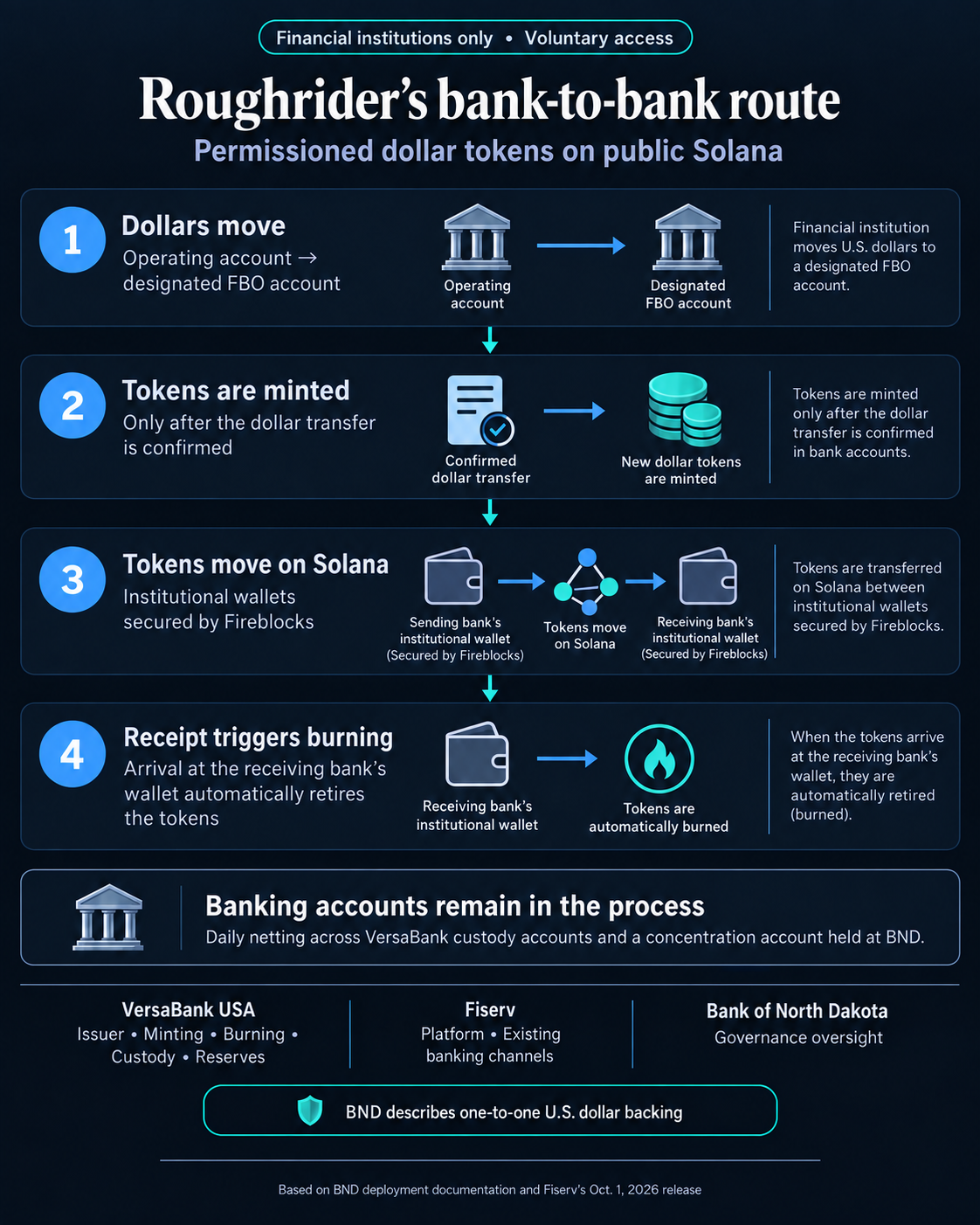
According to BND’s deployment documentation, Roughrider operates as a permissioned asset on Solana’s public blockchain. Participation is limited to financial institutions, and token transfers are conducted on Solana under institutional access controls.
VersaBank USA National Association issues Roughrider, while Fiserv manages the platform, and BND provides governance oversight. VersaBank is responsible for minting, burning, custody, and reserve management, with Fireblocks-secured wallets and freeze and clawback capabilities through Solana’s Token-2022 extensions.
While Fiserv refers to Roughrider as a stablecoin, BND’s current deployment page labels it as a dollar-backed token deposit. Each token is backed one-to-one by US dollars, with minting only occurring after a confirmed transfer from an institution’s operating account into a specified “for benefit of” account.
Upon arrival at the receiving institution’s wallet, the tokens are automatically burned through a smart contract instruction to maintain low token balances. Burning retires the transferred tokens, while the banking accounts are part of the process, with daily netting of account movements across VersaBank custody accounts and a concentration account at BND.
The system is designed to facilitate token settlement and banking account reconciliation separately.
BND highlights the system’s potential for treasury transfers and loan payoff, offering near-instant settlement 24/7 at lower costs than traditional wire transfers. While indicative costs are provided in a comparison table, there is no information on actual savings or performance testing methodology in the launch materials.
For community banks, this means having an additional settlement option integrated into their existing banking workflows. The true test will be whether participating institutions actively utilize this new option for routine interbank transactions, as evidenced by an increase in active senders and payment volume.