
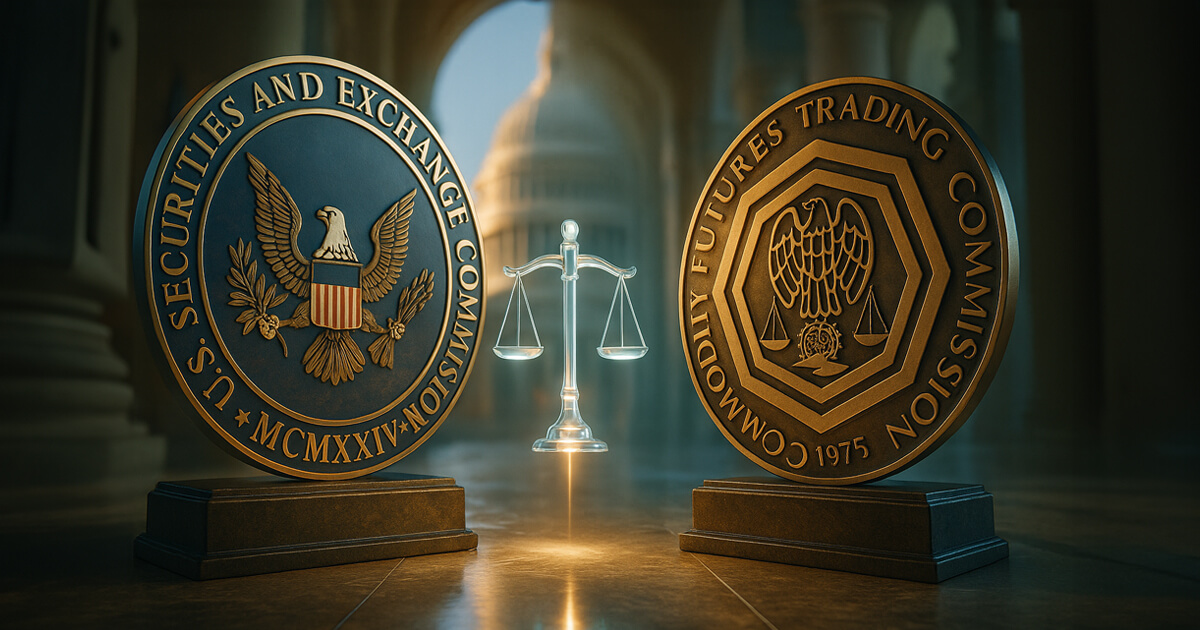

Washington has long struggled with who should control digital assets. The Digital Asset Market Clarity Act of 2025 passed the House of Representatives this summer, but the Senate had taken no action.
Now two Senate committees have released competing drafts, each promising regulatory action. These concepts create a new jurisdiction map poised to reshape everything from Bitcoin spot markets to Ethereum disclosures and exchange rules.
One bill from the Senate Agriculture Committee expands the role of the Commodity Futures Trading Commission. The Senate Banking Committee version creates new SEC authority over “ancillary assets” and clarifies when tokens outgrow securities status.
For everyone in crypto, this choice is crucial. These bills could transform custody, classification, and disclosure, redrawing the boundaries of the U.S. digital asset market.
The agricultural design and the CFTC authority
The Agriculture Committee plan, from Senators John Boozman and Cory Booker, gives the CFTC authority over “digital commodities” and their spot markets. It governs registration for exchanges, brokers and dealers and reflects CFTC oversight of traditional commodities.
Intermediaries would be required to use qualified custodians and segregate client assets to avoid conflicts of interest with affiliates. The bill allows for joint CFTC-SEC regulation for overlapping entities or dual registration, leaving some issues, such as DeFi, for later debate.
This version builds on the House Clarity Act and aims to bring crypto spot markets under CFTC supervision. US Bitcoin platforms would be required to register as digital commodity exchanges, comply with new capital and custody rules and offer stricter retail protections.
It could standardize data sharing between different platforms, which could improve the oversight that ETF issuers use. However, ETFs would remain under the jurisdiction of the SEC.
The impact goes beyond paperwork. Moving Bitcoin spot oversight to the CFTC would ensure that exchanges follow commodity exchange logic, with an emphasis on clear reporting and market oversight of investor disclosures.
This could give analysts and traders a better understanding of market quality and liquidity. Despite the expanded role of the CFTC, the SEC would still oversee securities instruments and crypto futures. Double supervision continues.
The banking concept and the SEC’s “additional assets” lane
Across the Capitol, the Senate Banking Committee’s draft, called the Responsible Financial Innovation Act, targets digital assets that straddle the line between securities and commodities. It defines an ‘ancillary asset’ as a ‘fungible digital asset’ that is distributed through an arrangement that also constitutes an investment contract.
The draft would give the SEC explicit authority to oversee these instruments, requiring issuers to provide information on token distributions, governance and associated risks. It also gives the agency about two years to finalize a rule defining what constitutes an “investment contract,” and it introduces a decentralization certification process that allows a project to stop dealing with securities once network control falls below certain thresholds.
This framework provides a conditional escape hatch for coins associated with “active projects,” such as Ethereum. A token could start out under SEC supervision, subject to disclosure and investor protection, but later “graduate” once the board is sufficiently divided.
This adds structure to a gray area that has haunted the industry since the days of the DAO report. It also forces the SEC to explain in writing what decentralization means, rather than relying on ad hoc enforcement.
Under this model the practical differences become sharper. Bitcoin would likely be treated as a digital commodity under the CFTC.
Tokens with ties to the corporate world would remain under the SEC’s ancillary assets regime until they prove decentralization. Centralized exchanges would be caught between both frameworks. They would register as CFTC digital commodity exchanges for spot crypto, but remain subject to SEC supervision of listed securities.
The combined effect could force US platforms to adopt dual registration, stricter capital requirements and more transparent trading books.
Looking at both approaches, one of the biggest unknowns is timing. The Banking Draft imposes specific regulatory deadlines.
However, agricultural design leaves important questions unresolved. Both are subject to future coordination rules and public consultations before coming into effect. The House version is already over. The Senate proposals are still under discussion and opposition has emerged within both parties.
The two designs currently serve as a practical guide for builders and tradesmen. First, they show how U.S. spot locations might evolve under a CFTC-led regime.
They then illustrate how token projects could eventually leave securities trading, and how exchanges might need to rebuild internal firewalls. While the drafts don’t provide the clarity their titles promise, they do map out the next phase of the regulatory tug-of-war.
In a market where classification dictates liquidity, custody and compliance, knowing which authority draws the line first can prove to be as valuable as any signal in the chain.