
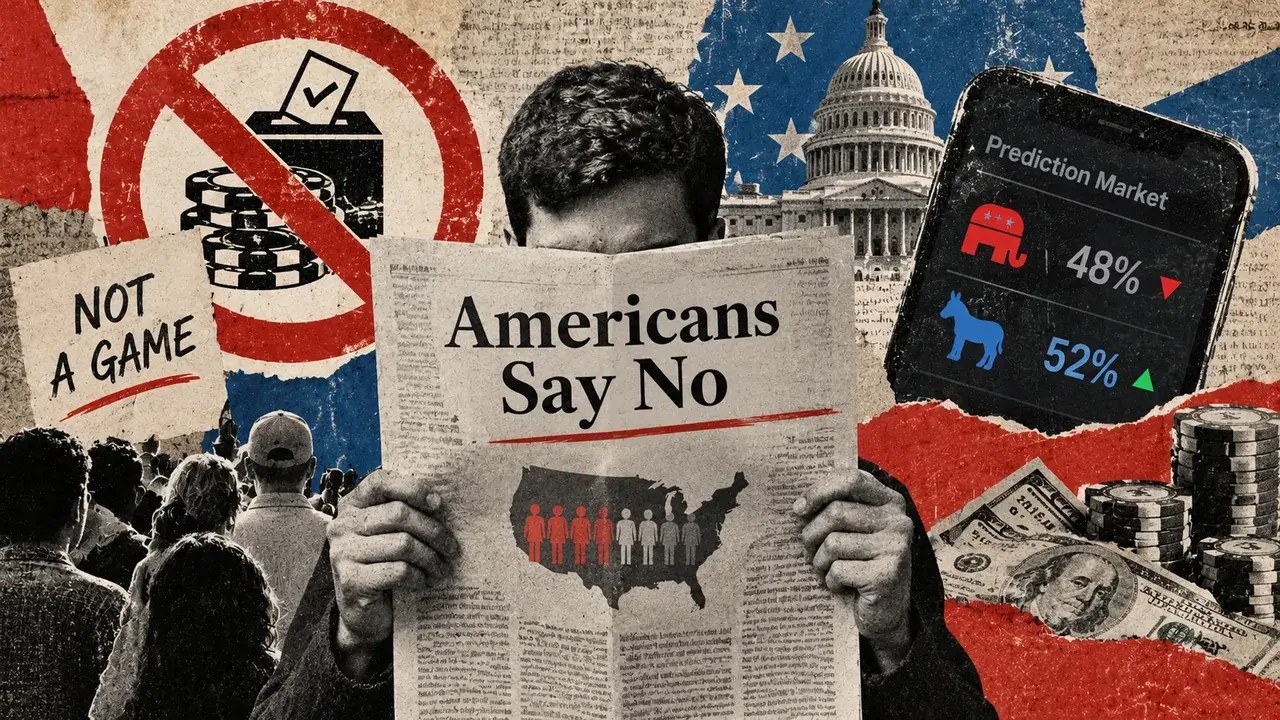
Prediction markets are often touted as one of the most effective tools for gaining insight into what’s happening in the world. These markets provide a real-time probability of various events, such as election outcomes, which can be easily accessed and understood by the general public. The appeal of prediction markets lies in their ability to distill complex and uncertain events into a single number that serves as a forecast.
However, a recent poll conducted by Ipsos and published by Reuters revealed that a majority of Americans, both Democrats and Republicans, are opposed to using prediction markets for betting on election results, military actions, and government policy decisions. This opposition raises questions about the ethical implications of profiting from events that directly impact people’s lives.
While prediction markets claim to offer better information and more accurate forecasts, the poll results suggest that public trust in these markets is lacking. Many voters value election forecasts but object to a system where those running elections can profit from the outcome. This disconnect highlights the need for the industry to not only defend the accuracy of their predictions but also address concerns about the ethics of betting on real-world events.
In a prediction market, participants buy and sell contracts based on the likelihood of a particular event occurring. The price of a contract reflects the probability of the event happening, with traders making bets based on their expectations. These markets attract a diverse range of participants, including supporters of a candidate as well as individuals looking to profit from their predictions.
Kalshi, a prominent prediction market platform, has introduced features to make trading activity more transparent and accessible to users. The platform aims to provide valuable information to both active traders and passive observers, catering to a wide range of users seeking insights into various events.
One of the key challenges facing prediction markets is the issue of insider trading and potential election tampering. Recent incidents involving congressional candidates trading on their own races have raised concerns about conflicts of interest and the integrity of the market. To address these issues, platforms like Kalshi implement strict rules to prevent political insiders from profiting from their privileged information.
As prediction markets continue to evolve and gain prominence in election coverage, it is crucial for these platforms to maintain transparency and accountability in their operations. By showcasing the trading activity behind their forecasts and disclosing enforcement actions, prediction markets can build credibility and trust among users. Ultimately, the success of prediction markets hinges on their ability to navigate the delicate balance between providing accurate forecasts and upholding ethical standards.