
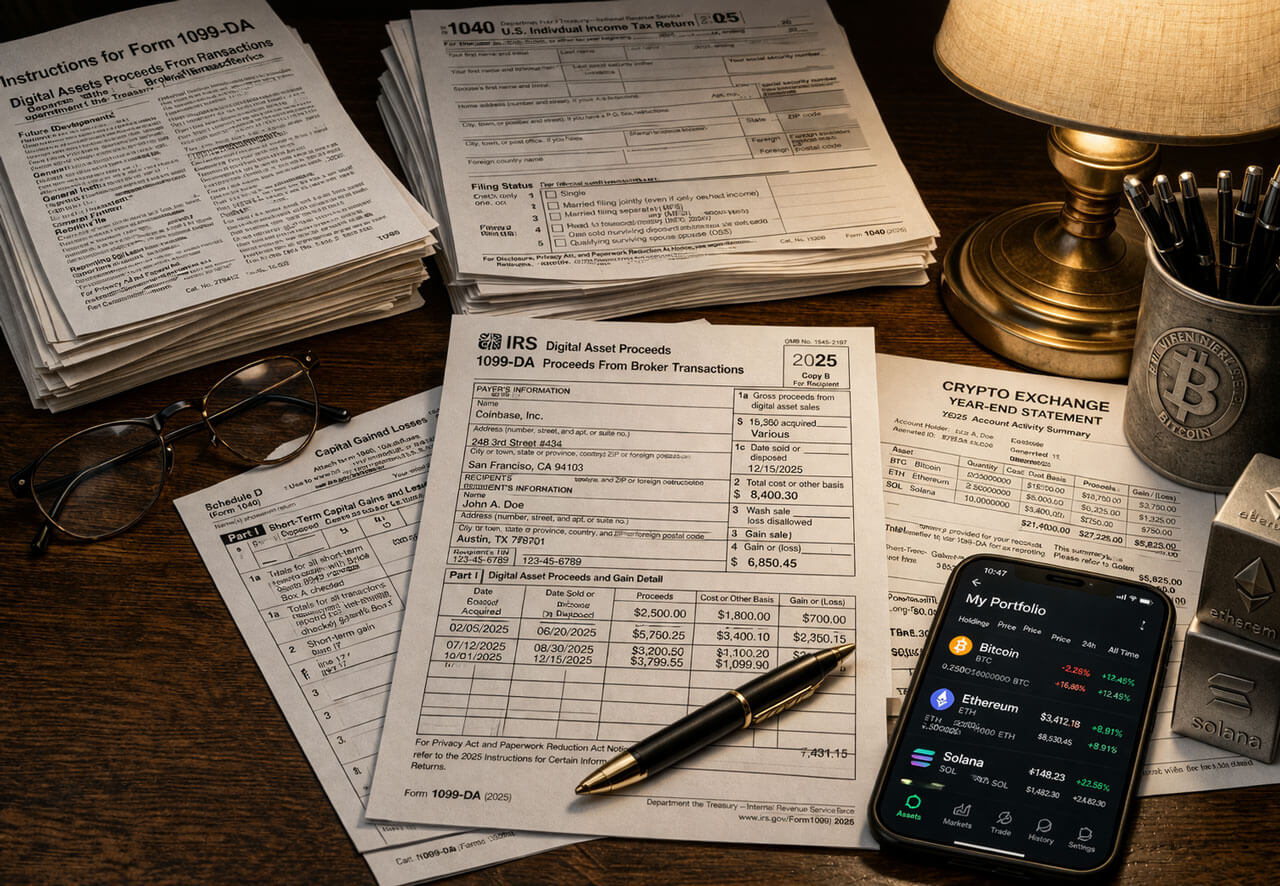
The first Form 1099-DA season is dawning for US crypto investors with a fundamental problem: Many people are getting the new IRS form before they understand what it’s actually telling them.
A Coinbase and CoinTracker questionnaire of 3,000 US crypto users found that 61% were unaware of the new 2025 reporting rules, even though 74% said they knew crypto activities could be taxable and 56% rated their own knowledge of crypto tax rules as good or excellent.
That gap is emerging as the IRS begins to receive more standardized data on digital asset sales handled by brokers. The Treasury Department and the IRS require brokers to report gross proceeds on Form 1099-DA for digital asset sales occurring in 2025, with basic reporting on covered securities beginning in 2026.
The IRS has also told taxpayers that most 2025 statements will be without basis, meaning the form can show that a sale occurred without doing the work necessary to determine actual gain or loss.
For many investors, this new information return turns into a false sense of completeness. The IRS says Form 1099-DA is used by brokers to report the proceeds of, and in some cases the basis for, dispositions of digital assets to both taxpayers and the government.
It also says taxpayers must report all income, gains and losses from digital asset transactions, whether they receive the form or not, and calculate basis before filing returns.

A new form, but no completed tax response
The structure of the transition year makes the first filing season unusually easy to misread. A taxpayer who bought Bitcoin on one exchange, self-managed it, later transferred some of it to another platform and sold it there may receive a Form 1099-DA showing the proceeds from the sale.
However, if the asset has been transferred by another broker or wallet, the form may not contain the basic information needed to calculate the real taxable result.
Tax advisors register The tax advisor named taxpayers may receive Forms 1099-DA without basis for assets transferred from another broker or self-custodial wallet, for sales on some non-custodial platforms, and for assets purchased before 2026 that are not treated as covered securities.
That’s why tax specialists caution taxpayers not to treat the document as a completed broker’s statement. Jonathan Cutler, a senior manager at Deloitte, reportedly said the 2025 form is mainly a signal that the taxpayer has been trading in crypto, while adding that taxpayers “really need their own records to be tight.”
The IRS has made the same point in clearer terms. As per the guidelines, taxpayers should use Form 1099-DA along with their other documents and that they should calculate the basis before submitting. It also notes that taxpayers who transact through foreign brokers may not receive a Form 1099-DA from those brokers, even if the transactions remain taxable in the United States.
Where investors stumble
Meanwhile, survey data from Coinbase and CoinTracker suggest the confusion isn’t limited to the basics, as only 49% of respondents correctly said a tax event is triggered when crypto is sold.
Another 41% said taxes are charged when crypto is transferred to a bank, 36% think taxes only apply once profits rise above a threshold, and 22% think a transfer from another account itself is the trigger.
At the same time, users reported an average of 2.5 platforms or wallets, 83% said they used self-custodial wallets and 71% said they transferred assets between wallets or platforms.
The new IRS guidance goes against the payout logic still common among retailers.
The agency treats digital assets as property for federal income tax purposes, and under Form 1099-DA guidelines, taxpayers can receive the form when they dispose of digital assets for dollars, exchange them for another digital asset, use them to pay for goods or services in any amount, or use digital assets to pay broker transaction fees.
The IRS FAQ on Virtual Currency also says that a taxpayer generally recognizes a gain or loss when virtual currency is sold for real currency.
That leaves a market full of investors who broadly know that crypto can be taxable, but still misunderstand when taxable events occur and what data the IRS expects them to keep.
Coinbase’s survey found that 76% of respondents knew that cost basis adjustments might be needed, but only 35% said they had actually made these adjustments in the past.
Shehan Chandrasekera, head of tax strategy at CoinTracker, said:
“Although crypto brokers will be providing 1099-DA forms this tax year, users are responsible for correctly calculating their cost basis, holding period, and actual gains or losses. This cost basis issue is uniquely difficult to resolve.”
Visibility increases before compliance catches up
The pressure on reporting reflects a broader belief that the old system captured only part of the market. An article from 2026 Review of accounting studies with the help of the tax authorities facts found that the agency appeared to observe only 32% to 56% of U.S. cryptocurrency owners.
A separate NBER article using Norwegian data found that 88% of crypto holders did not declare their assets or gains, and that even among investors using domestic exchanges that shared identifiable data with tax authorities, 80% still did not declare.
Meanwhile, the current increased scrutiny could change the behavior of crypto investors before it can fully close the tax gap. An NBER study on crypto tax loss harvesting found that increased tax scrutiny pushed investors toward more legal tax planning and influenced preferences for U.S.-based exchanges.
That’s consistent with what practitioners are seeing in the first 1099-DA season, where a missing or incomplete foundation has forced accountants to do what Accounting Today described as forensic reconciliation based on client-maintained records rather than simply matching forms.
For US investors filing this year, the immediate lesson is more limited and practical. Form 1099-DA gives the IRS a better picture of many crypto sales in 2025. However, it does not settle the tax bill on its own.
Taxpayers still have to prove what they paid, where the asset was moved, how long they owned it and whether the sale resulted in a gain, a loss or something much smaller than the amount of proceeds listed on the form.
Until these data are reconciled, the government can see the sales more clearly than the investor can explain the profits.