

The idea that Jane Street is single-handedly the reason Bitcoin isn’t trading at $150,000 is the wrong frame, according to ProCap CIO and Bitwise advisor Jeff Park. In an X-thread on February 25, Park argued that the real problem is not one company, but a structural feature of the US spot Bitcoin ETF system that gives all authorized participants unusual flexibility in how they hedge and settle trades.
Is Jane Street Suppressing Bitcoin?
Parks core point is that the market has turned a question about Jane Street into a question about the ETF plumbing itself. On IBIT alone, he noted, the authorized participant roster includes Jane Street Capital, JPMorgan, Macquarie, Virtu Americas, Goldman Sachs, Citadel Securities, Citigroup, UBS and ABN Amro. According to him, this is important because APs are not ordinary short sellers.
“The question deserves a precise answer – and the most important thing to understand up front is that it is not really a question about Jane Street,” Park wrote. “It is a question about a structural feature of the Bitcoin ETF architecture that applies equally to every authorized participant in the ecosystem.” He added that the role of these institutions is “truly misunderstood, even among industry veterans.”
The mechanism Park focuses on is the AP exemption under Regulation SHO. In standard short selling, traders generally have to locate shares before going short, and face borrowing costs that put pressure to close the trade. APs, Park argued, fall into a different category because their creation and redemption rights allow them to effectively produce ETF shares without those same frictions.
Related reading
“The practical consequence is significant: each AP can produce shares as it sees fit – no borrowing costs, no capital conventionally tied to short positions, and no hard deadline to close the position beyond what is commercially reasonable,” he wrote. “This is the gray window: a regulatory exception designed for orderly ETF market formation, which is structurally indistinguishable from a regulatory arbitrage of unprecedented duration.”
That framework is important because Park isn’t claiming that APs can simply push Bitcoin lower forever. His argument is narrower and more structural. If an AP is short IBIT and chooses to hedge with CME Bitcoin futures instead of buying spot BTC, then the normal arbitrage path that would force spot buying becomes weaker. In that design, the hedge can remain economically tight enough for market-making purposes while bypassing direct demand on the spot market.
“The crucial implication: If the hedge is futures rather than spot, the spot was never bought,” Park wrote. “The gap cannot be closed through the natural arb mechanism because the natural arb buyer has chosen not to buy locally.” He also cautioned that the separation is not frictionless as basis traders work to keep futures and spot aligned, but said basis risk becomes more meaningful during periods of stress.
According to Park, the recent shift to in-kind creations and redemptions removes another barrier that previously pushed activity to the spot market. Under the previous cash-only model, APs were required to provide cash, which the fund’s custodian then used to purchase Bitcoin. That created what Park called a “structural governor,” because spot purchasing was a mechanical byproduct of creations. Transfers in kind change that. APs can now source Bitcoin directly, at times and from counterparties of their choosing, including OTC desks and negotiated transactions that can minimize visible market impact.
Related reading
Yet Park stopped short of endorsing outright claims of market oppression. “The short answer is that no AP explicitly suppresses the Bitcoin price,” he wrote. “What the AP structure can suppress is the integrity of the price-setting mechanism itself. They are not the same, but the latter is arguably more consequential than the former.”
Other experts agree
Senior ETF Analyst at Bloomberg Intelligence Eric Balchunas noted: “The boogeyman is gone. That’s the vibe on CT and in today’s price action. I understand it too, that big daily dump. [at 10am] seemed to kill every gathering and everyone’s spirit. Is eliminating it enough for a sustainable recovery? I guess we’ll find out.”
That distinction provoked resistance. Monad founder Keone Hon said the theory doesn’t hold water because a short futures hedge implies someone else has a short futures and has to hedge somewhere else on average, thus maintaining the market-wide delta equilibrium. Dave Weisberger also argued that the claim does not hold up “over a substantial time frame,” noting that futures converge to the spot date at expiration.
Park did not dispute the accounting identity. What he disputed was whether that identity resolves the practical question of how long transactions can survive within the system’s legal exceptions. “To be clear, I do not subscribe to the conspiracy theory that APs are suppressing prices,” he wrote. “The conspiracy theory I agree with, if there is one, is that with infinite duration and no transportation costs, funny things can happen.”
Leading on-chain analyst James “Checkmate” Check agreed: “Jane Street didn’t suppress the Bitcoin price, folks. HODLers all did. It’s just not that hard, stop summoning your inner salty goldbug, just blame manipulators. People. Sold. A. Fucktonne. Or. Spot. Bitcoin.”
At the time of writing, Bitcoin was trading at $67,883.
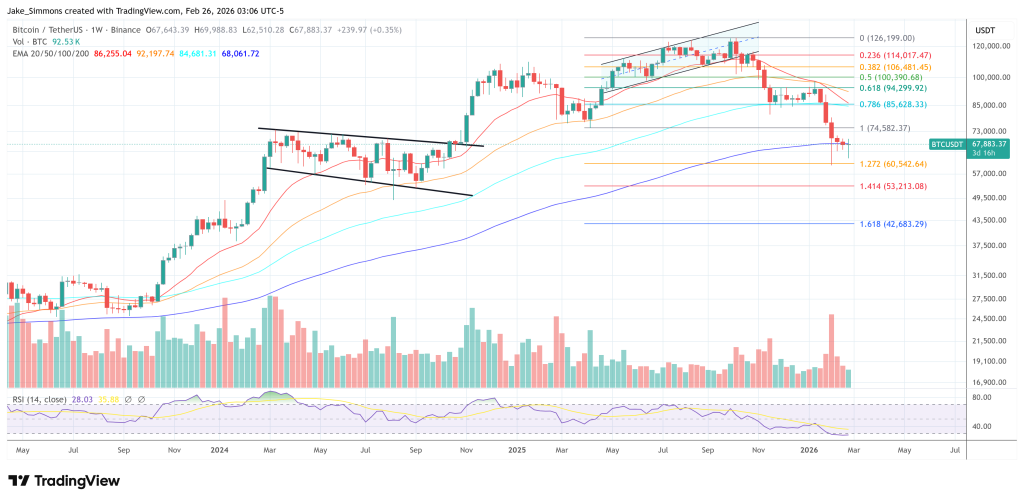
Featured image created with DALL.E, chart from TradingView.com