

Financial institutions are moving away from Ethereum (ETH) and opting for purpose-built blockchains tailored to their institutional needs.
Recent developments, such as Klarna’s launch of its stablecoin on an alternative network and the rise of privacy-focused chains like Canton, raise questions about the network’s dominance.
Enterprise Blockchain Adoption Signals a New Threat to Ethereum: Here’s Why
On November 25, Klarna announced KlarnaUSD, becoming the first bank to issue a stablecoin on Tempo, a payments blockchain from Stripe and Paradigm. This decision has sparked debate in the crypto community. Some consider it a bearish signal for Ethereum.
“Can anyone tell me why this isn’t bearish for Ethereum? A major fintech with a big push into stablecoins isn’t launching on Ethereum. If Tempo didn’t exist, this would probably have launched on Ethereum or an ETH L2… Tempo is taking market share in what is the most important thesis for Ethereum: stablecoins,” said one analyst.
Ethereum is home to major stablecoins, including Tether (USDT) and USDC (USDC), which together command more than $100 billion in market capitalization. They create significant network activity and costs. By choosing Tempo, Klarna bypasses Ethereum’s ecosystem, potentially diverting liquidity and innovation.
Another analyst, Zach Rynes, emphasized that Klarna’s decision shows that corporate blockchains are becoming increasingly popular, while public chains continue to be overshadowed by large fintech companies.
“Yet another confirmation that Corpo L1 chains are here to stay and your favorite commoditized ‘neutral’ public chain #375936 is being overrun by Fintech once again,” he said.
The rise of the Canton Network is a further example of this. It is a Layer 1 network built with privacy controls at its core. Institutions can choose how visible or limited their activities are, allowing for setups ranging from completely permissionless to completely private systems.
Despite these differences, applications on Canton can still connect and communicate over the network. Goldman Sachs’ Digital Asset Platform (GS DAP) uses the Canton network natively.
Notably, Canton exhibits a significant level of capital efficiency, producing approximately $96 of RWA Total Value Locked (TVL) for every $1 of market capitalization. Ethereum, on the other hand, generates approximately $0.03 in RWA TVL for every $1 in market cap.
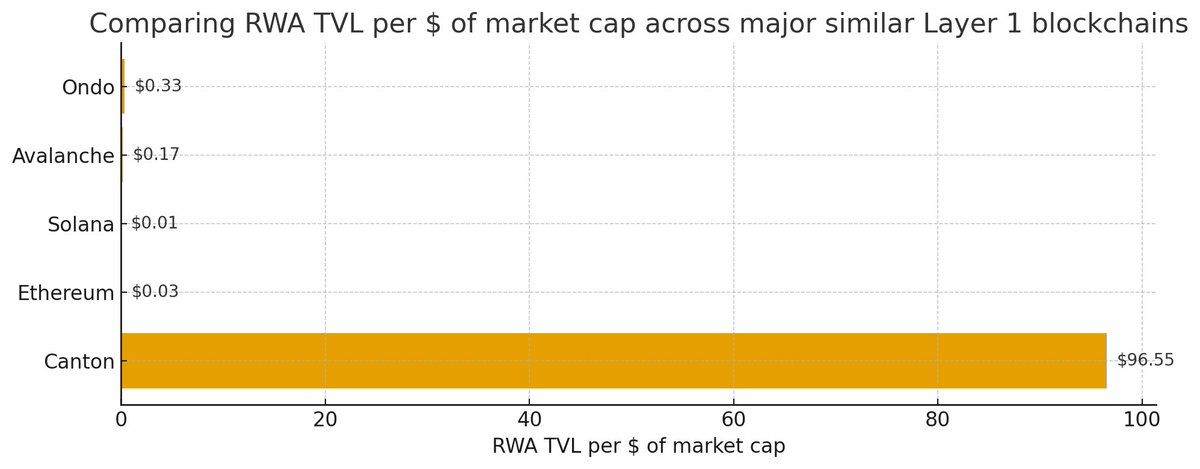
A comparison of RWA TVL per dollar market cap. Source: X/MattMena__
But why are institutions diverging from Ethereum? Privacy could be the main driver of this exodus. Public blockchains such as Ethereum make all transactions permanently visible, a core challenge for institutions.
When banks or companies transfer large amounts, this transparency entails significant risk. Competitors can analyze patterns, execute front-run transactions, and uncover strategic business ties.
According to COTI Network’s analysis, companies adopting Web3 often overlook blockchain transparency as a risk. The article notes that public blockchains expose all transactions and metadata, which can reveal sensitive data or undermine bargaining power. This creates regulatory challenges with laws such as GDPR and exposes trade secrets.
This disconnect explains why institutions are building private blockchains or seeking public networks with enhanced privacy. Transparency, a celebrated virtue in crypto, creates vulnerabilities when dealing with billion-dollar transactions and confidential relationships.
This trend signals a split: public networks like Ethereum for decentralized or retail use, while institutions with confidentiality move to private or specialized chains. Whether Ethereum can regain institutional trust or whether specialized networks will take over remains uncertain as the financial world undergoes a digital transformation.
The post Institutions turn to purpose-built blockchains as privacy concerns drive Ethereum’s shift appeared first on BeInCrypto.