

Bitcoin entered April on firmer footing, but the recovery is heading straight into a macro test that could decide whether this move has legs. Traders are now wondering whether waning war fears can continue to lift risky assets, or whether the Fed’s next signal will undermine that recovery.
The Bitcoin price started back above $68,000 in April, following an aid meeting in late March tied to hopes that the war in Iran could move toward de-escalation.
According to Crypto Slates Data shows the flagship digital asset rose more than 3% to $69,170 over the past 24 hours, before retreating to around $68,456 at the time of writing. Investors were considering whether the rebound marked the start of a more lasting recovery or just temporary relief from a tough first quarter.
The recovery followed a rapid shift in broader market sentiment. Reuters reported that oil prices fluctuated sharply after media reports said Iranian President Masoud Pezeshkian was willing to end the war if Tehran received guarantees, while US President Donald Trump said Washington could end the conflict within weeks.
Why this is important: Bitcoin responds to crypto-specific flows, but also trades against a macro backdrop where oil, inflation expectations and Fed timing are pulling in opposite directions. That tension makes even a strong start in April vulnerable to a rapid weakening if policymakers signal less willingness to relax.
Market watchers noted that relief over that possibility helped push up risky assets, including crypto, even as traders continued to price in higher energy costs and lingering geopolitical uncertainty.
Let’s take a look at the factors that can significantly influence Bitcoin’s price performance in this new month.

Oil, inflation and the Fed are now in the middle of April trading
The mixed signals from the Middle East indicate that the macroeconomic backdrop will continue to do much of the work this month.
Binance Research noted that signals from the US-Iran ceasefire could extend the recent crypto recovery, with digital assets like Ethereum likely to outperform as risk appetite improves further.
However, the company also warned that caution remains necessary as Iranian officials have described the contacts as messaging rather than formal negotiations. According to the firm, Israel’s war aims remain more difficult than Washington’s, and the Islamic Revolutionary Guards’ threats against major American companies remain a perilous tail.
This view is very important to note as the war in Iran has led to the sharpest rise in oil price forecasts, with analysts now expecting Brent to average $82.85 per barrel in 2026, up from $63.85 in February.
Notably, Brent crude and US crude have both risen about 60% since the conflict began, a move that has directly contributed to inflation concerns and interest rate revisions in global markets.
That dynamic makes April a tougher macro calendar than usual for Bitcoin traders. The Bureau of Labor Statistics calendar shows the March employment report on April 3, while the Federal Reserve’s April calendar includes minutes from the March 17-18 FOMC meeting on April 8, the April 15 Beige Book, and the next Fed meeting on April 28-29.
Any sign that higher energy costs feed into inflation expectations, or that the Fed becomes less willing to ease, would complicate matters for crypto’s recovery.
Bitcoin enters April with hope and downside protection
Against that backdrop, crypto traders are entering the new month with the hope that Bitcoin’s historic performance in April will provide a breathing space.

Facts from CoinGlass show that April has often been one of Bitcoin’s better months, with an average return of 33.4% and an average gain of 7.57%.
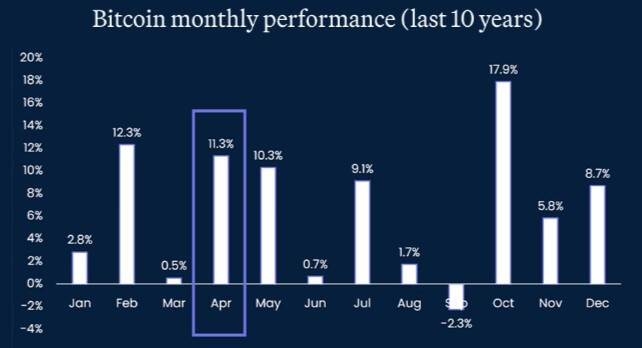
However, BIT, formerly Matrixport, has noted that these patterns have become less reliable in recent years, especially when assets enter the month with weak momentum.
According to the company, BTC’s Relative Strength Index (RSI) of nearly 47% puts the digital asset closer to last year’s starting point than the overheated conditions that preceded sharper corrections in previous cycles.
In practical terms, the firm expects volatility to rise following range-bound trading in March, as investors test whether the latest sell-off stabilizes or expands into a broader reversal.
The positioning of crypto traders in the options market reinforces that view. CME Group said Bitcoin options open interest in March showed about $660 million in calls against $240 million in puts, a nearly three-to-one ratio that pointed to demand for a recovery at the end of the first quarter.
However, the longer-term positioning is more defensive, with June expiration yielding more open interest than call options.
That view is consistent with how Bitcoin has traded in the first quarter. The market has shown enough buying interest to regain big round numbers after sharp dips, but not enough follow-through to quickly restore confidence.
That puts Bitcoin in a tough spot. Seasonal optimism and short-term relief are supporting the price, but the deeper support that typically sustains rallies is starting to look less reliable.
ETF and institutional flows have weakened
This lack of conviction is reflected in the institutional demand for the flagship digital asset.
Coin shares said Digital asset investment products recorded their first outflows in five weeks in the week to March 30, with $414 million leaving the sector. Bitcoin products accounted for $194 million of that total, although they still had a positive net inflow position of $964 million year to date.
CoinShares linked the reversal to a longer Iran conflict, higher inflation risk and a shift in market expectations toward the possibility of rate hikes rather than rate cuts by June.
Glassnode’s data points in the same direction. The analytics firm said the seven-day moving average of U.S. ETFs’ net flows turned negative early last week, with daily net outflows ranging from 200 to 500 Bitcoin.
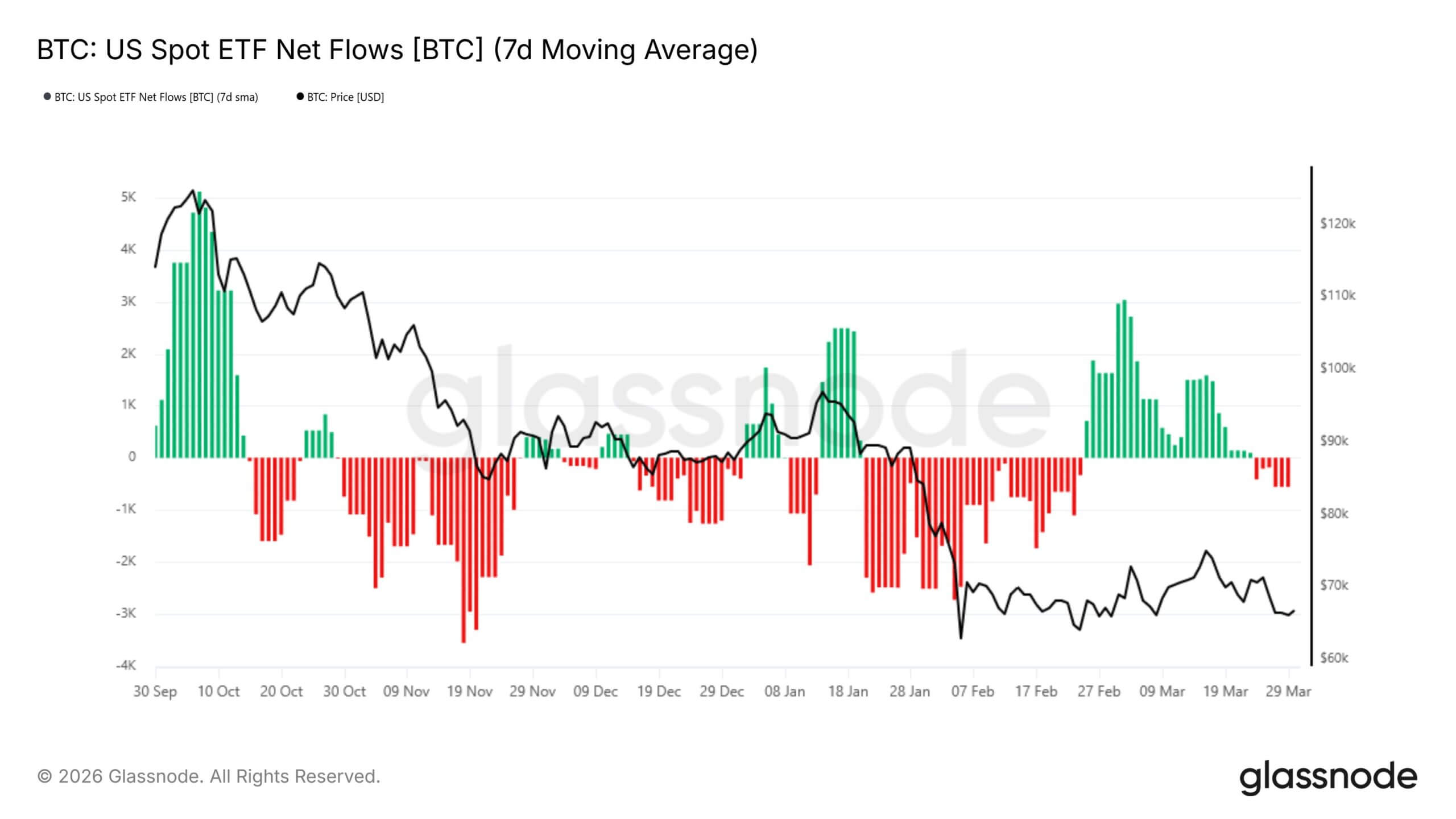
The numbers are small compared to the largest inflow weeks since the introduction of spot ETFs, but they indicate that institutional demand is no longer acting as a pure stabilizer at current prices.
At the same time, corporate government bond purchasing has also slowed significantly outside of Strategy, formerly MicroStrategy, leaving Bitcoin without the same broad institutional support that helped sustain previous rebounds.
With ETF flows declining and demand for government bonds weakening, the market enters April with less cushion against a new period of macro stress.
How will the Bitcoin price perform in April?
Taken together, these factors leave Bitcoin entering April with support, but without a clear, all-clear signal.
Rachael Lucas, analyst at BTC Markets, said $66,000 remains the level to watch this month. According to her, a hold there would support a consolidation argument after a volatile quarter, while a lower break would expose Bitcoin to another downturn.
Meanwhile, crypto market maker Wintermute said Credible diplomatic progress and a pullback in oil prices to $100 would leave the short side vulnerable to a push toward $70,000 to $74,000, after which resistance near $74,000 could come into view if the de-escalation continues.
However, another escalation, combined with a rise in oil prices to $120, would reopen a path to the low $60,000s, with the high to mid $50,000s also back on the table if cycle analogs hold.
Recently CryptoSlate Research shows that seasonality in April offers a weak tailwind, but no signal. Historically strong monthly returns contrast with the broader pattern that years that start with similarly weak first-quarter conditions have rarely ended higher, placing the burden on macro and capital flows rather than calendar effects.
For now, April offers Bitcoin a window, not judgment. The next real test will be whether the price can hold above key support points as the market absorbs the April 3 jobs report and, more importantly, the April 8 Fed minutes. If macro pressures diminish and capital flows stabilize, the recovery can continue. If not, there is a risk that this recovery will go down in history as yet another relief effort that failed the first serious policy review.
At the time of printing 16:25 UTC on April 1, 2026Bitcoin is number 1 in terms of market capitalization and so is its price upwards 2.26% in the last 24 hours. Bitcoin has a market capitalization of $1.37 trillion with a 24-hour trading volume of $40.38 billion. Learn more about Bitcoin ›
Summary of the crypto market
At the time of printing 16:25 UTC on April 1, 2026the total crypto market is valued at € $2.36 trillion with a 24 hour volume of $96.35 billion. Bitcoin’s dominance currently stands at 58.16%. Learn more about the crypto market ›