

The Ethereum price fell sharply as panic gripped global markets, pulling ETH/USD from near $4,300 to a low of $3,510 before partially recovering towards $3,830. The move came amid one of the biggest single-day selloffs of 2025, fueled by nearly $19 billion in crypto liquidations.
This scared market participants and institutions worldwide, even the most robust ones Blackrock ETH ETF product “ETHA” saw outflows of $80.2 million, in addition to outflows from other AUMs.
Broader market sentiment turned sharply away from risk due to renewed geopolitical tensions and macroeconomic uncertainty. The ETH price today reflected the overall crypto decline, with Bitcoin, Solana and other large-cap tokens suffering double-digit losses.
Despite the steep decline, Ethereum managed to stabilize just above $3,800 as buyers entered at major technical support levels.
Rate shocks cause sell-offs in markets
The catalyst behind the decline came from political headlines rather than blockchain fundamentals. Late Friday, President Donald Trump announced via Truth Social that the US would impose a 100% tariff on Chinese imports starting November 1. He also hinted that this move could come sooner depending on China’s response.
Moreover, there were rumors that Trump would not meet Chinese President Xi Jinping at the upcoming APEC South Korea 2025 summit on October 29-31, but he personally denied this rumor in the media today. A signal that trade tensions could have a chance to get better rather than intensify as Trump is already getting angrier.
However, the spike in rates roiled both the traditional and digital asset markets, leading to widespread selling pressure.
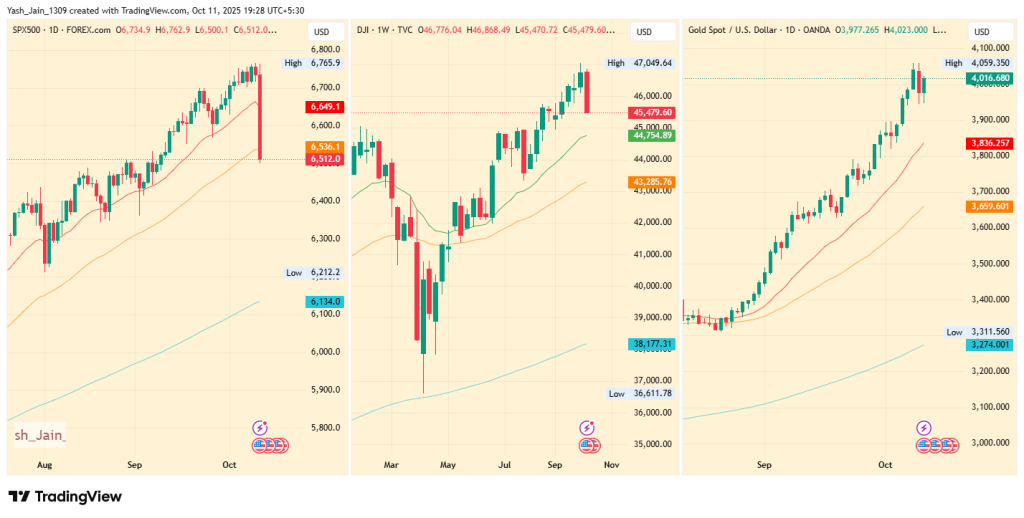
Global indices reacted quickly: the S&P 500 fell 2.71%, the Dow Jones fell almost 1.90%, while gold, often seen as a safe haven, rose 1.02% to $4,016 an ounce. As investors sought stability, ETH crypto and other risky assets experienced sharp outflows.
The technical picture is turning bearish, but the long-term outlook holds
From a technical point of view, the Ethereum price chart shows a temporary collapse in bullish momentum. A bearish crossover between the 20-day and 50-day exponential moving averages (EMA) confirmed near-term selling pressure.
However, the 200-day EMA, a crucial indicator of long-term support, continues to hold, preventing bigger losses for the time being.
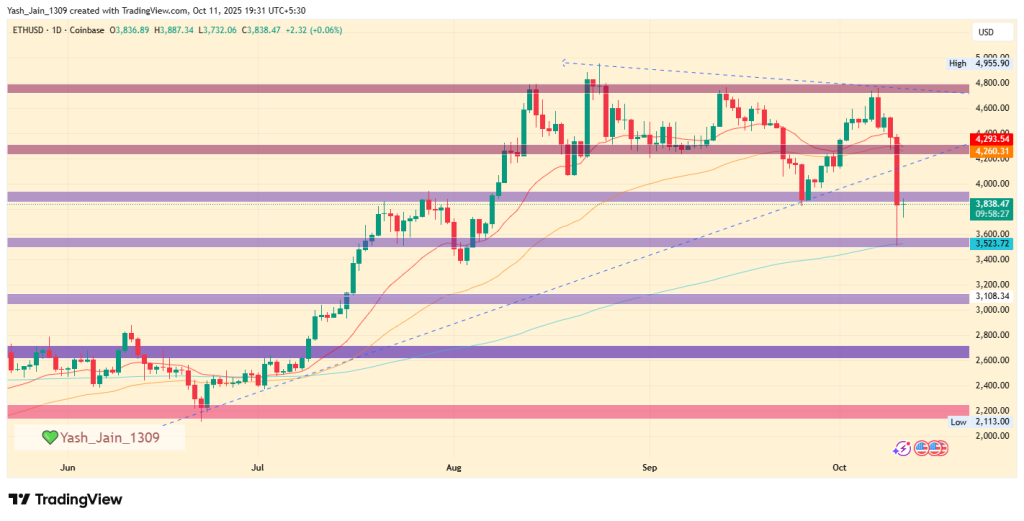
If the 200-day EMA and the $3,500 support zone remain intact, a near-term recovery to $3,900 or even $4,100 is possible. But a decisive break below this level could expose Ethereum to even more downside, with potential targets around $3,100 or even $2,600 according to the ETH price prediction.
Still, market observers remain cautiously optimistic in the long term. Despite the short-term volatility, Ethereum’s health, active developer ecosystem, and continued Ethereum stakes could support a gradual recovery once macroeconomic pressures subside.
Buyer’s eye recovery now stabilizing macro factors
As the market digests the impact of rates and possible rate adjustments, traders are watching to see how the Ethereum price USD behaves near its long-term support. A stabilization above $3,500 could renew buying momentum, especially as institutional accumulation resumes at key exchanges.
At this point, Ethereum price is at a crucial crossroads. Holding above the lifeline could determine whether the current correction becomes a springboard for the next bullish wave or extends into a deeper pullback phase.
Trust CoinPedia:
CoinPedia has been providing accurate and timely cryptocurrency and blockchain updates since 2017. All content is created by our expert panel of analysts and journalists, following strict editorial guidelines based on EEAT (Experience, Expertise, Authoritativeness, Trustworthiness). Each article is fact-checked from reputable sources to ensure accuracy, transparency and reliability. Our review policy ensures unbiased evaluations when recommending exchanges, platforms or tools. We strive to provide timely updates on everything crypto and blockchain, from startups to industry majors.
Investment Disclaimer:
All opinions and insights shared represent the author’s own views on current market conditions. Please do your own research before making any investment decisions. Neither the writer nor the publication accepts responsibility for your financial choices.
Sponsored and Ads:
Sponsored content and affiliate links may appear on our site. Ads are clearly marked and our editorial content remains completely independent from our advertising partners.