
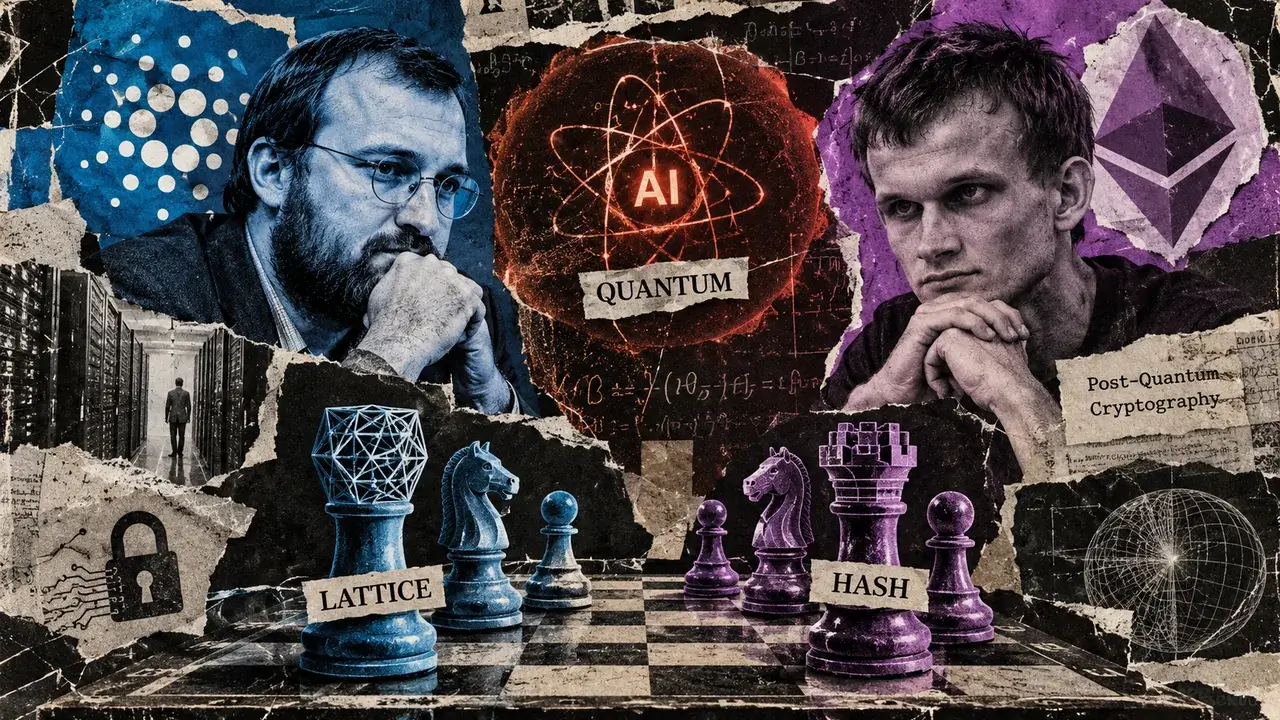
Cardano founder Charles Hoskinson recently criticized Ethereum co-founder Vitalik Buterin for his skepticism towards lattice-based cryptography. In a post on Oct. 9, Hoskinson argued that Buterin’s warnings about AI-driven mathematical breakthroughs undermining quantum-resistant cryptography were unfounded. He pointed out that decades of security research have already addressed the known weaknesses of lattice-based cryptography.
Hoskinson cautioned that discouraging developers from using established cryptographic approaches could hinder the adoption of existing protections deployed across internet infrastructure. This could potentially leave systems vulnerable to future quantum attacks. Buterin, on the other hand, has advocated for hash-based signatures and proofs in Ethereum’s long-term roadmap, steering away from lattice-based designs.
The debate between the two tech innovators centers around post-quantum alternatives to the elliptic-curve signatures utilized by Bitcoin and Ethereum. Buterin expressed concerns about potential AI-assisted mathematical discoveries weakening lattice-based systems, drawing parallels to historical advances in integer factorization that compromised RSA encryption.
Hoskinson countered Buterin’s arguments by emphasizing the lack of demonstrated mechanisms against the lattice problems supporting modern post-quantum standards. He highlighted over four decades of research in lattice reduction and sieving algorithms, which have improved attacks without yielding a breakthrough capable of defeating properly configured systems.
Furthermore, Hoskinson disputed Buterin’s suggestion of increasing key sizes by ten as a protective measure against AI-driven mathematical advancements. He stressed the importance of adjusting security parameters based on measurable improvements in attack algorithms, rather than relying on arbitrary numerical adjustments.
The Cardano founder also raised questions about Ethereum’s reliance on hash-based cryptography, citing historical vulnerabilities in MD5 and SHA-1 as evidence of potential weaknesses in hash functions. He specifically called out Poseidon and Poseidon2, hash functions funded by the Ethereum Foundation for use in zero-knowledge proofs, as potential targets for AI-assisted attacks.
In conclusion, Hoskinson argued that abandoning lattice research in favor of hash-based cryptography could limit developers’ options for building secure communication systems and privacy applications. Both hash-based signatures and lattice techniques play crucial roles in ensuring quantum-resistant encryption and other advanced cryptographic mechanisms. It remains to be seen how the ongoing debate between Hoskinson and Buterin will shape the future of cryptographic protocols in the blockchain space.