

Tokenization has become one of crypto’s favorite buzzwords, but Zach Pandl, head of research at Grayscale, said investors should think of it less as a single trade and more as a long roadmap with several winners at different stages.
Speaking at the EthCC conference in Cannes, France, Pandl said the trend is still in its infancy. Tokenized assets – the process of using blockchain rails to settle, transfer and record all kinds of financial assets, such as bonds, funds and stocks – are growing rapidly. However, with a current value of $27 billion, it still represents roughly 0.01%, a tiny fraction, of global capital markets. That’s expected to rise to nearly $19 trillion by 2033, according to BCG and Ripple.
Big banks and asset managers already understand these opportunities. “The two things institutions are aware of are stablecoins and tokenization,” Pandl said. But they’re still trying to figure out where to spend capital to actually benefit from these innovations.
From here, Pandl expects tokenization to unfold in phases, with different types of networks and models capturing value in each phase.
The first winners, he said, could be projects that look more like traditional financing, not less.
“In the early stages of the tokenization process, you will see things that are successful and more similar to how the financial system works today,” he said.
That means institution-oriented, permissioned systems that solve practical problems such as privacy, identity and control.
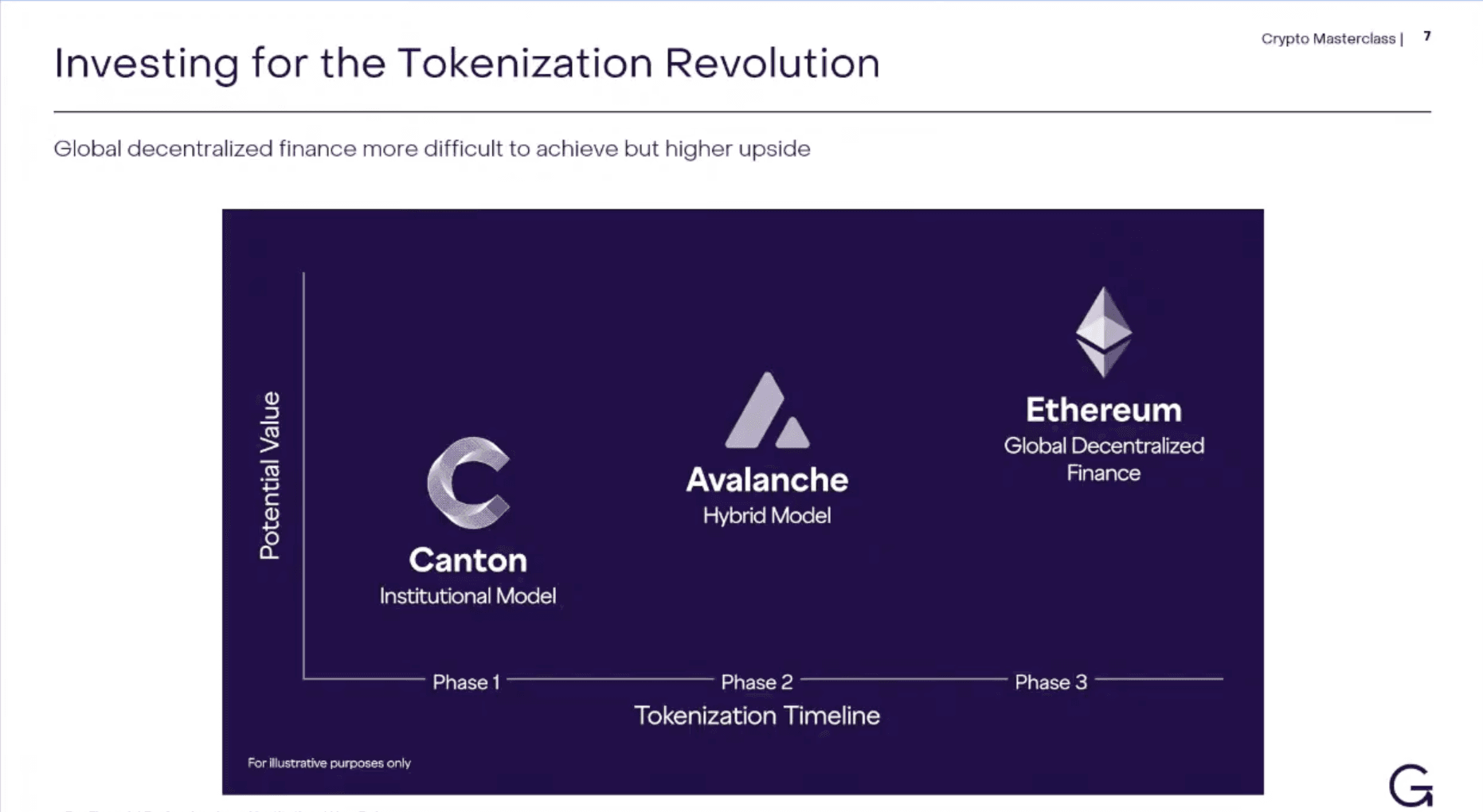
Pandl pointed to the Canton Network (CC), backed by Wall Street giants like DRW, TradeWeb, Goldman Sachs and Nasdaq, as a potential winner in this early phase of tokenization.
He said it’s “a perfectly reasonable investment” for investors looking for short-term traction, even though Canton’s approach represents only “a slightly different, slightly improved version” of the current financial system.
The second phase
The second phase of tokenization could be a hybrid model where we have both institutionally owned blockchains and a global shared state, where these networks are connected and talking to each other. An example of this is Avalanche (AVAX), which has hundreds of sovereign, proprietary chains (called subnets) that are live but connected to a primary layer 1 network.
Ethereum’s ether ($ETH), he believes, is the bigger but slower bet. Pandl said he believes the market will eventually move toward “global decentralized finance,” but added that “the technology is not fully ready yet” and institutions are not ready for it either.
That makes $ETH the more ambitious investment for those willing to wait for the longer-term shift away from financial intermediaries.
There are also picks and shovels plays. Pandl highlighted chain-agnostic service providers like Chainlink as another way to gain exposure, saying they could be “even more compelling” than some blockchains.
Read more: How tokenized assets could become a $400 billion market by 2026