
John Bollinger, the inventor of Bollinger Bands and a figure whose occasional crypto market calls carry outsized weight, says Ethereum and Solana are tracking potential “W” bottoms – while Bitcoin is not. In a post to
Potential ‘W’ bottoms in Bollinger Band terms in $ETHUSD And $SOLUSDbut not in it $BTCUSD. It’ll be time to pay attention soon, I think.
— John Bollinger (@bbands) October 18, 2025
Ethereum and Solana Price: What to Watch Now
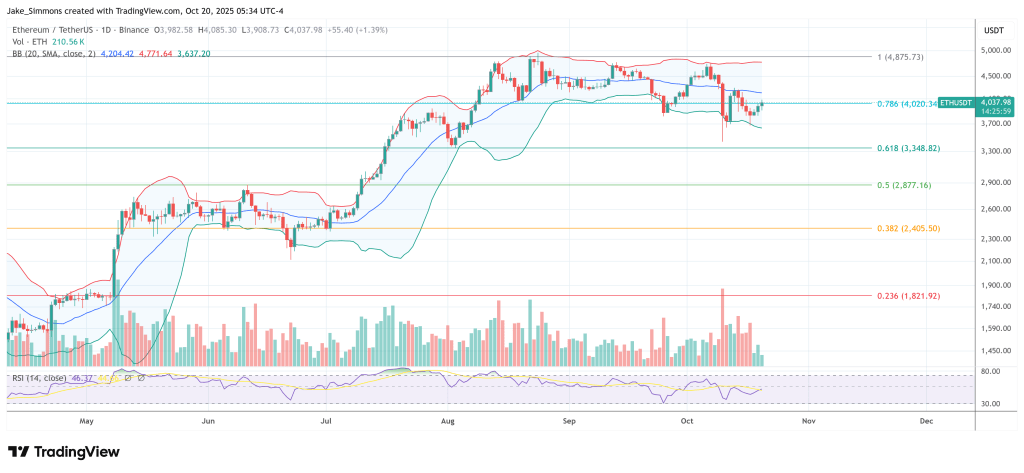
The emphasis on “Bollinger Band terms” does some heavy lifting here. In classical Bollinger taxonomy, a W bottom is a reversal of two troughs, where the second low is above the first, often accompanied by a volatility signature that includes a previous band expansion, subsequent contraction, and the inability to register a lower low on the bands on the second leg.
Related reading
In the more robust versions, the second layer is formed within the bands or with a positive divergence from the lower band, followed by a band “pinch” and a movement through the middle band that transitions into an upper band walk. Bollinger’s formulation – ‘potential’ and ‘time to pay attention’ – indicates that pattern recognition in his framework precedes confirmation, and that the validation trigger lies in the subsequent price interaction with the mid and upper bands, and not just in the raw form of the price lows.
The rarity of Bollinger’s crypto commentary added urgency to the signal. As crypto trader Satoshi Flipper (@SatoshiFlipper) stressed“John Bollinger, the creator of Bollinger Bands, barely makes one crypto call a year and hasn’t made a single crypto call on ETH in three years until yesterday. And every call he makes marks generational bottoms. He just told us that SOL + ETH have bottomed out, now imagine this legend fades away.”
The same report details that Bollinger’s last notable Ethereum call was on September 9, 2022, noting that ETH “rose further from $1,290 to $4,000.” This historical reference reflects the prevailing market psychology: Bollinger’s infrequent, technically disciplined warnings are seen by many traders as cycle-defining.
Context from earlier this year also helps frame the design. On April 10, Bollinger publicly flagged a similar structure in Bitcoin, saying, “Classic Bollinger Band W bottom in BTCUSD. Still needs confirmation.” In the exact same week, BTC bottomed at $74,508 and went on to log seven straight green weekly candles, up about 55%. From Bollinger’s call in the first week of October, BTC rose more than 70%.
Related reading
The market nuance in Bollinger’s latest lecture is the explicit exclusion of Bitcoin. If ETHUSD and SOLUSD are printing W-like structures in Bollinger terms, while BTCUSD is not, this implies a temporary disconnect in volatility structure and relative strength. In practical terms, a non-confirming Bitcoin could either lag behind a later confirmation, remain range-bound in a mid-band churn, or fail its own setup if lower-band interactions persist without recapturing the mid-band.
For Ethereum and Solana, confirmation would typically look like sustained closes above the 20-period moving average (Bollinger’s middle band), followed by a disciplined advance that converts the upper band from resistance to a guide. A healthy W bottom sequence tends not to cause immediate overturning of vertical bands; rather, it builds a stair tread profile with periodic midband checks that hold up.
A bust would bring another excursion into the lower band that undermines the second low, or a boom in volatility that widens the bands without targeted follow-through – both hallmarks of an incomplete base.
At the time of writing, ETH was trading at $4,037.
Featured image created with DALL.E, chart from TradingView.com