

XRP is quietly leaving Binance at a pace that is starting to register in CryptoQuant’s exchange supply metrics, a pattern that CryptoQuant contributor Darkfost (X: @Darkfost_Coc) says is consistent with renewed accumulation after a sharp decline this year.
In one remark published on CryptoQuant, Darkfost pointed to a steady decline in Binance’s XRP supply ratio, a measure of how much of the total supply of assets is on a given exchange, as a signal that some holders are opting for custody over liquidity.
Binance Ratio Deteriorates as XRP Moves Off-Platform
CryptoQuant’s formulation is simple: rising foreign exchange reserves often follow a greater willingness to sell, while falling reserves often reflect withdrawals into private wallets and a longer time horizon. Darkfost described the current setup in clear terms: “A drop in reserves on trading platforms suggests investors are pulling out. Funds are being moved to private custody solutions. This is the trend on Binance.”
Related reading
The data point in the middle of the note is the Binance XRP supply ratio for the past ten days. “Over the past ten days, Binance’s XRP supply ratio has fallen from 0.027 to 0.025. Approximately 200 million
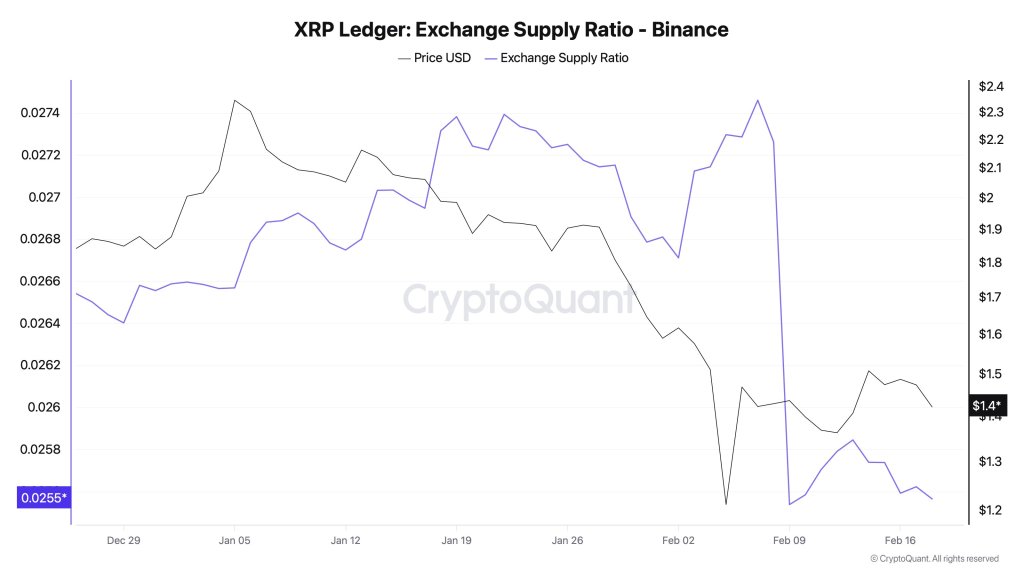
Exchange-specific ratios are important to traders because they are indicative of short-term sell-side availability (and Binance the most liquid exchange). When balances drop, it usually means that there are fewer coins one click away from the order book. This is not a guarantee of higher prices, but a measurable shift in positioning.
CryptoQuant also made a well-known caveat: not every large transfer is “organic.” Exchanges rearrange wallets, rotate custody addresses, or consolidate funds for operational reasons, which can cloud any simplistic interpretation of inflows and outflows.
Related reading
Darkfost argued that the Binance dataset is still interpretable because the public custody infrastructure provides some visibility. “Some moves may be internal reallocations. Binance publishes holding addresses, making it possible to distinguish organic user flows from operational adjustments,” the note said, suggesting the observed decline likely reflects at least some user-driven withdrawals rather than pure internal accounting.
Why This Matters After a 40% Drawdown
The note links the pullback trend to the price context without relying on forecasts. Darkfost said that XRP has “corrected around 40% since the beginning of the year,” and that the lower levels may attract interest from investors with a longer horizon.
That combination: a material correction for the current year, in addition to a measurable reduction in the supply held on the exchange, is often what analysts look for when trying to identify accumulation phases. The logic is simple: coins taken off exchanges are by definition less immediately liquid, and that is usually more akin to a holding rather than an imminent sale.
At the time of writing, XRP was trading at $1.4161.
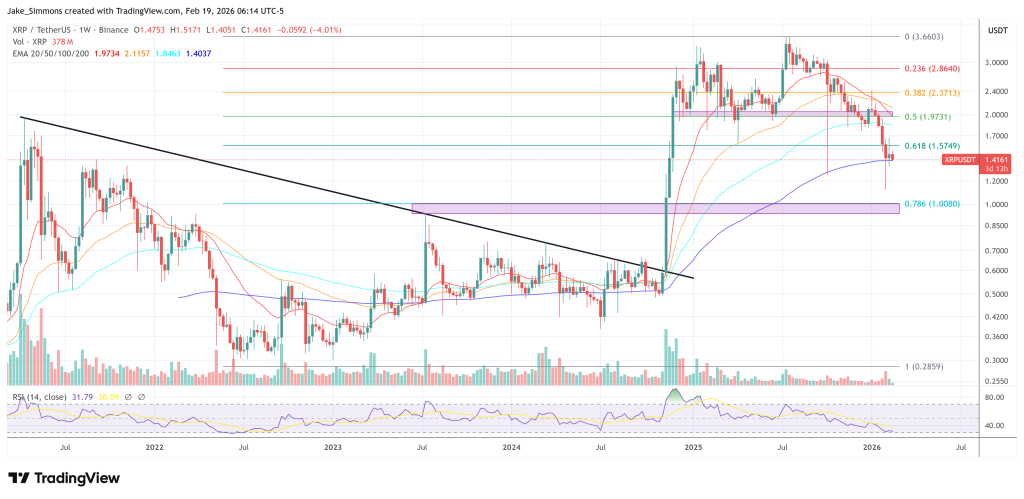
Featured image created with DALL.E, chart from TradingView.com