
Close Menu
  • News
    • Bitcoin
    • Altcoins
    • DeFi
    • Market Cap
  • Blockchain
  • Web 3
    • NFT
    • Metaverse
  • Regulation
  • Analysis
  • Learn
  • Blog
What's Hot

Velvet and DFlow join forces to refine Solana’s trading precision

2026-05-15

Bitcoin fails three times in the $82,000 breakout as short-term holders sell

2026-05-15

Billionaire Ron Baron Says SpaceX Will Skyrocket to a Market Cap of $30,000,000,000,000 – Here’s When

2026-05-15
Facebook X (Twitter) Instagram
  • Contact
  • Terms & Conditions
  • Privacy Policy
  • DMCA
  • Advertise
Facebook X (Twitter) Instagram
Bitcoin Platform – Bitcoin | Altcoins | Blockchain | News Stories Updated Daily
  • News
    • Bitcoin
    • Altcoins
    • DeFi
    • Market Cap
  • Blockchain

    Velvet and DFlow join forces to refine Solana’s trading precision

    2026-05-15

    BNB Chain unveils on-chain agent identity and payment framework with ERC-8004 standard

    2026-05-15

    Fidelity International launches a Moody’s-rated tokenized fund on Chainlink

    2026-05-15

    Societe Generale deploys stablecoins in Canton for tokenized financing

    2026-05-15

    Solana’s ‘Alpenglow’ upgrade is live for testing

    2026-05-14
  • Web 3
    • NFT
    • Metaverse
  • Regulation

    How the CLARITY Act survived a chaotic Senate floor after Warren, Banks and Democrats tried to slow it down

    2026-05-15

    Bitcoin Rips as CLARITY Act Clears Major Senate Committee Hurdle, Advances to Full Senate Floor

    2026-05-14

    Crypto markets are vastly underestimating the passage of the Clarity Act

    2026-05-14

    CLARITY Act faces more than 100 changes as bankers send 8,000 demand letters against stablecoin rewards

    2026-05-13

    Bank lobbyists battle Clarity Act, saying bill would risk ‘flight from bank deposits’ to payment stability

    2026-05-12
  • Analysis

    Billionaire Ron Baron Says SpaceX Will Skyrocket to a Market Cap of $30,000,000,000,000 – Here’s When

    2026-05-15

    Buyers of Solana (SOL) remain active, although resistance keeps the pressure high

    2026-05-15

    Bitcoin Traders Brace for a $1 Billion Liquidation Trap After Inflation Shock Breaks $80,000

    2026-05-15

    Ethereum price remains stuck below $2,320, hopes for recovery begin to fade

    2026-05-14

    Bitcoin Continues to Rise Mid-Month – Is Saylor Using Strategy’s STRC Funding Loop to Pump BTC?

    2026-05-14
  • Learn

    Invite a Friend, Earn up to 200 USDT: Changelly’s first referral program is live

    2026-05-14

    AI Agent by Changelly: automated crypto swaps and no-code API integration

    2026-05-13

    Parabolic SAR Crypto Guide: Signals, Settings, and Risks

    2026-05-13

    What Is the Average Directional Index (ADX) in Crypto?

    2026-05-12

    Mean Reversion Trading in Crypto: Strategies, Signals, and Risks

    2026-05-12
  • Blog
Bitcoin Platform – Bitcoin | Altcoins | Blockchain | News Stories Updated Daily
Home»Regulation»Crypto wallets offer a backdoor remedy if a hidden amendment to the state bill passes the Senate
Engineer adjusting Bitcoin mining servers in a data center amid network power struggle over anti-spam proposal and disputed node support
Regulation

Crypto wallets offer a backdoor remedy if a hidden amendment to the state bill passes the Senate

2026-03-24No Comments7 Mins Read
Share
Facebook Twitter LinkedIn Pinterest Email

This month, lawmakers in Kentucky introduced a new bill that critics say could make self-custody impossible for hardware wallet makers without building a backdoor into their products. It comes after the passage of a bill last year to protect residents’ right to use crypto wallets.

The vehicle is HB 380, a consumer protection measure targeting cryptocurrency kiosks. The core provisions are substantive: a $2,000 daily transaction limit, a $10,500 limit for new user accounts, a 72-hour cancellation period, fee caps, mandatory scam warnings, and defined refund rights for fraud victims.

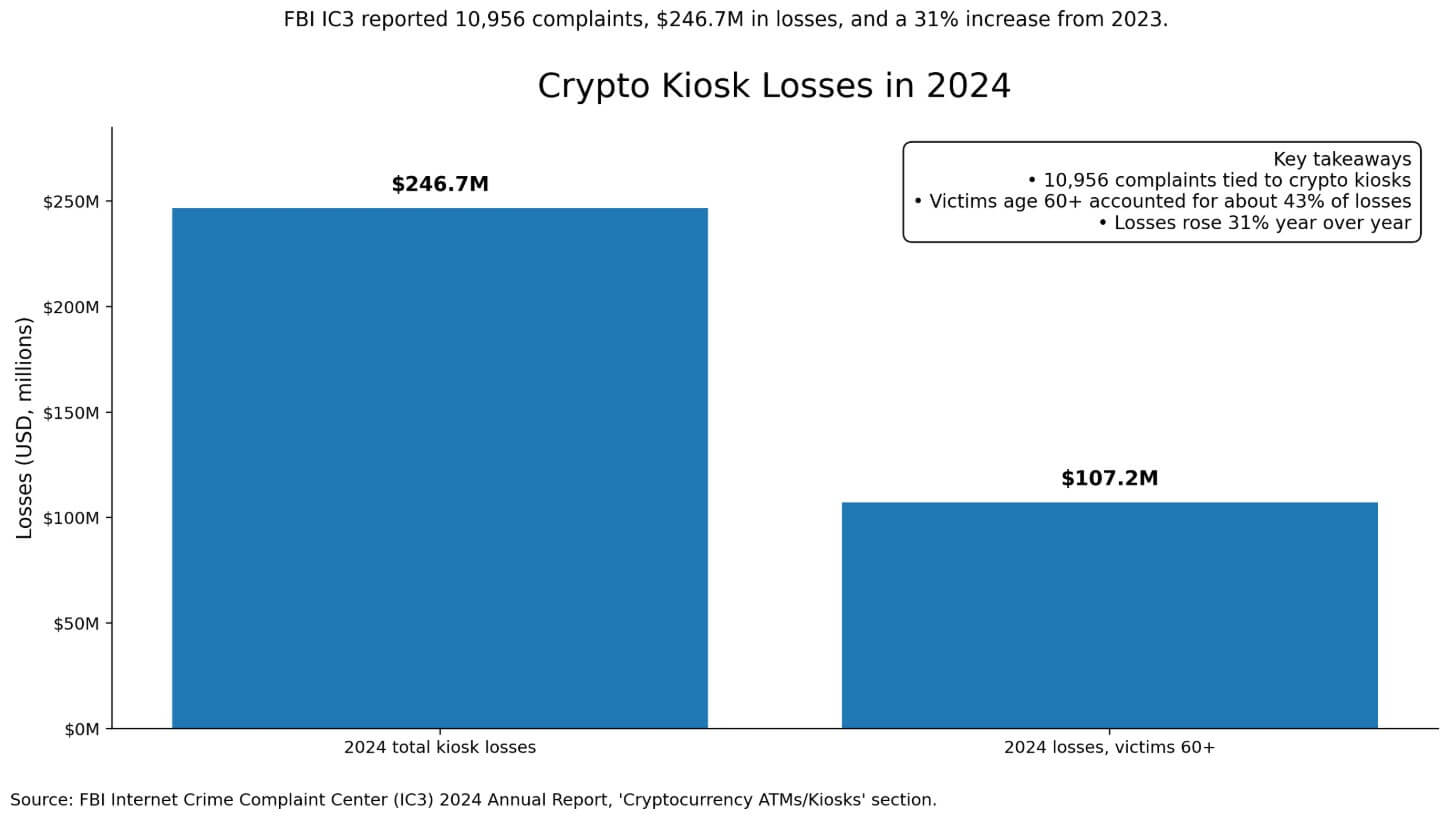
The FBI’s 2024 Internet Crime Complaint Center report documented 10,956 complaints related to crypto kiosks, resulting in $246.7 million in losses, a 31% increase from 2023. Victims over 60 accounted for about $107.2 million of that total.
Crypto kiosk lossesCrypto kiosk losses
The FBI’s IC3 recorded $246.7 million in crypto kiosk losses through 10,956 complaints in 2024, with victims over 60 accounting for $107.2 million.

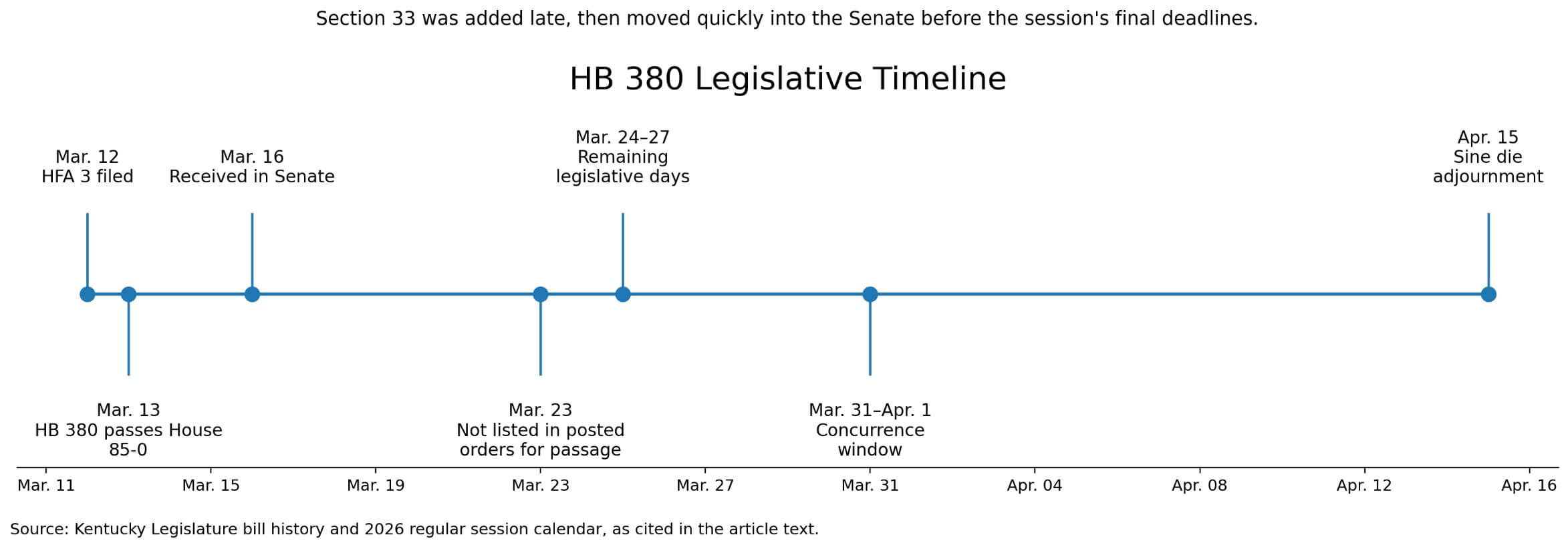
What lawmakers inserted, however, was House Floor Amendment 3, filed on March 12, one day before the House passed HB 380 85-0.

Section 33 of that amendment requires any “hardware wallet provider” to provide live customer service and “provide a mechanism for and assistance in resetting any password, PIN, seed phrase or other similar information” needed to access the wallet.

Violations of Kentucky’s consumer protection law have consequences for unfair and deceptive trade practices.

Bitcoin is gaining ground at the state level in Arizona, Kentucky and OklahomaBitcoin is gaining ground at the state level in Arizona, Kentucky and Oklahoma
Related reading

Bitcoin is gaining ground at the state level in Arizona, Kentucky and Oklahoma

Republican leadership is strengthening crypto-friendly initiatives in these key US states.

March 25, 2025 · Oluwapelumi Adejumo

The contradiction in the light of constitutional law

HB 701, signed in March 2025, defined a hardware wallet as a device that stores private keys offline and allows the owner to maintain independent control.

The bill also defined a self-hosted wallet in identical terms, such as ownership, independence and private keys, while explicitly stating that an individual should not be prohibited from using a wallet.

The Kentucky Legislature wrote these definitions to protect the very architecture that Section 33 now asks hardware wallet providers to circumvent.

See also  China initiates crackdown on use of stablecoins in illegal forex trading
Subject HB 701 (2025) HB 380 + HFA 3 / Section 33 (2026)
Wallet philosophy User retains independent control The provider should assist in resetting access
Definition of hardware wallet Stores private keys offline Treated as a usable consumer product
Self-hosted wallet principle The user manages assets and keys The provider may require a recovery path
State posture Protects wallet use Increase exposure to deceptive business practices
Practical effect Strengthens self-control Critics say this puts a strain on repairability and backdoor design

A seed phrase acts as the master cryptographic reference from which every private key in a non-custodial wallet arises. Anyone who owns it owns the assets. That’s exactly why the default no-save design gives the basic phrase to the user upon installation and then destroys any copy from the manufacturer.

Trezor clearly states that without a wallet backup, users will not be able to restore their wallet, and if the backup is lost, the wallet will become inaccessible. This conscious design choice means that repair is entirely the responsibility of the user.

Ledger offers an optional paid recovery service, Ledger Recover, which allows subscribers to reconstruct a seed phrase using identity-verified snippets stored with third parties.

The company claims that non-subscribers will continue to manage the seed phrase themselves, and that the recovery flow will require a subscription, physical consent on the device, and identity verification.

Section 33 treats voluntary opt-in recovery and mandatory manufacturer assistance as equivalent obligations. As written, any hardware wallet provider operating in Kentucky should make this recovery mechanism available to every user, regardless of whether the user wants it.

The Bitcoin Policy Institute said just that in a March 20 letter to the Senate. Complying with Section 33 would mean storing the seed sentences on the server or implementing a remote reconstruction path, which would result in a ‘cryptographic backdoor’. The letter then urged the Senate to remove the provision before taking any substantive action.

See also  Crypto company Kraken secures a direct link to Federal Reserve payments

What happens if the Senate acts on the bill as written?

HB 380 cleared the House and arrived in the Senate on March 16. As of March 23, the chamber was adjourned until March 24, with HB 380 not listed among the passing orders posted.

The legislative session in Kentucky runs through March 27, with a consensus period from March 31 through April 1 before the veto period expires and the Legislature adjourns on April 15. The Senate has a narrower window.

If the chamber passes HB 380 with Section 33 intact, the immediate impact falls on manufacturers.

Pure, non-custodial sellers, whose products are designed so that only the user ever controls the basic sense, are exposed to deceptive business practices that they cannot cure without redesigning their products.

Possible outcomes include some taking on that exposure, while others will decide that Kentucky is not worth the compliance costs and withdraw from the market or limit sales to residents.

CryptoSlate daily briefing

Daily signals, no noise.

Market-moving headlines and context, read in one sitting every morning.

5 minute summary 100,000+ readers

Free. No spam. You can unsubscribe at any time.

Oops, looks like there’s a problem. Please try again.

You are subscribed. Welcome aboard.

Both outcomes degrade the self-determination options available to Kentuckians, precisely contrary to what HB 701 was written to protect.

Section 33 distributes the compliance burden unevenly among hardware wallet makers.

Vendors that already offer optional recovery products, such as Ledger, are closer to compliance than vendors that have never saved a seed sentence or built a recovery path.

A state mandate that rewards remediable architecture and punishes pure self-restraint architecture is essentially a regulatory thumb on the product market.
HB 380 legislative timelineHB 380 legislative timeline
House Floor Amendment 3 was introduced on March 12, and HB 380 passed the Kentucky House 85-0 the next day and reached the Senate on March 16, with a zero delay until April 15.

Which would keep a correction in the Senate

The more direct resolution is a targeted amendment.

See also  Senator Warren emphasizes the desire for crypto collaboration, while claiming that the industry accepts criminals

If the Senate eliminates Section 33 entirely, or narrows the language to exclude self-hosted and non-custodial devices, as defined in HB 701, Kentucky will retain its anti-fraud kiosk framework without rolling back its own two-year-old wallet sovereignty policy.

The core consumer protections of daily limits, refund windows, scam alerts and rate caps remain intact under both approaches.

That path also puts Kentucky in line with the direction outlined by the Office of the Comptroller of the Monetary Fund in its March 2 stablecoin custodial proposal, which explicitly excluded from the custodial obligation any entity that merely provides hardware or software that facilitates a person’s self-custody of private keys or payment stablecoins.

Stablecoins just lost the key battle because insurance protection is only reserved for bank-issued tokensStablecoins just lost the key battle because insurance protection is only reserved for bank-issued tokens
Related reading

Stablecoins just lost the key battle because insurance protection is only reserved for bank-issued tokens

Not all digital dollars are equal anymore, as the FDIC indicates that only banks will receive insurance protection.

March 19, 2026 · Gino Matos

Meanwhile, Washington is making room for self-custody tools, and Tennessee has taken a harder line on kiosks, introducing a 2026 bill that would make operating a virtual currency kiosk a Class A misdemeanor.

Both data points consider Kentucky a live test case, without determining which direction it will go.

Kentucky’s kiosk problem is real, the legislative response is largely proportionate, and the consumer protection instinct behind HB 380 is defensible on the merits. Section 33 operates at a different level, as it imposes an affirmative design duty on a class of products defined in Kentucky’s own prior law by the absence of precisely that duty.

The Senate can neatly resolve that contradiction before the session closes.

If Section 33 remains intact, the state’s 2025 commitment to pocketbook sovereignty and the 2026 expansion of deceptive trade practices will work in opposite directions, leaving manufacturers to decide which law to circumvent.

Mentioned in this article

Source link

Amendment backdoor Bill Crypto Hidden Offer Passes remedy Senate State Wallets
Share. Facebook Twitter Pinterest LinkedIn Tumblr Email

Related Posts

How the CLARITY Act survived a chaotic Senate floor after Warren, Banks and Democrats tried to slow it down

2026-05-15

Bitcoin Rips as CLARITY Act Clears Major Senate Committee Hurdle, Advances to Full Senate Floor

2026-05-14

Crypto markets are vastly underestimating the passage of the Clarity Act

2026-05-14

Previous Bitcoin’s Market Top Was Hidden Behind a Sophisticated Whale Distribution – Analyst Explained

2026-05-13
Add A Comment

Comments are closed.

Top Posts

OKX Wallet Embraces Art NFTs with HeartX Marketplace Integration

2023-07-31

2024: a year in crypto

2024-12-27

XRP ETF decision delayed until 17 June while SEC keeps the crypto market guessing

2025-04-30
Editors Picks

Top Analyst Predicts Major Ethereum Correction, Outlines Worst Case Scenario For ETH

2023-06-20

Singapore Gulf Bank tackles global financial obstacles with crypto-oriented SGB network launch

2025-05-01

DEXPro announces major upgrade with new chain integrations and improved security features

2024-10-08

ChatGPT says the case will not end if SEC misses the deadline today

2024-10-16

Our mission is to develop a community of people who try to make financially sound decisions. The website strives to educate individuals in making wise choices about Cryptocurrencies, Defi, NFT, Metaverse and more.

We're social. Connect with us:

Facebook X (Twitter) Instagram Pinterest YouTube
Top Insights

Velvet and DFlow join forces to refine Solana’s trading precision

Bitcoin fails three times in the $82,000 breakout as short-term holders sell

Billionaire Ron Baron Says SpaceX Will Skyrocket to a Market Cap of $30,000,000,000,000 – Here’s When

Get Informed

Subscribe to Updates

Get the latest news and Update from Bitcoin Platform about Crypto, Metaverse, NFT and more.

  • Contact
  • Terms & Conditions
  • Privacy Policy
  • DMCA
  • Advertise
© 2026 Bitcoinplatform.com - All rights reserved.

Type above and press Enter to search. Press Esc to cancel.