

Enhancing Asset Management with ISO 20022 Messaging and Smart Contracts
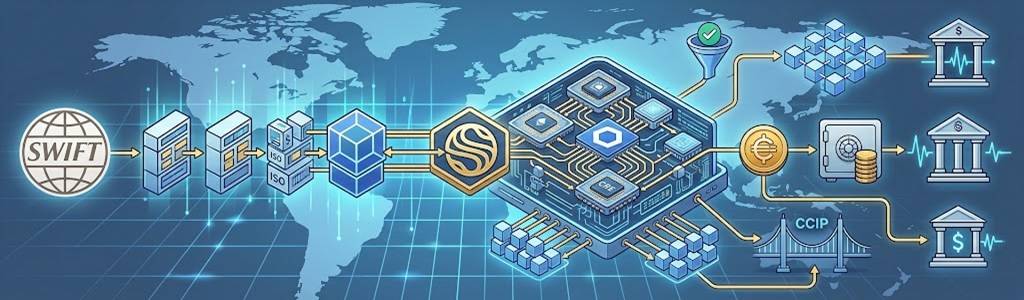
A groundbreaking technical integration has been achieved by combining Swift’s ISO 20022 messaging standard with the Chainlink Runtime Environment (CRE). This innovative architecture allows for seamless coordination of corporate actions across multiple blockchain networks.
The system effectively handles balance synchronization by consolidating distributed holdings into a single canonical ledger, thereby preventing any discrepancies during the trading process. This ensures that shares are accurately accounted for and eliminates the risk of double-counting.
Furthermore, the Automated Compliance Engine plays a crucial role in verifying eligibility criteria, tax obligations, participant identities, and sanctions screening before calculating net payments. This adds an extra layer of security and transparency to the asset management process.
When all criteria are met, monetary distributions are executed using stablecoins or tokenized bank deposits directly on the investor’s network. In cases where the settlement asset is on a different blockchain, the Cross-Chain Interoperability Protocol (CCIP) facilitates seamless cross-chain transfers.
Revolutionizing Institutional Asset Management
While the current focus is on dividend distribution, the technical framework is versatile enough to handle various corporate actions such as stock splits, debt coupon distributions, rights offerings, and capital redemptions. This demonstrates the scalability and adaptability of the system.
According to Chainlink’s projections, the architecture is fully compatible with a wide range of digital assets including stablecoins, tokenized deposits, and central bank digital currencies (CBDCs). This positions the platform as a key player in the evolving landscape of asset management.
The collaboration between Swift and Chainlink signifies a strategic partnership aimed at bridging traditional banking networks with blockchain technologies. By ensuring that assets on distributed ledgers adhere to the same operational standards as traditional markets, the initiative aims to bring greater efficiency and transparency to the industry.
Both organizations plan to evaluate the pilot results at international financial forums before moving towards full-scale commercial deployments. This marks a significant step towards revolutionizing institutional asset management through advanced technical integration.