

Bitcoin’s ongoing correction is drawing large holders back to centralized locations, with CryptoQuant data showing a sharp jump in whale-dominated inflows to Binance. At the same time, derivatives positioning continues to decline, reinforcing the image of a market that is de-risking in both the spot and futures markets.
Bitcoin Whale Share Inflows Spike on Binance
CryptoQuant contributor Darkfost (@Darkfost_Coc) said Binance is seeing a notable uptick in whale activity as the decline puts pressure on participants “from private participants to whales and even institutions.” His focus was on the whale inflow ratio, a measure that compares BTC inflows from the 10 largest transactions to total currency inflows, smoothed using a weekly average to reduce the impact of one-time transfers.
“Based on the whale influx, we see a clear increase in whale activity on Binance, which reflects a specific dynamic in the market,” Darkfost wrote. “This ratio is calculated by comparing the BTC inflows from the 10 largest transactions to the total inflows. Using a weekly average helps reveal a clearer trend, filtering out noise from isolated, exceptional transactions.”
Related reading
Between February 2 and February 15, Darkfost said the ratio rose from 0.4 to 0.62, implying that a larger portion of incoming BTC to Binance now comes from a small series of large transfers. While this metric does not prove intent, a higher concentration of whale inflows is often read as an increase in the potential sell-side supply on order books, especially during risk periods.
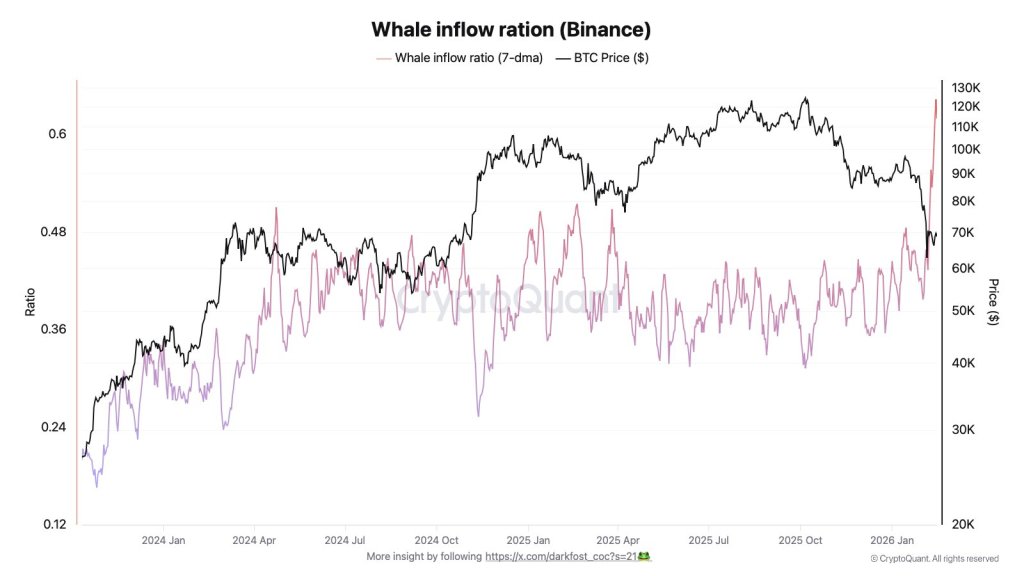
“However, it is important to note that this reflects an increase in their share of inflows, which could be interpreted as increasing sell-side pressure on the market,” he added.
Darkfost has also indicated that some of the activity may be linked to a specific entity. “Some of this inflow can be attributed to a well-known whale, believed to be Garrett Jin. Nicknamed 19D5 or ‘the Hyperunit Whale’. This whale has been particularly active on Binance lately and has moved almost 10,000 BTC to the platform.”
He described the broader context as a story of liquidity and location choice rather than a single wallet-driven anomaly, arguing that multiple whales have sent “significant amounts of BTC” to Binance, aided by its depth, while uncertainty is causing investors to reassess exposure.
Settlement of derivatives increases the pressure
In a separate article, Darkfost argued that the contraction of the derivatives market after the top of the cycle remains a central feature of the current tape. “Analyzing Bitcoin open interest across exchanges shows how severely the derivatives market has contracted since the last all-time high and the October 10 sell-off,” he wrote, adding that speculation “reached unprecedented levels.”
Related reading
He pointed to previous peaks in BTC-denominated open interest on Binance: 94,300 BTC after the November 2021 peak versus 120,000 BTC at the October 2025 market top and said total open interest across all exchanges rose from 221,000 BTC in April 2024 to 381,000 BTC at the cycle peak.
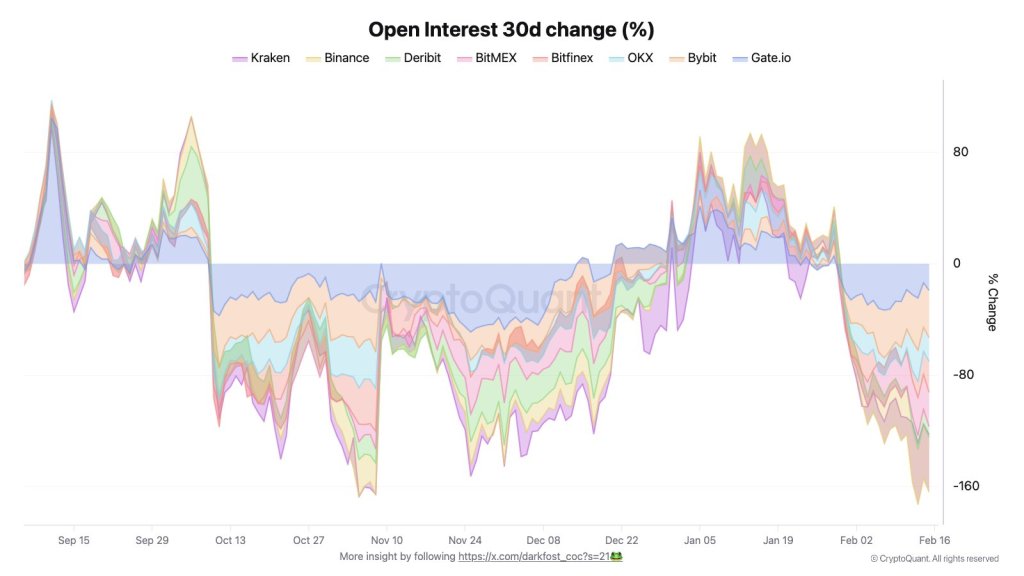
Since that peak, open interest has fallen in almost every month, including a steep drop between October 6 and October 6. On October 11, Binance’s open interest fell 20.8%, while Bybit and Gate.io each recorded a decline of 37%. The contraction has continued, with Binance down another 39.3%, Bybit down 33% and BitMEX down 24%, according to Darkfost.
His conclusion is that the market is still in a phase of risk reduction, either voluntarily or forced through liquidations amid volatility. “Overall, this environment indicates that investors are actively reducing exposure, reducing risk, or being forced out through liquidations due to continued volatility,” he wrote. “Under these conditions, it is difficult to imagine that Bitcoin will stabilize sustainably and revive a bullish trend in the short term.”
At the time of writing, BTC was trading at $67,823.
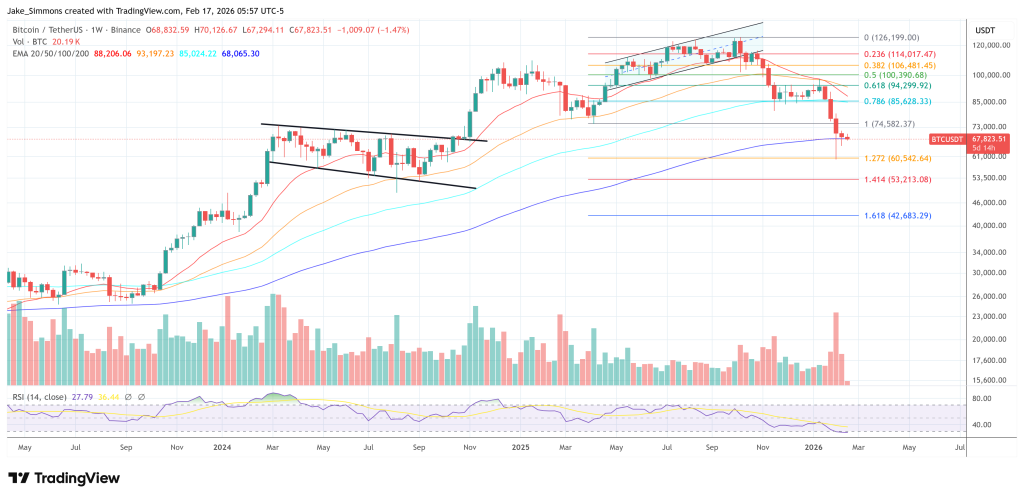
Featured image created with DALL.E, chart from TradingView.com