
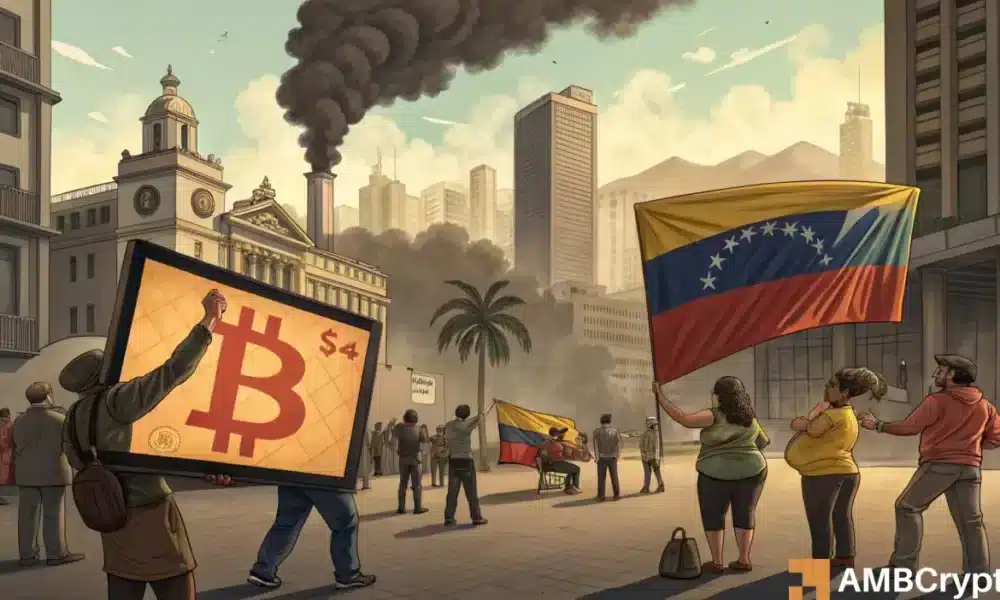
In the crypto world, there is no such thing as a closed market, even during a crisis.
So while Wall Street remained calm on January 3, digital asset markets became the first place people looked for a response to the shocking developments. capture by Nicolas Maduro.
As news about “Operation Absolute Resolve” spreadalong with reports of explosions in Caracas and images of Maduro in US custody, crypto didn’t wait.
Bitcoin’s response
After the dramatic events in Caracas, Bitcoin [BTC] saw a brief pullback around 2 a.m. ET after reports of military action in Venezuela, with Bitcoin down about 0.5% to $89,300.
By the time the markets approached 9:00 AM ET, the coin had already recovered most of that loss and was trading just below the $90,000 level.
At the time of writing, the asset was back up 1.91% in the last 24 hours and it was trade for $91,399.76.
Still, some analysts warn that the market may be in a “calm before the storm” phase.

Source: Lennaert Snyder/X
Needless to say, Venezuela’s importance to global energy supplies adds an additional layer of uncertainty. Any major shift in the region could impact oil prices, which could then directly impact the behavior of the crypto market.
Observers weigh in
In an email to AMBCrypto, Nischal Shetty, founder of WazirX, emphasized that the prospect of a pro-Western regime change could lead to a significant structural decline in global oil prices.
Shetty said:
“The drop in oil prices is usually seen as an indicator of weakening macroeconomic demand. This could deter investors from risking assets like Bitcoin.”
He added:
“But factors such as potential rate cuts, a lower probability of inflation and a general shift in sentiment towards commodities, due to the oversupply and subsequent drop in oil prices, could indicate an increase in cryptocurrency investment, given how these assets closely mirror the stock market.”
Past patterns of BTC’s current price action
Miners currently own about a million Bitcoin, and their profitability depends heavily on energy costs.
According to Shetty, crude oil is still one of the cheapest and most available energy sources for major mining operations.
He believes that if Venezuela, home to the world’s largest oil reserves, moves toward a pro-Western government, the global market could see a wave of cheaper oil.
This would make mining much more efficient and reduce operational costs across the sector.
Shetty also points to a repeating pattern: Over the past year, small increases in oil prices have often caused short-term dips in Bitcoin, followed by strong rebounds.
Naturally, traders now see these dips as buying opportunities, shifting money from commodities to Bitcoin in response to broader economic pressures.
What’s more?
This coincided with Bitcoin’s recent price action, which suggests the country is shaking off its stagnation in “digital gold” to reclaim its crown as the leader of the risky pack.
For weeks, an explosive metals rally, culminating in silver’s historic peak at $83, seemed to cap the crypto market, leaving BTC below the psychological resistance level of $90,000.
However, as precious metals begin to pull back from their overextended highs, a shift in market mechanics is becoming apparent.
If the current trend continues, the end of the metals’ dominance could serve as the main catalyst for a BTC supply squeeze, paving the way for a continued run towards the six-figure area.
Final thoughts
- BTC’s rapid recovery from sub-$90,000 levels indicates strong underlying demand, with buyers acting faster than panic could set in.
- Venezuela’s vast oil reserves unexpectedly tie its political future to Bitcoin’s mining economy, making this crisis a potentially bullish structural event.