
Former CoinRoutes CEO Dave Weisberger argued in an X-post on February 23 that Bitcoin’s hashrate rebound in early 2026 is more than a rebound in the mining cycle and may be a lagging signal of a broader price rally. His core statement is that state-owned mining activities are starting to play for Bitcoin the same structural role that central bank gold buying played for gold before its outbreak.
Weisberger bases the comparison on the recent gold cycle, where he says the accumulation of government bonds preceded the price discovery by years. He said the key signal was not ETF demand or retail flows, but central banks steadily adding reserves as geopolitical fragmentation and fiat risk concerns increased.
“The result? A parabolic gold rally that few saw coming in real time,” he wrote. “Gold has soared to record highs well above $5,000/oz in this cycle, confusing the ‘it’s just inflation’ crowd. The buying came first. The price discovery came later.”
Related reading
Why Bitcoin’s Hashrate Recovery Signals the Next Rally
Applying that framework to Bitcoin, Weisberger points to what he describes as a “textbook V-shaped recovery” in network hashrate in early 2026. After a sharp pullback of around 15% to 20% from previous peaks, he says computing power recovered from below 900 EH/s to above 1 ZH/s, accompanied by one of the largest absolute difficulty increases ever, at almost 15%.
For Weisberger, that recovery is not just a normalization after the stress, after winter restrictions, regional shutdowns and margin compression after the halving. He argues that it is a reflection of a different class of miners intervening. “This is not random noise. It is the direct footprint of sovereign mining stepping in where private miners hesitated,” he wrote.
A central part of the message is Weisberger’s claim that at least 13 nation-states are now mining Bitcoin at a government or state level (supported by research from VanEck). He cites Bhutan, the UAE and El Salvador, and also names Russia, Iran and Ethiopia as countries deploying energy resources in mining.
“These are not private or even corporate miners chasing the daily hash price,” he wrote. “These are governments that convert stranded or strategic energy into a portable, verifiable, attack-proof reserve. They mine for policy reasons: revenue without depressing local currencies, network security in which they have a direct interest, and positioning in a world where financial sovereignty matters.”
Related reading
Weisberger argues that sovereign miners operate under different constraints than private miners: a longer time horizon, different capital costs and less need to sell production when the market is weak. In that context, sovereign mining becomes a mechanism to directly incorporate newly issued BTC into long-term investments, reducing sell-side pressure while strengthening network security.
Weisberger explicitly describes hashrate recovery as a delayed, not accidental, indicator because the expansion of sovereign mining requires hardware purchases, energy contracts, infrastructure build-out, and policy approvals. These processes occur slowly, often during periods when price action appears flat or corrective.
He argues that this sequence could change the market structure before the price reflects it: stronger security, tighter issuance flow, and broader validation of Bitcoin as a reserve asset rather than a purely speculative vehicle. His conclusion is blunt: “Recovering the hashrate is not just technical resilience. It is a sovereign signal flashing brightly. Governments vote with energy infrastructure and balance sheets.”
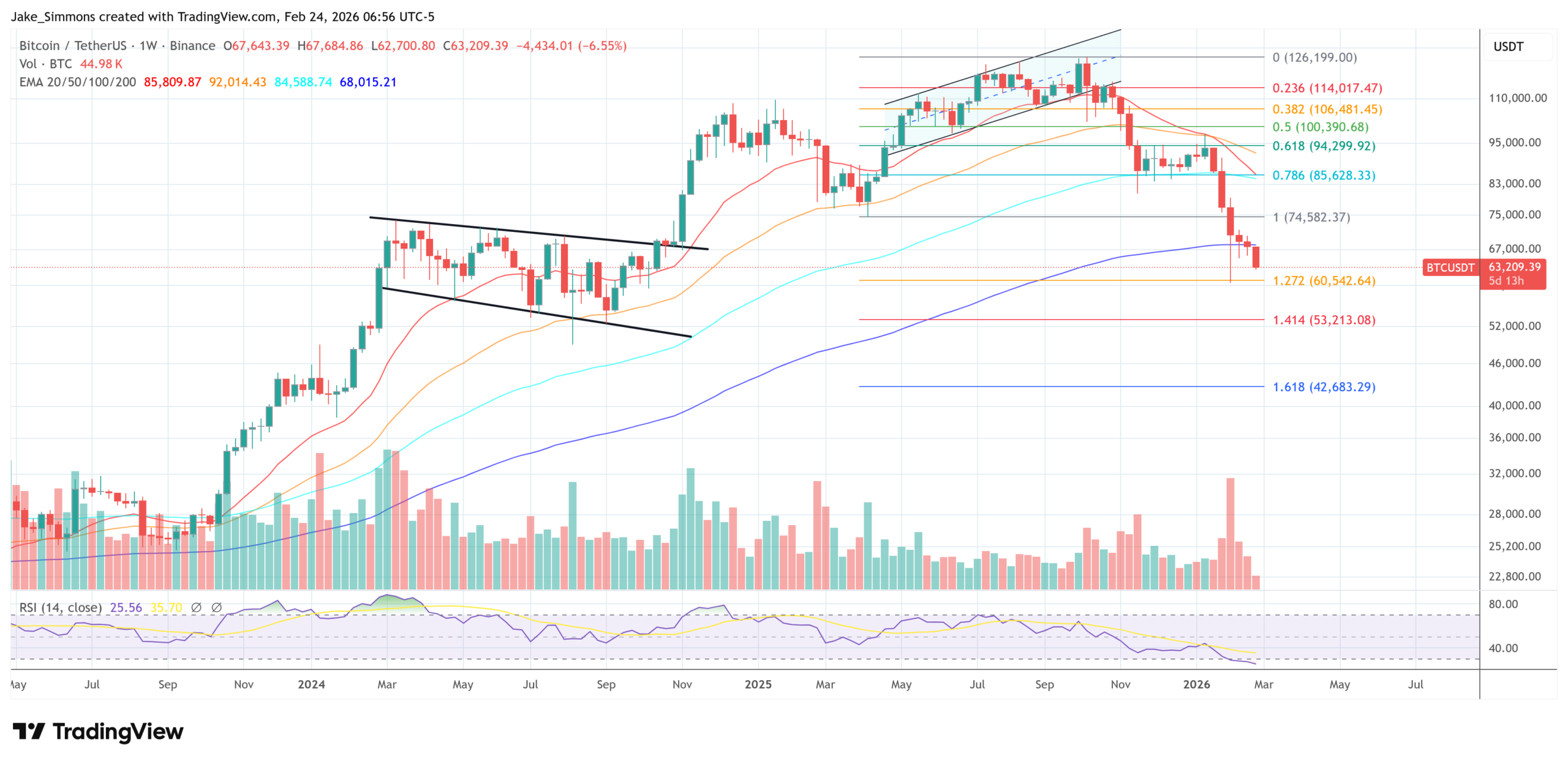
At the time of writing, BTC was trading at $63,209.
Featured image created with DALL.E, chart from TradingView.com