
Bitchat has become the most downloaded app in Uganda after government officials confirmed that internet access has been cut and will remain inaccessible during the presidential elections, which begin on Thursday.
It marks the third election in a row in which Ugandan authorities have cut off internet access, a move officials say is necessary to combat the spread of online disinformation.
Critics, however, argue that shutting down the internet suppresses election-related information and could potentially manipulate the outcome.
The internet shutdown came into effect at 6pm local time on Tuesday, Nyombi Thembo, director of the Uganda Communications Commission, said in a statement on X.
Bitchat, an internet-free encrypted messaging app powered by Bluetooth mesh networking, is currently topping the app charts on the Apple App Store and Google Play in Uganda.
Other top applications include Virtual Private Network apps, highlighting that access to information remains one of the most pressing needs in Uganda as Thursday’s vote approaches.
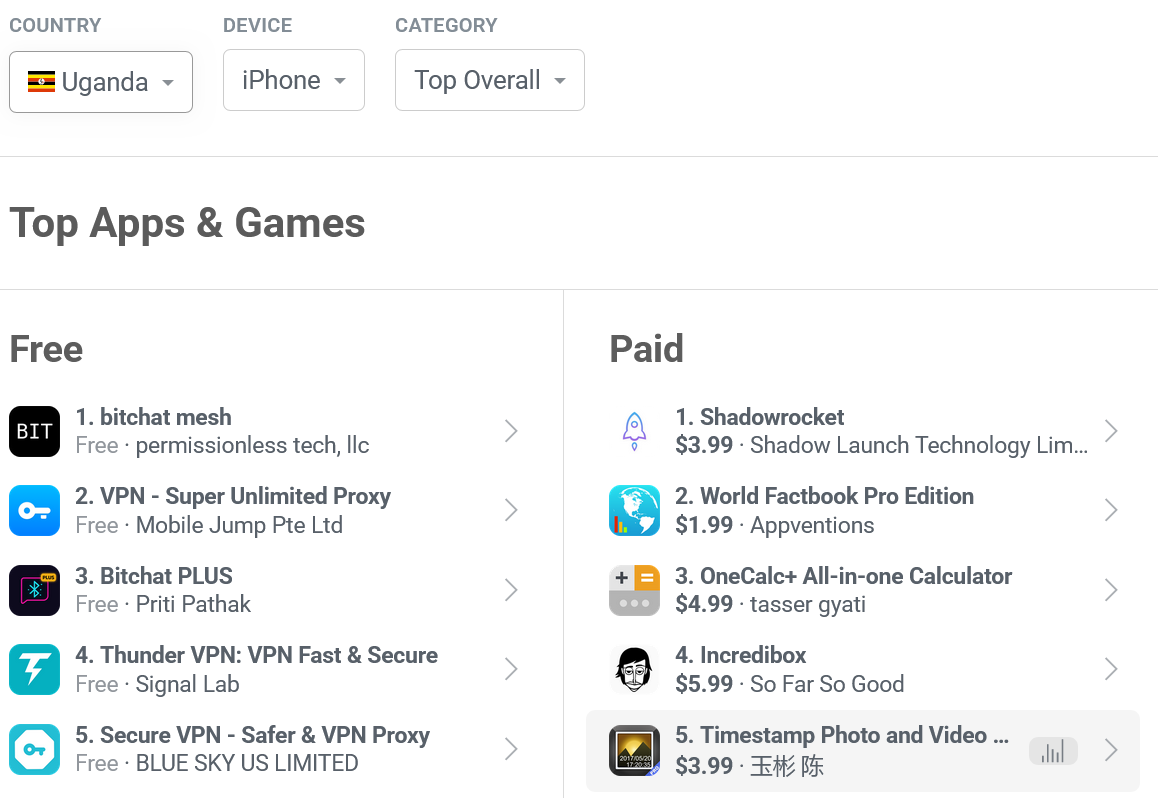
Bitchat’s ranking in the free section of the Apple App Store in Uganda. Source: App figures
Last week Thembo said the internet would not be shut down.
“Why would you use Bitchat when there is the internet, the internet will be there, use the internet,” he said last week. He also claimed that his team has the technical capacity to take down Bitchat.
Data shared by Calle on January 5 showed that more than 400,000 Ugandans had downloaded the app, a figure that is now likely much higher.
Uganda has now cut off internet access three times
During the 2016 elections, longtime Ugandan President Yoweri Museveni imposed a nationwide blockade on access to the internet and social media, citing security and safety concerns.
A similar situation also occurred in 2021, when a four-day internet blackout began on election night.
Bitchat is used in all corners of the world
Bitchat has since become a crucial solution for people in countries where internet access has been disrupted – either due to government interference or natural disasters.
In September, nearly 50,000 Nepalese users turned to the app to bypass a temporary social media ban as corruption protests unfolded, while a similar situation played out in Madagascar about three weeks later.
Many Jamaicans also flocked to the app in November when Hurricane Melissa hit, sending 180-mile-per-hour winds lashing the Caribbean and knocking out regular communication channels.