

The Berachain community is rolling out a proposal to reduce transaction inclusion times from two seconds to about 200 milliseconds, joining a broader wave of blockchain networks that aim to deliver near-instantaneous transaction feedback.
The proposal, “BRIP-0007: Berachain Preconfirmations,” outlines the implementation of an optional “fast lane” for users who want speed without compromising the chain’s core security guarantees.
This introduces a mechanism that allows transactions to appear confirmed within a second, making decentralized finance (DeFi) swaps, on-chain gaming interactions, and other latency-sensitive applications feel as responsive as traditional Web2 apps.
The proposal states that the preconfirmation layer will not change the existing consensus design of the network. Instead, it would add a sequencer that bundles transactions into small “partial blocks,” giving wallets and decentralized applications (DApps) near real-time feedback before final settlement via the usual two-second block cycle.
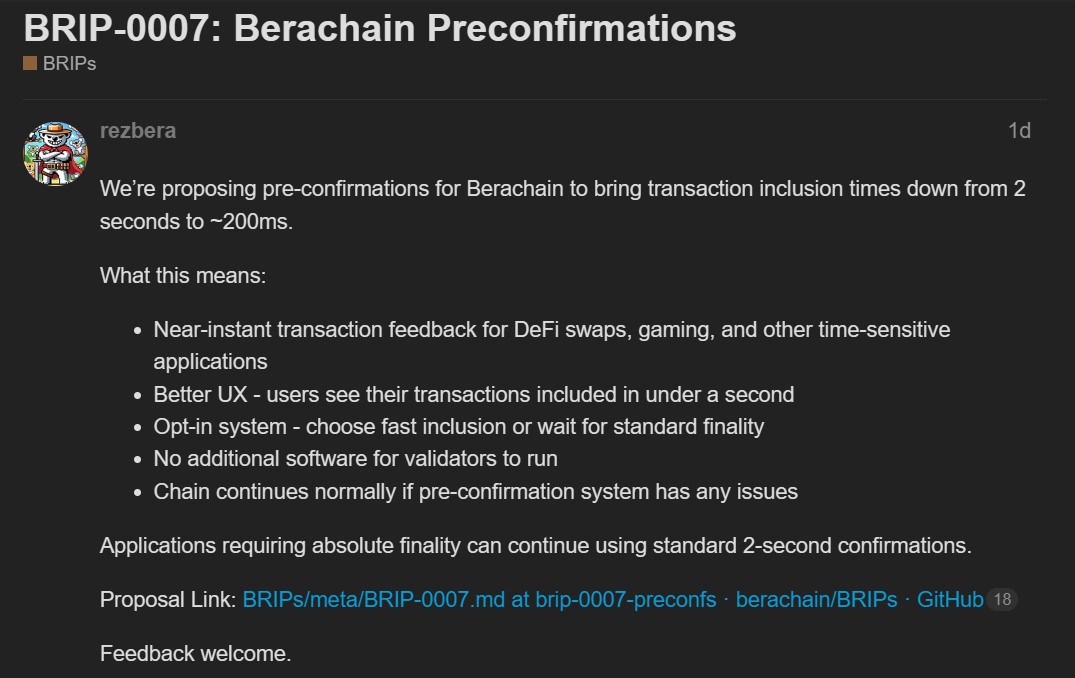
Berachain pre-confirmation proposal. Source: Berachain
What pre-confirmations mean for Berachain
By introducing a lightweight sequencer that temporarily validates and broadcasts partial transaction data, the preconfirmation design aims to reduce perceived latency.
This means that users will see their transactions recorded within 200 milliseconds, even though full finality still occurs within the original two-second schedule.
This development would make decentralized exchanges (DEXs) and Web3 games feel faster and indistinguishable from centralized systems. It would allow developers to build applications where swaps, moves, or payments feel instantaneous, even if full settlement is slightly behind.
The proposal also pays attention to safety and liveliness. If the sequencer fails to sync, Berachain simply reverts to the standard two-second block building cycle, ensuring network stability.
Related: Aave DAO proposes $50 million annual token buyback using DeFi revenue
Pre-confirmations on other blockchain networks
Berachain is not the first blockchain to explore the idea of preconfirmations. The concept originated in Ethereum research circles, where developers sought to provide “soft confirmations” before completing a transaction onchain.
Ethereum Layer-2 networks have experimented with similar, near-instant inclusion features via shared sequencers and fast lane systems. In July, Base deployed Flashblocks, bringing pre-confirmations to the mainnet.
On Thursday, preconfirmations were brought to the Ethereum mainnet via a new Remote Call Procedure (RPC) from the Ethereum infrastructure platform Primev. This enables faster transfers and smart contract interactions within the mainnet.
Magazine: Cliff bought 2 houses with Bitcoin mortgages: smart… or insane?