
Key Takeaways
Why were most crypto apps affected by the AWS outage?
Most of them still rely on AWS as the sole cloud provider for on-demand computing needs.
Will this be a wake-up call for the sector?
That remains to be seen as adoption of Web3 cloud providers like Akash Network remains somewhat muted.
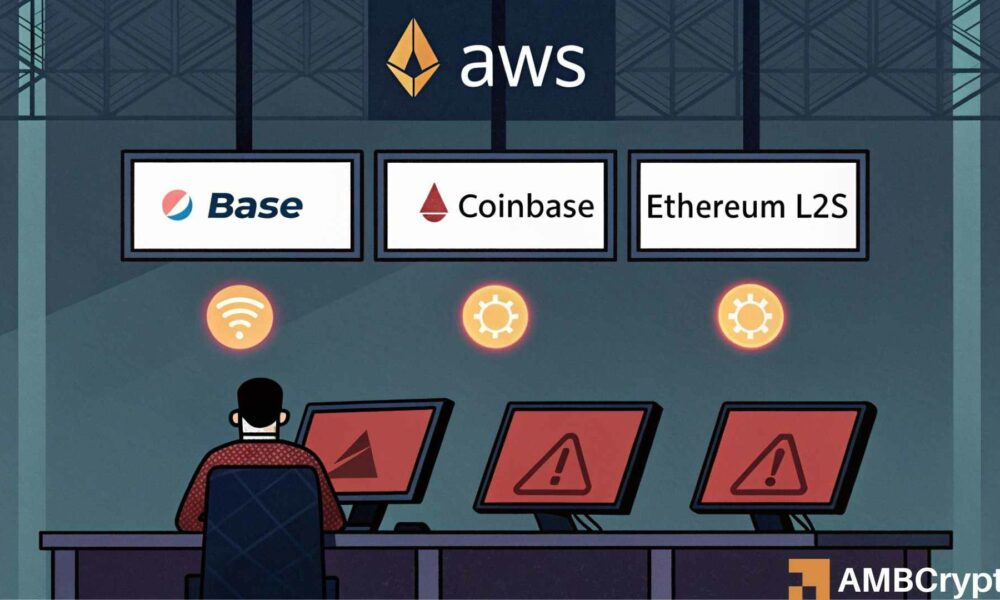
The Amazon Web Services (AWS) outage confirmed that most Web3 applications are far from “truly” decentralized.
On October 20, the AWS outage that lasted several hours crippled most protocols, including the Base app, the Ethereum Layer 2, incubated by the Coinbase exchange.
Users stranded with a ‘zero balance‘ glitch view and other services were temporarily inaccessible.

Source:
The protocol linked the outage to ‘testing’, but almost half of the internet was affected on Monday. In fact, even the Coinbase exchange had degraded service.
Other centralized exchanges such as Crypto.com faced similar issues, leaving users unable to access trading and transfers.
Is AWS the weak link of crypto?
Surprisingly, even non-custodial crypto wallets (which give you full control over your money) were affected. For example, MetaMask was crippled next to most Ethereum L2s, according to data from Infura.
Part of the Infura report read,
“The issue has reoccurred due to an ongoing AWS outage, impacting multiple Infura Mainnet JSON-RPC APIs (Ethereum, Polygon, Optimism, Arbitrum, Linea, Base, Scroll”
From a perspective, most protocols and apps opt for on-demand cloud services to save on costs related to computing resources, including electricity bills. cCurrently, AWS, Google, and Oracle dominate the field, and Web3 players rely on them.
Think of it as a protocol that, while “decentralized,” some of the underlying physical infrastructure is centralized and can become a risk factor.
As the AWS outage dragged on for hours, so did most Web3 applications and protocols.

Source: Downdetector
Some users took to social media to criticize Web3 players for this foolishness. A said,
“So AWS went down and half the crypto stopped working. Decentralization vibes are off the charts today.”
At the time of writing, AWS has done so dissolved the problem and services are back online. However, the friction derailed Sunday’s recovery. Bitcoin [BTC] had soared to over $110,000, but immediately reversed when the outage hit crypto exchanges.
Such frictions persist centralized exchanges tend to trigger sell-offs, similar to the recent flash crash.
It remains to be seen whether players will embrace Web3 alternatives to AWS Akash Network [AKT]that was somewhat measured as of press time.

Source: Akash (network usage on Akash)