
In the world of investing, knowledge is power. By understanding different asset classes and their unique features, you can make strategic investment decisions that align with your financial goals and risk tolerance.
In this article, we will explore the basics of asset classes in investing and how you can use this knowledge to create a well-balanced investment portfolio.
What Is an Asset Class?

Asset classes represent broad categories of assets that exhibit similar characteristics and behavior in the marketplace. They form the foundation upon which investors build their portfolios through asset allocation, a strategy designed to balance risk and reward by distributing investments among various asset classes. This diversification principle helps in optimizing returns while minimizing potential losses.
5 Major Asset Classes, Explained
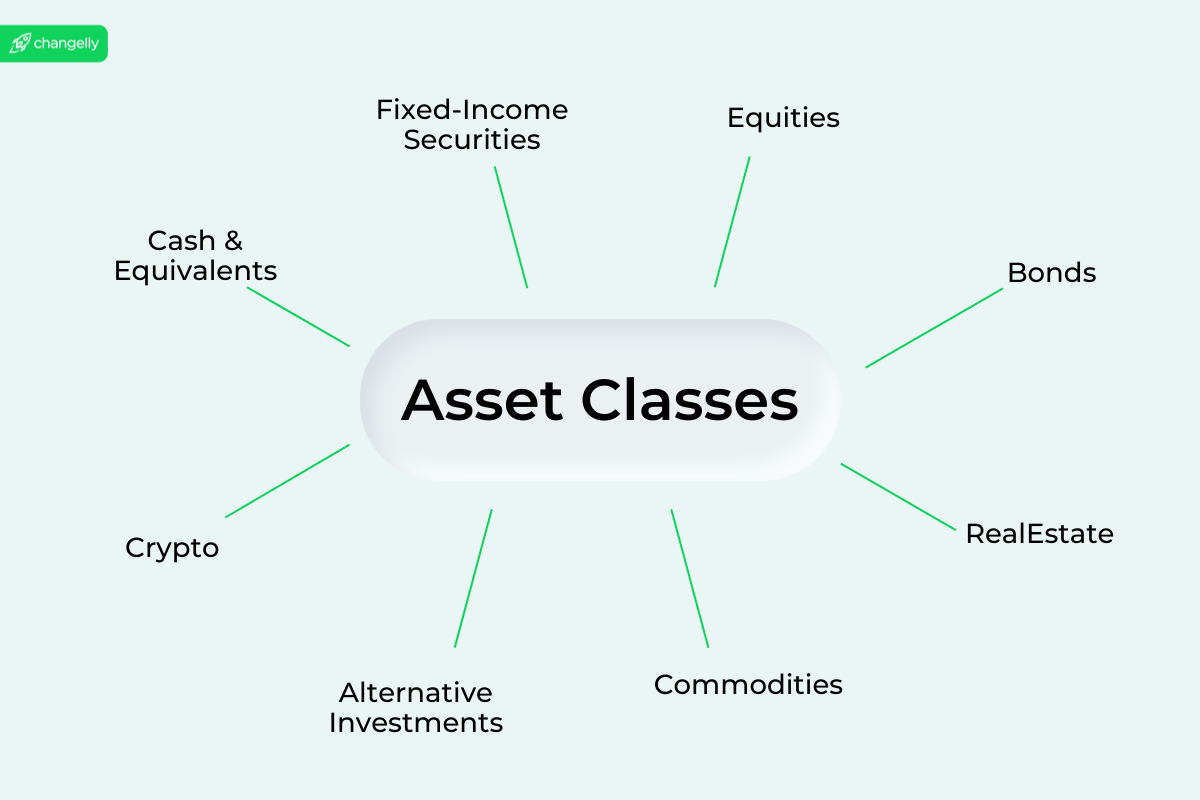
Each asset class, encompassing stocks, bonds, real estate, and commodities, holds a unique position in investment strategies. They each come with their own set of risks, returns, and contributions to an investor’s portfolio. I prepared a detailed review of each asset class to guide you through their specific benefits and considerations.
Cash and Cash Equivalents
Cash and cash equivalents represent one of the main asset classes in the investment landscape, characterized by their high liquidity and short-term nature. This asset class includes instruments that can be quickly converted into a known cash amount and are less susceptible to fluctuation in value, making them an attractive option for many investors seeking stability and immediate access to funds.
Treasury Bills
Treasury Bills, or T-Bills, are short-term government securities issued at a discount from their face value. They mature in one year or less and are considered among the safest investments because they are backed by the government’s credit. The return on T-Bills is realized when they mature at their face value, which is higher than the purchase price. Their safety and short maturity make them a staple in the investment characteristics of cash equivalents.
Guaranteed Investment Certificates (GICs)
Guaranteed Investment Certificates (GICs) are deposit investments offered by banks and financial institutions with a guaranteed rate of return over a fixed period. The term can range from a few months to several years, with the interest rate typically higher on longer terms. GICs are popular among many investors—especially those with a low risk tolerance— for their capital protection and fixed income. The guaranteed return and principal make GICs a secure choice within cash equivalents.
Money Market Funds
Money Market Funds are investment funds that invest in short-term debt securities, such as T-Bills, commercial paper, and certificates of deposit. They aim to offer high liquidity with a very low level of risk and a stable net asset value. Money market funds are favored by investors looking for a place to park cash temporarily, offering easy access to funds with an investment return slightly higher than a regular savings account. Their utility lies in combining liquidity with a return that often exceeds that of other cash equivalents, highlighting their favorable investment characteristics.
In summary, these options provide investors with safety, liquidity, and a predictable return, making them an essential part of a diversified investment strategy.
Fixed Income Securities
Fixed-income securities, a key category within asset class classification, offer investors a steady stream of income through interest payments. This class includes bonds, treasury notes, and other debt instruments that governments, municipalities, and corporations issue. Fixed-income investments are particularly valued for their predictability and lower risk compared to stocks, so it’s no surprise they’re a favored choice of conservative investors or those nearing retirement and seeking stability in their investment portfolio.
While the risk associated with fixed-income securities is generally lower, it is not absent. Interest rate fluctuations, credit risk, and inflation can affect the value and yield of these investments. However, the inherent safety and income generation capabilities of fixed-income securities provide a cushion against the volatility of the stock market, making them an essential part of a diversified investment strategy.
The primary benefits of fixed-income securities include regular income, capital preservation, and reduced portfolio volatility. They serve as a cornerstone for investors who prioritize income and safety over high growth. This asset class is ideally suited for risk-averse individuals, retirees, or anyone looking to balance higher-risk investments, ensuring a steady income stream while minimizing exposure to market fluctuations.
Stocks and Equities
Stocks and equities represent a dynamic component of asset class categories, offering investors ownership shares in publicly traded companies. This investment avenue is synonymous with the stock market, where the buying and selling of shares are facilitated. Stocks stand out for their potential to yield substantial returns, outpacing many other forms of investment over the long term. This growth potential makes stocks an appealing option for investors aiming to build wealth and capitalize on the success of corporations.
However, with the promise of higher returns comes increased risk. The value of stocks can fluctuate significantly due to market volatility, company performance, and broader economic factors; therefore, they are a more suitable choice for those who can tolerate uncertainty and have a longer investment horizon.
The benefits of investing in stocks include the opportunity for capital appreciation, dividends, and diversification within a portfolio. As part of a balanced investment strategy, stocks can provide substantial growth opportunities for investors who are willing to accept the inherent risks. This asset class is particularly well-suited for individuals looking to achieve long-term financial goals, such as retirement savings or wealth accumulation, through exposure to the global economy and various sectors.
Investment Funds
In addition to individual stocks, investment funds such as mutual funds, index funds, and exchange-traded funds (ETFs) offer investors diversified exposure to the stock market.
Mutual funds pool money from many investors to buy a wide range of stocks, bonds, or other securities. They offer diversification and professional management but are plagued by management fees and potentially lower performance compared to the market.
Index funds aim to replicate the performance of a specific index, like the S&P 500, by holding the same stocks in the same proportions. They offer simplicity, lower fees, and market-matching returns, hence the favorite status among passive investors.
Exchange-traded funds (ETFs) combine features of mutual and index funds, trading like individual stocks on an exchange. They offer real-time pricing, liquidity, and typically lower fees, but market fluctuations can affect their value.
Investment funds are ideal for individuals seeking diversified exposure to equities without the need to select and manage individual stocks. They cater to a range of investors, from those new to the market to seasoned investors looking for cost-effective, broad market exposure.
Read also: Mutual funds vs. ETFs.
Real Assets
Real assets encompass tangible, physical assets like real estate, commodities, and natural resources. This investment category is characterized by its inherent value derived from physical properties. Real estate, a prominent example, offers potential for capital appreciation and income generation through rent, appealing to those seeking a hedge against inflation and a stable, long-term investment.
However, real assets carry risks, including high initial investment costs, liquidity concerns, and market volatility. Despite these challenges, the tangible nature and potential for diversification make real assets attractive to investors looking for alternatives to traditional stock and bond investments. They are particularly suited for individuals with a longer investment horizon, able to manage the physical and market-related complexities of such investments, aiming for portfolio diversification and protection against inflation.
Cryptocurrencies as an Emerging Asset Class
Read also: How to invest in crypto?
Cryptocurrencies, a novel addition to the types of investments, are digital or virtual currencies that utilize cryptography for security and operate independently of central authorities.
With a growing market capitalization, they represent an emerging asset class attracting attention because of their high return potential and innovation.
However, this market is highly volatile, with prices subject to dramatic fluctuations.
The benefits include high liquidity and the opportunity for substantial gains, while the risks encompass regulatory uncertainties and security vulnerabilities. Cryptocurrencies suit adventurous investors comfortable with significant risk, seeking to diversify their portfolios with assets uncorrelated to traditional financial markets.
Alternative Asset Classes
Alternative asset classes extend beyond the broad asset classes of stocks, bonds, and real assets, offering investors unique opportunities and diversification benefits. This category includes:
- Hedge Funds: Pooled investments that employ diverse strategies to earn active return, or alpha, for their investors.
- Private Equity: Investments in private companies, often involving direct investment or buyouts, aiming for long-term capital appreciation.
- Commodities: Physical goods such as gold, oil, and agricultural products that are subject to market fluctuations based on demand and supply.
- Tangible Assets: Items like art, antiques, and collectibles, valued for their rarity and market demand.
Unlike traditional investments found in mutual funds and exchange-traded funds (ETFs), alternative assets often operate outside of the standard market mechanisms, potentially reducing correlation with the general market and offering a hedge against volatility. However, these benefits are countered by their own set of risks, including higher fees, limited liquidity, and complex valuation methods. The unique nature of each alternative investment also means it requires a deeper understanding and expertise to navigate effectively.
Alternative asset classes are best suited for sophisticated investors seeking to diversify their portfolios beyond traditional investments. They are particularly appealing to those with a higher risk tolerance, looking to explore opportunities in other asset classes that can potentially offer higher returns. These investors often have a long-term investment horizon and the financial capacity to absorb the inherent risks and illiquidity associated with alternative investments.
Asset Classes and Diversification
Earlier in this article, I’ve emphasized how various asset classes serve distinct investor preferences, but it’s clear that no wise investor would recommend putting all your eggs in one basket. Echoing the foremost investment principle of “invest only what you are willing to lose,” “always diversify” emerges as the essential rule number two.
Asset diversification involves spreading investments across a mix of asset classes to reduce overall risk in a portfolio. This strategy leverages the varying risk profiles and performance characteristics of assets like stocks (equities), bonds (fixed-income assets), real estate, and cryptocurrencies under different market conditions. The concept of correlation is central to diversification, as it measures how asset classes perform relative to each other over a period of time. Ideally, a well-diversified portfolio contains assets with low or negative correlation, meaning they react differently to economic conditions, thus smoothing out the portfolio’s performance.
Diversification strategies within asset classes can include investing in a variety of sectors and geographical regions or choosing a mutual fund that spreads its holdings across numerous investments. While equities offer growth potential, fixed-income assets and other defensive assets can provide stability during market downturns.
Diversification within asset classes
Diversification within a single asset class is a nuanced strategy that complements broader diversification across different asset classes. It involves allocating investments among various sectors, companies, or cryptocurrencies within that class to mitigate risk and align with investment objectives.
For instance, in the stock market, this could mean investing in a mix of sectors such as technology, healthcare, and consumer goods, as well as companies with varying market caps from large blue-chips to small caps. In the cryptocurrency space, diversification might involve spreading investments across Bitcoin, a range of altcoins, and even niche meme coins—to capitalize on so-called “altcoin seasons.”
While broad diversification across asset classes addresses systemic risk, diversifying within a single asset class tackles unsystematic risk, ensuring that an investor’s portfolio is well-equipped to navigate the complexities of the financial markets and closer to achieving their desired investment outcomes.
However, investors should be wary of over-diversification, which can dilute potential returns and complicate portfolio management. Over-diversification occurs when too many investments perform similarly under certain economic conditions or when the portfolio becomes so broad that its effective management becomes challenging. Balancing diversification with focused investment choices is key to optimizing risk and return.
Disclaimer: Please note that the contents of this article are not financial or investing advice. The information provided in this article is the author’s opinion only and should not be considered as offering trading or investing recommendations. We do not make any warranties about the completeness, reliability and accuracy of this information. The cryptocurrency market suffers from high volatility and occasional arbitrary movements. Any investor, trader, or regular crypto users should research multiple viewpoints and be familiar with all local regulations before committing to an investment.