

As Bitcoin (BTC) continues to lose crucial support levels, an analyst has shared three possible scenarios for the flagship crypto’s upcoming performance, raising alarms about possible early signs of a bear market.
Related reading
Bitcoin Price Correction Continues
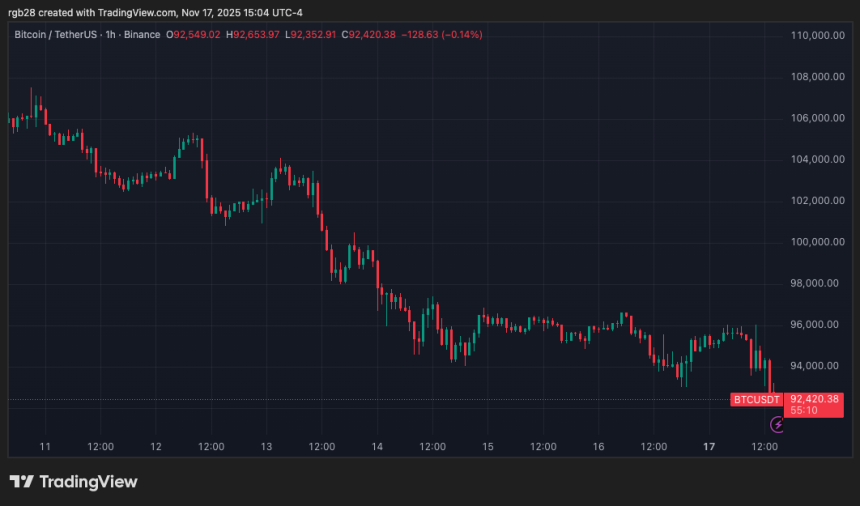
On Monday, Bitcoin hit a new multi-month low after falling below $93,000 for the first time since May. The cryptocurrency started the week down nearly 5% from the $96,000 area and retested the $91,000 level as support.
Notably, BTC has seen a 16% correction since its opening in November and has lost several crucial levels in recent weeks, including the $100,000 psychological barrier and the 21-Week Exponential Moving Average (EMA) as support.
Most recently, the flagship cryptocurrency closed the week below the 50-week EMA, which has raised alarms for several market observers.
Analyst Rekt Capital noted that losing this indicator is “not something we normally want to see if the bullish market structure is to remain intact,” adding that “bear markets tend to reassert when price loses key bullish levels that have supported upward momentum throughout the cycle.”

He explained that throughout the cycle, Bitcoin has formed clusters of lower lows at the 50-Week EMA, which “have helped sustain a broader bullish technical uptrend.” However, BTC is currently still forming a cluster below this indicator, rather than approaching the possible macro lower top developing above the 50-week EMA.
As a result, BTC’s recent performance signals the first step of a possible collapse, the analyst warned:
A full breakdown unfolds in three parts: first, a weekly close below the key level; second, a post-crisis relief rally that converts that level into new resistance; and third, a downward continuation that completes the bearish confirmation.
Early signs of a bearish trend?
Rekt Capital emphasized that the 50-week EMA will be crucial in determining whether BTC’s bullish trend and propensity for “benign downside deviations” still hold.
He emphasized that if the flagship crypto fails to regain this indicator as support and it turns into a resistance, it could make a transition from its downside deviation bias into the early stages of a confirmed bearish trend.
The analyst explained that during early bear markets, “a weekly close below the 50-week EMA is followed by several weeks of post-crisis relief toward that moving average, but those attempts ultimately fail and the EMA simply acts as resistance until a downward acceleration unfolds.”
Based on this, he shared three possible outlooks for BTC’s performance. The best-case scenario for Bitcoin would be to regain this indicator and successfully end this correction as a downside deviation, as this would indicate that BTC remains in a bull market.
The second best scenario would be for Bitcoin to experience a multi-week hesitation period below the EMA as it enters the bear market, which could include a brief overextension above this level before a clearer trend resolution comes down.
Related reading
Meanwhile, the worst-case scenario would see the cryptocurrency’s price fail to retest the 50-Week EMA even as resistance and enter straight into the downside acceleration phase.
Nevertheless, the analyst noted that the third scenario does not seem as likely historically if we have already entered a bear market. Instead, he concluded that the recurring “relief rally scenario” in the 50-week EMA before continuation of the downtrend appears more likely.
Featured image from Unsplash.com, chart from TradingView.com