
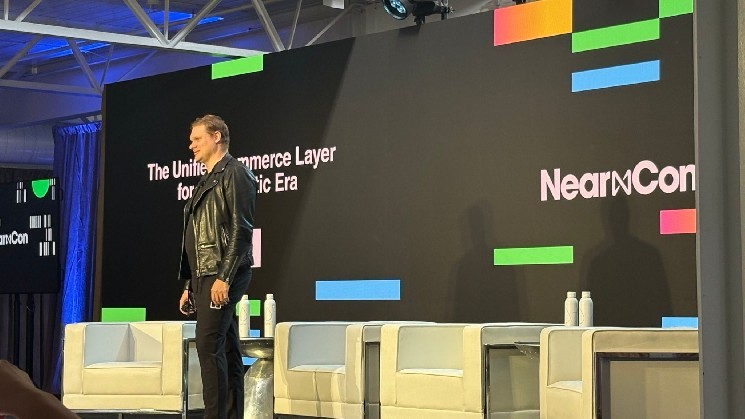
SAN FRANCISCO, CA – For years, the crypto industry has been searching for its next breakthrough moment – something on the scale of the DeFi summer or the NFT boom. In the meantime, artificial intelligence has quietly embedded itself in everyday life. Developers use ChatGPT as a co-pilot. Consumers rely on AI assistants to compose emails, plan trips and increasingly manage workflows. Crypto still feels infrastructural in comparison.
Illia Polosukhin, co-founder of $NEARBYbelieves the divide is about to collapse – but not in the way many expect.
“The users of blockchain will be AI agents,” Polosukhin said in an interview. “AI will be at the front end and blockchain at the back end.”
His framing goes against many of the recent crypto experiments with AI, which have largely focused on speculative tokens, memecoins, and agent-themed trading bots. Instead, Polosukhin argues that AI will become the primary interface layer for everything online, including crypto, taking away wallets, explorers and transaction hashes.
“The goal is to make sure that your AI hides the entire blockchain,” he said. “The fact that we have that [blockchain] Explorers is actually a failure because we don’t abstract the technology.”
In this view, blockchain does not disappear, but retreats. AI agents interact directly with protocols, make payments, manage assets, coordinate services, and even vote in governance systems. Meanwhile, people communicate with the AI.
“AI is the front end, not just for blockchain, but for everything,” Polosukhin said. “In a few years it will be all AI, just like the operating system.”
That shift, he said, could explain why crypto hasn’t had an “AI moment” comparable to the consumer explosion of generative tools. “Blockchain is inherently financial,” he said. “It will be limited to finances, but everything we do in our lives is finances.”
Rather than competing with AI platforms, crypto’s role could be to provide neutral financial rails underneath: settlement, ownership, verifiability, and programmable incentives.
Still, Polosukhin is critical of how the industry has approached both AI and governance to date – comments that come just days after Ethereum co-founder Vitalik Buterin proposed “AI stewards” to help reinvent DAO governance.
“In blockchain, we propose technical solutions before asking: what is the core problem?” he said.
As an example he mentions decentralized autonomous organizations, or DAOs. “DAOs have failed dramatically because they are limitless and not really designed to solve any problem,” he said, arguing that governance tools, including AI-enabled polling stations, only make sense if they are tied to clearly defined economic or coordination needs.
Another point of friction between the AI and crypto communities is culture. “The memecoins are screwing up [the industry’s] reputation,” Polosukhin said, arguing that rampant speculation and scams have alienated serious AI researchers. “AI people are effectively banning crypto because of memecoins.”
Longer-term convergence, however, may be less about token launches and more about infrastructure. As AI systems increasingly act on behalf of users, such as paying bills, hiring services, and allocating capital, they will require reliable execution, privacy, and programmable financial coordination.
“Blockchain is about neutral markets and neutral infrastructure,” Polosukhin said.
If AI becomes the operating system of the internet, the future of crypto may not lie in app users being open, but in becoming the invisible settlement layer on which their AI agents quietly depend.
Read more: $NEARBY Launches super app Near.com, touting AI capabilities and confidential transactions