
Acurast, a decentralized network that uses everyday smartphones as secure computing nodes, has officially activated a 225,000-node smartphone computing network on Base. It is a major development in bringing confidential artificial intelligence (AI) into mainstream Web3.
The integration with Base, an Ethereum Layer-2 chain designed to make decentralized applications faster, cheaper and more scalable, allows developers to run confidential AI workloads directly on-chain using millions of smartphones worldwide.
Rather than relying on a centralized infrastructure, this network uses Trusted Execution Environments (TEEs) built into mobile devices to perform sensitive tasks securely, while maintaining user privacy and auditability.
Smartphones are the new cloud
Acurast aims to leverage the billions of smartphones already deployed around the world to create a decentralized computing layer. While traditional cloud providers have centralized servers that pose risks of censorship and data exposure, Acurast’s model distributes the workload across devices in more than 140 countries, all running confidential AI inference tasks within secure hardware enclaves.
Jesse Pollak, creator of Base, said:
“Base is about giving builders the sweet spot for bringing new ideas on-chain. Acurast is expanding that footprint by introducing decentralized, confidential computing power, powered by smartphones. That makes it possible for developers to run AI workloads on Base that are secure, verifiable, and not dependent on centralized infrastructure. This is the kind of infrastructure that helps move autonomous, real-world applications completely on-chain.”
The network just went live on the main Base net, following the token generation event, and is already handling production workloads securely.
Acurast founder Alessandro De Carli said:
“AI agents cannot rely solely on centralized servers when they are tasked with managing real assets in the chain. By leveraging smartphone-based TEEs, we enable confidential AI that is verifiable, decentralized, and owned by the users who power it.”
Confidential AI, native payments
An important part of this integration is the payment mechanism for computing.
Acurast now supports natively $USDC payments on Base’s network without the need for bridging or offchain settlement layers. By embracing the x402 payment standard (originally developed to enable instant, HTTP-native stablecoin payments), AI agents can autonomously pay for computing resources in real-time.
This opens the door for a pay-per-request model in decentralized services, where AI agents can automatically settle fees in $USDC while processing tasks. It is a critical building block for autonomous Web3 applications that interact with APIs, data services, and complex onchain logic without intermediaries.
A new layer for onchain AI workloads
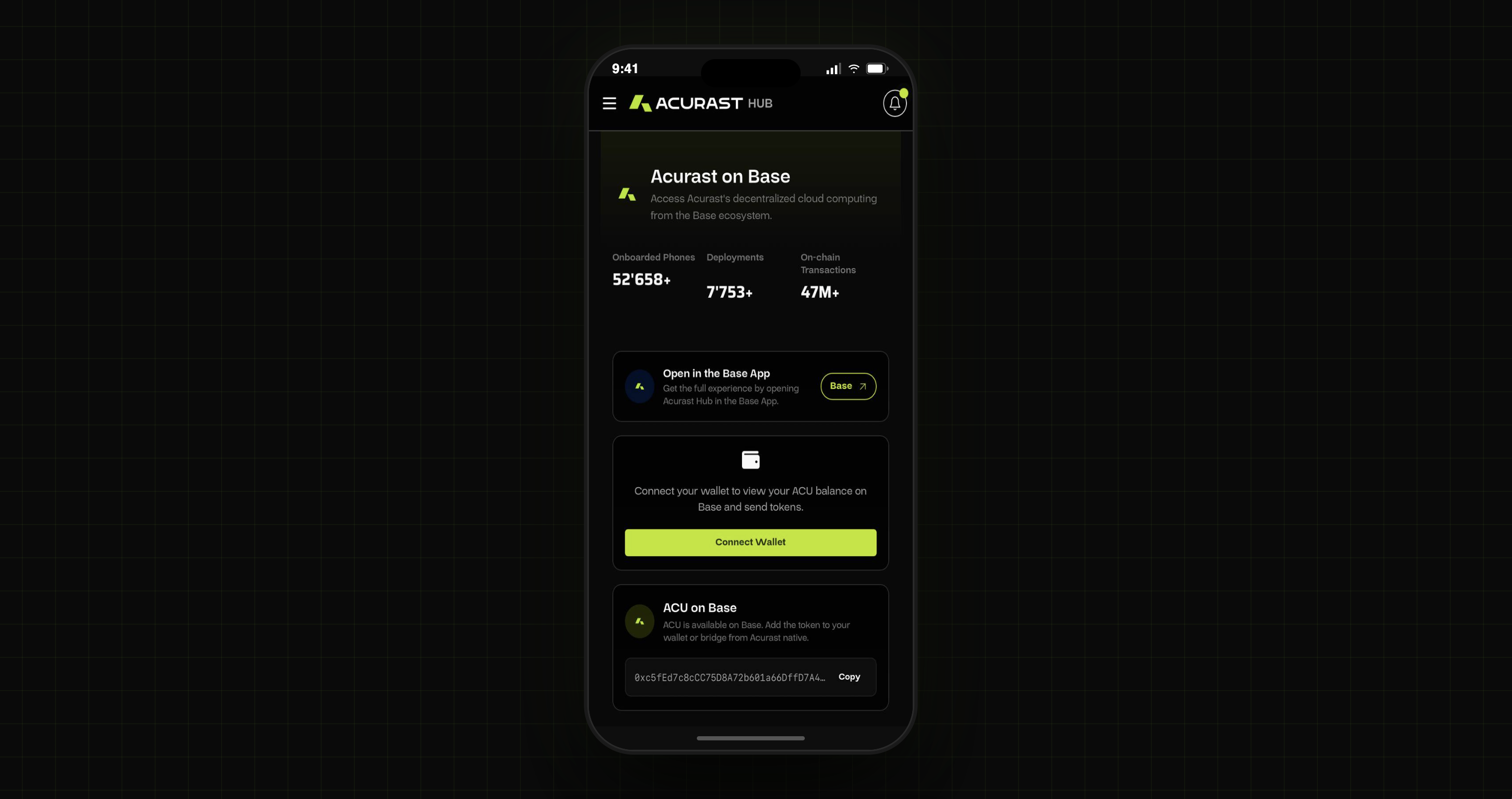
Developers using Acurast on Base can onboard devices and manage computing infrastructure through the Acurast Hub with a Base wallet.
Within the Hub, builders can deploy secure, autonomous AI agents, such as bots that execute transactions, manage assets, or perform on-chain reconciliations. This happens while the input and output remain encrypted and invisible to node operators.
All AI inference is performed in smartphone TEEs, meaning neither the device owner nor outside observers have access to confidential data during processing, essential for privacy-oriented applications in finance, identity and business workflows.
Beyond data centers
This move follows Acurast’s strong growth. The decentralized computing network will have grown rapidly by 2025, from tens of thousands to hundreds of thousands of phones powering Web3 workloads.
Acurast is driving the development of large-scale confidential computing, combining decentralized physical infrastructure (DePIN), onchain AI and real-time machine-native payments.
Now that its native token is being traded on major exchanges and its global network is running live workloads, Acurast aims to lay the foundation for a new class of onchain applications that are decentralized, verifiable, confidential, and autonomous by design.
The post Acuras turns 225,000 smartphones into a secure AI network on Base appeared first on BeInCrypto.