

In a recent report by Citi Research, Aave has been highlighted as a key player in tokenized finance, positioning itself as the most significant real-world use case for tokenized finance. The report emphasizes Aave’s role as a leading collateral mobility protocol for tokenized capital markets, essentially functioning as a decentralized prime brokerage. With the ability to bridge collateral, liquidity, and financing, Aave is paving the way for the future of finance by enabling functions that move trillions of dollars in traditional finance (TradFi).
Stani Kulechov, the Founder and CEO of Aave, commended the report for providing insight into the future of finance and acknowledged Aave’s position as the backbone of all future financial activities.
Aave’s Potential for Trillions in Borrowing
Kulechov also mentioned the substantial potential for stock borrowing within Aave, suggesting that as more stocks move on-chain, there is a significant opportunity for Aave to attract over $200 trillion in borrowing. Despite a dip in active loans following an April security incident, the protocol has shown signs of recovery, with active loans rebounding from $9 billion to $12 billion.
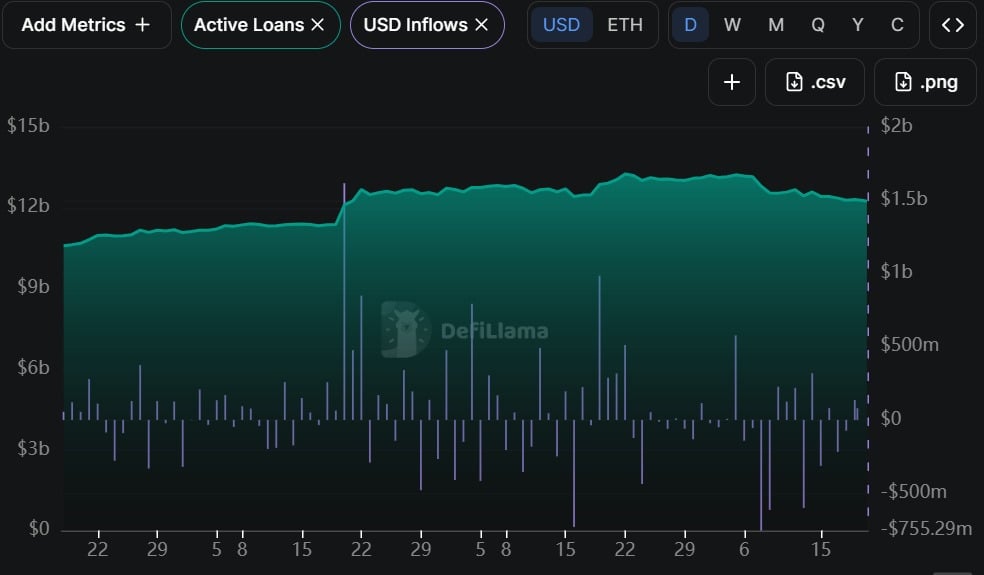
With a steady flow of capital into the protocol, recent USD inflows exceeding $213 million indicate a growing demand for Aave’s services.
Market Response to Aave
Despite its prominent position in DeFi, Aave has shown some weakness in its market performance. Following a rejection at $187, Aave has been trading within a descending channel, breaking below the $150 support level to reach $148. This decline may not fully reflect the optimism surrounding Aave’s borrowing potential and financial role.
In the short term, a spotlight from Citi Research could drive investor interest and potentially lead to a rebound towards $175. However, if the current trend persists, Aave may dip below $140 with a possible drop to $134.
Final Thoughts
- Citi Research recognizes Aave as a crucial collateral mobility protocol in tokenized capital markets.
- Aave’s potential for stock borrowing could reach over $200 trillion, with active loans showing signs of recovery post-April incident.