
A July 4 target date for advancing crypto market structure legislation through the Senate now appears less certain, according to Galaxy Digital’s head of research.
Senate calendar creates a bottleneck
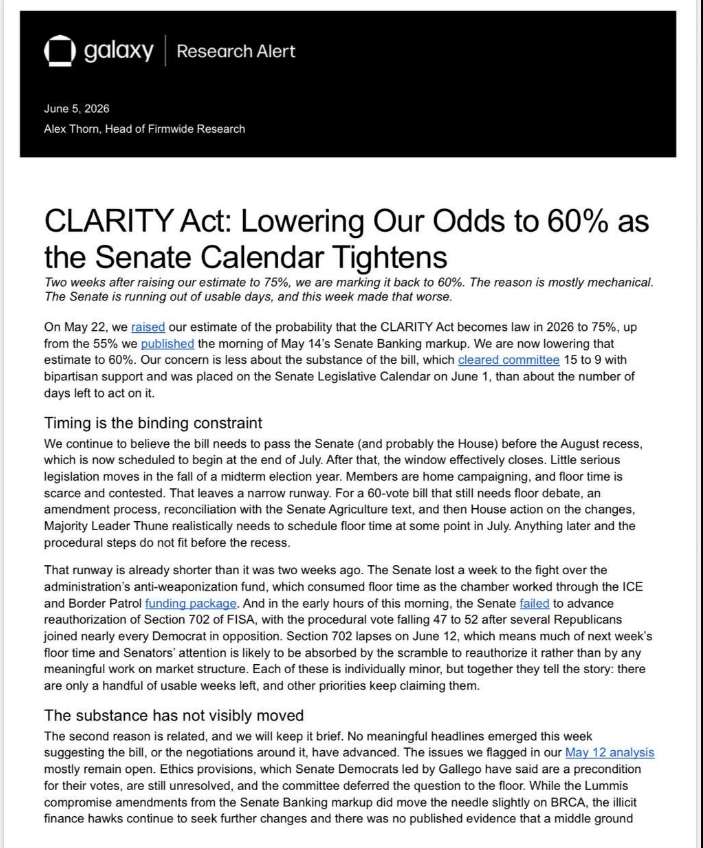
Alex Thorn has revised his probability estimate for the CLARITY Act passed in 2026 from 75% to 60%, citing a Senate schedule that has become increasingly crowded with competing priorities.
Next week’s agenda is expected to be largely taken over by FISA-related matters after a failed vote on reauthorization, leaving little room for progress on crypto legislation.
Thorn said the obstacle is no longer political will – support for the bill has not collapsed. The problem is time.
I just sent this message to clients, which lowered my chances of the Clarity Act’s passage in 2026 from 75% immediately after the markup to 60% today
I said in May that the Senate calendar was one of the biggest hurdles, and that picture has worsened. Last night the FISA herald vote failed, so now for the next… pic.twitter.com/2EcxMb3Hwh
— Alex Thorn (@intangiblecoins) June 5, 2026
Unresolved issues increase the delay
There are still two sticking points on the table: the legislator’s ethical rules and the illegal financing provisions linked to the bill. Neither has been resolved, and the lack of movement on either front has further complicated the path forward.
Despite the reduced odds, Thorn said he remains optimistic about the bill’s eventual chances — though he cautioned that the timeline is now smoother than many had assumed.
The CLARITY Act is widely considered the most consequential crypto legislation currently before Congress. Its central purpose is to settle a long-running dispute between the Securities and Exchange Commission and the Commodity Futures Trading Commission over who regulates what in digital assets.
Under the proposal, tokens classified as commodities would fall under the supervision of the CFTC, while those considered securities would remain with the SEC – a distinction that would reshape how exchanges operate and what compliance requirements apply to crypto projects.
Advocates say federal clarity on those boundaries would reduce regulatory uncertainty and prevent crypto development from migrating abroad.
A window that may close
Senator Cynthia Lummis had previously pointed to July 4 as a milestone in getting market structure legislation moving in the Senate.
Thorn’s revised figure puts pressure on that informal target. His assessment reflects planning constraints, and not a shift in the way lawmakers view the bill itself.
For crypto stakeholders awaiting regulatory certainty, the revised outlook points to a potentially longer path to comprehensive legislation.
Featured image from Unsplash, chart from TradingView