
XRP bull Jake Claver argues that Ripple’s RLUSD stablecoin does not weaken the case for XRP, but could instead strengthen it by bringing more institution-friendly dollar liquidity to the XRP Ledger. In one wire About X, Claver said the two assets are built for different roles: RLUSD as a compatible digital dollar, and
The argument answers a recurring question in the XRP community: if RLUSD can move money in seconds, why should XRP still exist? Claver said framing misses the distinction between a settlement asset and a routing asset.
“RLUSD is not the finish line. It is the front door,” Claver wrote. “Institutions are coming for a compliant digital dollar. Once they’re on the ledger, they start asking bigger questions. Can we tokenize securities here? Settle transactions immediately? Drop the three-day waiting period.”
XRP as The Ledger’s ‘money changer’
To explain this point, Claver used the analogy of an ancient trading port where merchants arrive with silks, spices, wool, salt, and gold, but rarely have exactly what another merchant wants. A silk trader looking for pepper may have to trade wool first before finally reaching the spice seller. With just ten goods, he noted, this creates 45 possible trading pairs; for a hundred goods the number rises to almost 5,000.
His conclusion is that markets need a neutral middle position to reduce friction. On the XRP Ledger, Claver said, that role is played by XRP.
“On the surface, that looks like one transaction. Underneath it, it’s two. He’s buying your side and selling you silver, both at the same time. Remove that money changer and the whole haven slows down. On the XRP Ledger, XRP plays exactly that role,” he wrote.
Claver gave the example of someone who exchanged a tokenized treasury bill for a euro stablecoin. In his framing, the user may only see one asset going in and another going out, but the routing path may move through XRP in between. “The trader never sees the XRP move. The assets go in, the ones they want come out. XRP sits quietly in the middle and makes it work,” he said.
Why RLUSD Doesn’t Replace XRP
Claver described RLUSD as a digital dollar designed to remain stable at one dollar and backed by real reserves at a bank. That makes it useful when both sides of a trade want exposure to the dollar. But he argued that many future use cases of XRP Ledger may not end in dollars at all, including tokenized Treasuries moving to Euro funds, credit markets in non-dollar currencies or other asset-to-asset transactions.
Related reading
“RLUSD is perfect when both sides of a trade ultimately want dollars. Many trades do that,” Claver wrote. “But many don’t. Tokenized Treasuries exchange in Euro funds. Borrow in other currencies. Any transaction where neither party is USD. There can’t be a dollar coin in the middle.”
He then pointed out three limitations that, in his view, prevent RLUSD from becoming the ledger’s universal bridge asset. First, RLUSD has an issuer and therefore carries issuer-specific risk. If the company behind it faces legal, banking or operational issues, the stablecoin could be affected. XRP, on the other hand, is not issued by any one issuer and cannot be taken out by one company, he argued.
Second, Claver said that a global routing agent must be neutral. Regulated stablecoins must comply with sanctions, blacklists and regional rules, and can freeze tokens or block certain users. That may be appropriate for a regulated dollar product, but Claver says it is less appropriate for a basic-level bridge asset.
Third, liquidity pools require two different assets. RLUSD can be in pools against euro stablecoins, tokenized Treasuries or other instruments, but it cannot be on both sides of the market. Claver said the asset most likely to become the primary routing layer is one that is liquid, neutral, free of issuer risk and already proven over time. His answer was XRP.
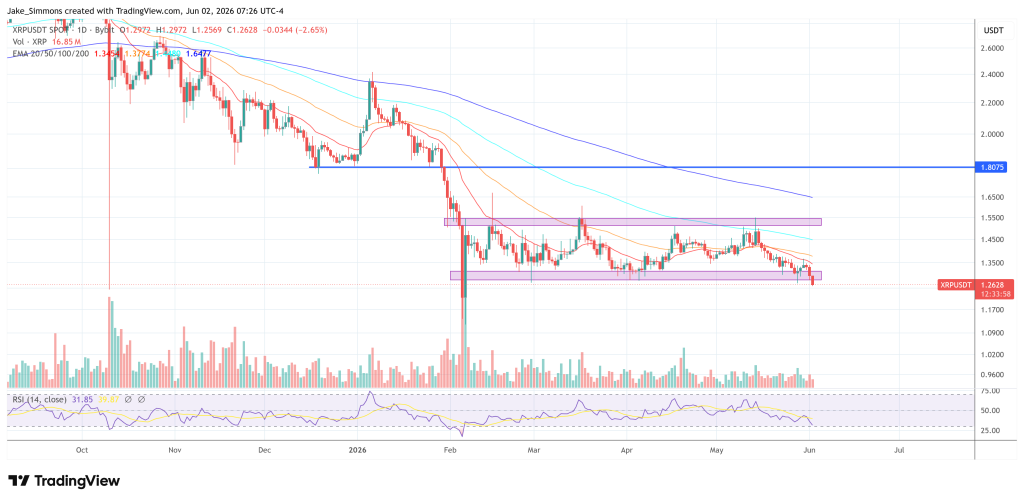
At the time of writing, XRP was trading at $1.2628.
Featured image created with DALL.E, chart from TradingView.com