
Former Ripple CTO David Schwartz pushed back against renewed claims that XRP could reach $10,000, arguing that the market itself already provides a reality check on such extreme price targets. In an exchange on
Schwartz Pushes Back on XRP Moonshot Claims
The discussion started after an X user asked Schwartz to comment on theories built around a crypto adaptation of Chris Burniske’s Price = PQ/(V × S) model, which some XRP proponents have used to argue for a possible $10,000 XRP. Schwartz responded with a simple, market-based objection.
“If there were a few very rich, very rational people who really believed there was a 1% chance that XRP would reach $10,000 within ten years, they would bid XRP up to at least $20 today,” Schwartz wrote. “Why not? Conspiracy?”
The point wasn’t just that $10,000 is a big number. Schwartz’s argument was that if the expected value of such a target were credible to rational, well-capitalized investors, they would not wait passively. Even assigning just a small probability to a huge future price, according to his reasoning, would be enough to justify aggressive buying at much higher levels than the current market has sustained.
Related reading
That answer tapped directly into one of the recurring assumptions behind ultra-bullish XRP forecasts: that the market has failed to price in future institutional utilities, settlement demand, or a latent strategy from Ripple. Schwartz’s response suggested that markets may be imperfect, but they are not so inert that large pools of capital would ignore an asymmetric opportunity of that magnitude if they believed it was even remotely plausible.
The debate then turned to another well-known claim in XRP circles: that Ripple itself could use its own products, including Ripple Prime or treasury-related flows, to drive assets dramatically higher. One user asked why Ripple wouldn’t “use their own stuff” through those channels and suggested it could push XRP above $100.
Schwartz dismissed the idea that Ripple still possesses an untapped mechanism capable of massively repricing XRP on command.
“Maybe there was once a time when you could semi-plausibly argue that Ripple had an easy way to skyrocket the price of XRP for good, but was just waiting for the right moment to maximize something or other,” he wrote. “But boy, that’s hard to argue with today. First of all, circumstances have changed so much that it’s hard to imagine that we’ve held on to this magic switch for so long and it’s still waiting to go.”
Related reading
He added that Ripple has already explained its strategy, even if the company is not disclosing every internal detail. “We explained what we are doing, why we are doing it and what we hope to achieve,” Schwartz wrote. “While we are not transparent about everything, we are not hiding some grand conspiracy. At least not to my knowledge.”
Another user argued that wealthy investors often focus on preserving their wealth rather than making risky bets. Schwartz countered that this is a misunderstanding of how large capital pools often behave. “The way rich people keep their wealth is by taking bigger risks than other people can tolerate,” he replied.
The exchange continued when another user suggested that very wealthy buyers accumulate XRP over the counter rather than on centralized exchanges, limiting the visible price impact. Schwartz conceded that this might initially be true, but argued that it would not change the broader conclusion. “At first,” he wrote. “But they didn’t stop until they raised the price or ran out of money.”
At the time of writing, XRP was trading at $1.3749.
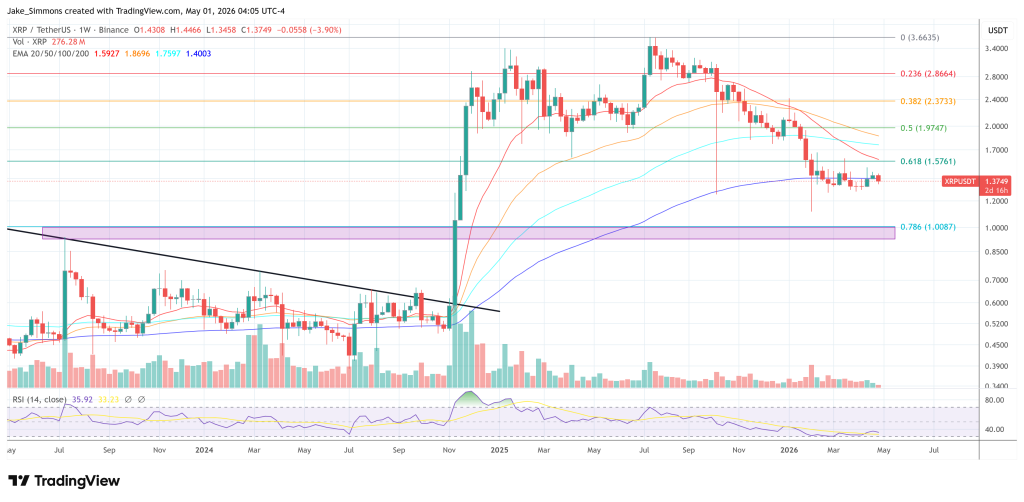
Featured image created with DALL.E, chart from TradingView.com