

Anthony Scaramucci said Bitcoin may not see a meaningful recovery until October or November, arguing that the current pullback still fits into the asset’s historic four-year cycle despite a more favorable regulatory environment in Washington.
Speaking of the Thinking Crypto podcast At the Solana Policy Summit, SkyBridge Capital’s founder framed the market weakness as a cyclical bear phase rather than a structural break. He said investors had expected a stronger policy-driven rally following the change in US administration, but whales and long-time holders have continued to sell off to ETF-driven demand.
“I’m old fashioned. I’ve been in the category that this is a cyclical bear market that is traditional to Bitcoin’s four-year cycle,” Scaramucci said. “You’re just halfway through the halving and so you’re heading into the last half of this story. Normally you won’t see any recovery until the first quarter of next year.”
Related reading
Scaramucci added that Bitcoin’s timeline may have been accelerated somewhat by macro factors, including President Donald Trump’s tariff-related messaging and the geopolitical conflict. Still, he said Bitcoin has remained “pretty sticky” during the wartime period referenced in the interview.
“You probably won’t see a Bitcoin recovery until the first month of the last quarter,” he said, pointing to “October, possibly November” as a more realistic window.
Why Demand for Bitcoin ETFs Hasn’t Been Enough
The comments address a central frustration in the crypto market: why prices have failed to respond more forcefully to pro-crypto administration, institutional ETF access, and improving legislative momentum.
According to Scaramucci, the answer partly lies in supply. ETF activity has brought new buyers to Bitcoin, including older investors using traditional brokerage channels, but that demand has faced heavy distribution from whales and early holders.
“You’re still seeing a lot of Bitcoin buying. A lot of boomers are buying Bitcoin, but it’s just not enough,” he said. “You have whales that are being sold in the – the OGs in this industry believe in the four-year cycle. And so what they’re doing is fulfilling the prophecy of the four-year cycle by trading on the four-year cycle and selling.”
He said whales “pumped a lot of coins into the supply around $100,000,” which he said helped push Bitcoin to the high $60,000s.
Scaramucci also linked the next phase of institutional adoption of Bitcoin to US market structure legislation, specifically the Clarity Act. He argued that the idea that Bitcoin is “worthless” is now “completely off the table,” but said banks are unlikely to act aggressively without clearer rules.
“If the Clarity Act legislation doesn’t pass, you’re not going to get the banks to actually open,” he said.
He cited experimental custody programs at the Bank of New York and SoFi, while arguing that true adoption will require major money center banks to offer custody, returns and loans against Bitcoin on more competitive terms. Until then, he said, investors won’t see “true full adoption.”
Related reading
Scaramucci also criticized the political and lobbying dynamics surrounding stablecoin yields and crypto legislation. He said the banks are pushing back because of their entrenched market position, while warning that insisting on a perfect bill could slow progress.
“I’m a bit more practical. I probably would have tried to get something done, but I wouldn’t make the perfect deal the enemy of progress,” he said. “The best example I can give you is the Bitcoin ETF. Gary Gensler hates us. He didn’t want that to happen. He lost the lawsuit, so he was forced to make it happen.”
The Bitcoin Reserve debate is still politicized
When asked whether the US government should hold Bitcoin in strategic reserves, Scaramucci said yes, but only if the issue can go beyond a partisan political framework.
“It’s very difficult to hold Bitcoin in a strategic reserve when it’s a partisan issue,” he said. “If we can make this a transformative post-partisan issue of what is right or wrong for the country, what is right or wrong for the American taxpayer, then the answer is yes.”
He said he would not aggressively push the issue before a broader consensus emerges, but would instead prefer an approach that involves holding rather than selling government-owned Bitcoin against legal action. He also said he was unsure whether the US government had completed an audit of its Bitcoin holdings.
At the time of writing, BTC was trading at $77,844.
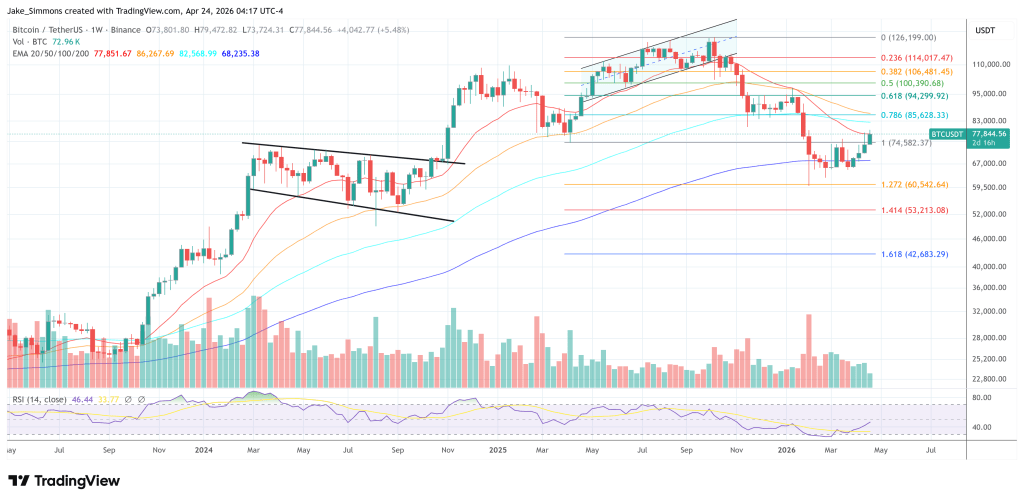
Featured image created with DALL.E, chart from TradingView.com