

When Customs launched the CAPE reimbursement portal, it put administrative certainty behind an asset class that Wall Street had already begun pricing.
As of April 9, 56,497 importers had registered for electronic refunds totaling $127 billion, of the roughly $166 billion the government expects to get back after the Supreme Court ruled in February that IEEPA did not approve President Donald Trump’s tariffs.
CBP says valid claims will generally be paid within 60 to 90 days. That timeline has brought back into focus a number of questions, including what Cantor Fitzgerald actually did with the tariff refund right, and what Howard Lutnick knew about it when he was Secretary of Commerce.
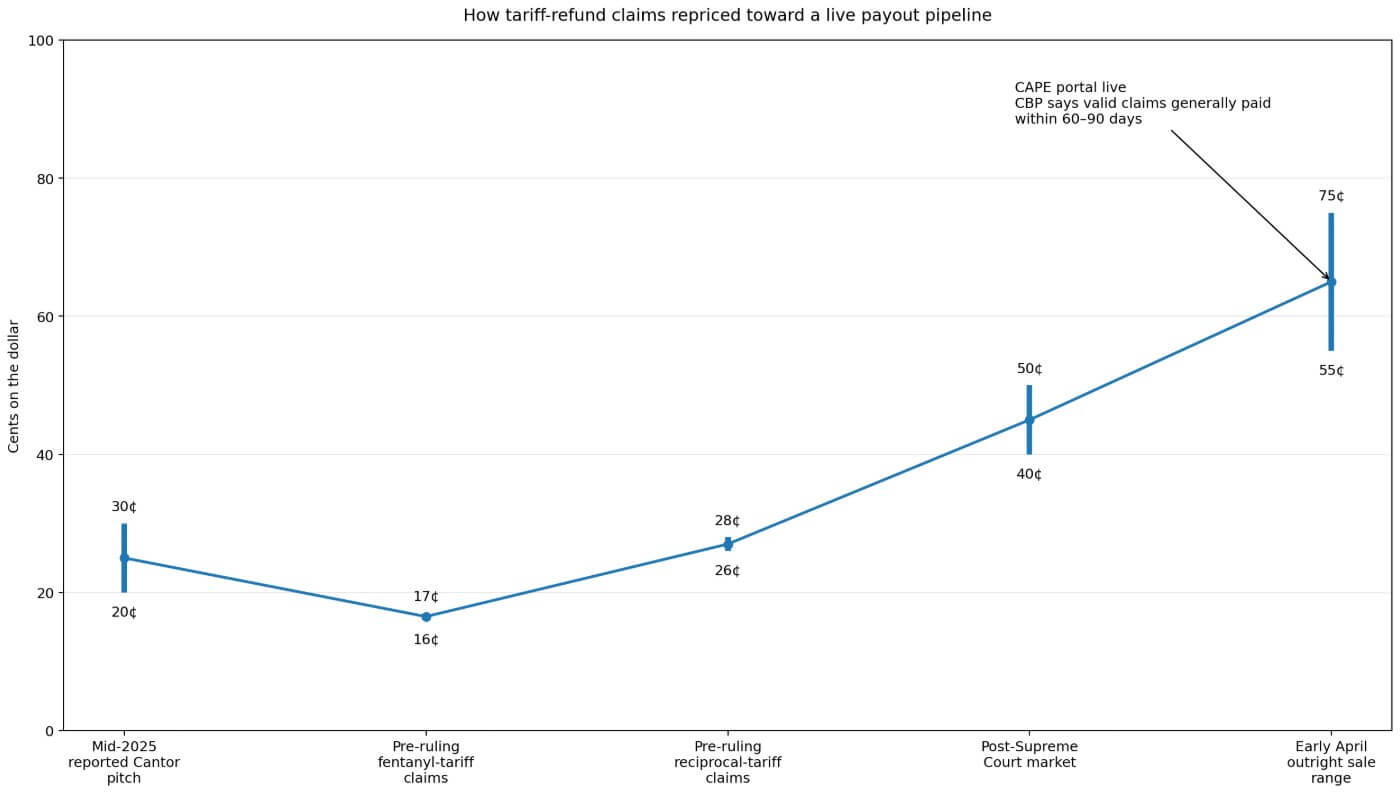
WIRED reported in July 2025 that a Cantor representative had approached importers offering to buy tariff drawback allowances for 20 to 30 cents on the dollar, claiming the company had capacity for “several hundred million” of these transactions, and saying Cantor had already completed a transaction representing approximately $10 million in IEEPA allowances.
The pitch described an arbitration scheme that involved buying distressed receivables from importers who wanted liquidity now, and collecting at or near par when the courts ruled the tariffs were illegal.
Cantor called the reporting “absolutely false,” with a February Semafor report noting that the company had considered the product but decided against it, and quoting a spokesperson as saying that Cantor had “never transacted or taken any risks regarding the legality of tariffs.”

As of April 21, these two records are unsolved.
The structural position that Howard Lutnick took made that dispute inflamed from the start. He publicly supported blanket tariffs and advised Trump to pursue them while Cantor’s investment bank explored ways to make a profit if courts later invalidate those same tariffs, according to WIRED.
Cantor Fitzgerald has publicly served as custodian for Tether’s U.S. Treasuries, tying Lutnick’s former company to one of the top crypto reserves.
The ethical architecture
Lutnick built that structure to create a clear line between his policy role and his former firm’s commercial activities. He transferred his interest in Cantor to trusts for his adult children, controlled by Brandon Lutnick, and agreed to forgo all economic benefits in Cantor, BGC and Newmark effective May 16, 2025.
His ethics agreement with OGE states that he would not receive any economic benefits related to his property while the sale was pending.
Congressional Democrats argued that the arrangement did not meet that standard. Senators Ron Wyden and Elizabeth Warren demanded in August 2025 that Cantor disclose how many tariff reimbursement agreements had been drafted or completed and whether Cantor or a subsidiary was the counterparty.
Representative Jamie Raskin followed up in February 2026 with a records request addressed to both Howard and Brandon Lutnick, citing the “appearance of tariff profiteering” and asking for documents on any agreements, counterparties, communications with the trade or White House, and any non-public information related to the tariff disputes.
Both Congress’s demands and Cantor’s responses left the ownership question publicly unresolved.
| Subject | What is documented | What is disputed/unresolved | Why it matters |
|---|---|---|---|
| Cantor’s reported trade talk | WIRED reported offers to purchase rights from 20-30 centsclaimed capacity for “several hundreds of millions”, and one claimed $10 million transaction | Cantor denied the reports; Semafor said the product was considered but not implemented | Determines whether this was just a market survey or an actual transaction |
| Howard Lutnick’s Ethical Structure | Stakes transferred to trusts for adult children; Brandon Lutnick audits trusts; Howard agreed to forego economic benefits from then on May 16, 2025 | Whether that structure completely isolated policy decisions from business activities | Central issue of conflict of interest |
| Control by Congress | Wyden/Warren asked about drafted/completed agreements and counterparties; Raskin was looking for records by Howard and Brandon Lutnick | No public resolution on whether or not executed agreements existed | Shows that the issue had formal oversight, not just media attention |
| Refund chain of ownership | CAPE pays importers from registered/authorized brokers | Private contracts, term sheets and side letters may contain economic rights outside the portal | Explains why the portal alone may not answer who really benefits |
| Current reimbursement market | Claims are priced sharply higher; some importers may sell at 55-75 cents; lenders demand large claims | Who purchased, financed or arranged these positions in specific cases | Changes the story from theory to traceable economics |
Reuters reported in February that secondary market prices for tariff reimbursement claims soared after the Supreme Court ruled, reaching 40 to 50 cents on the dollar, from about 16 to 17 cents for fentanyl tariff claims and 26 to 28 cents for cross tariff claims before the decision.
In early April, reports said some importers could sell a $500,000 claim outright for about 55 to 75 cents on the dollar, while others were exploring loans backed by claims, with lenders generally requiring a loan of at least $10 million backed by a claim of at least $20 million.
A claim bought for 20 to 30 cents on the dollar in mid-2025, in a market now demanding between 55 and 75 cents for some categories, would represent a decent return on cost if bought and held.
The letters from Congress asked for counterparties, term sheets and executed agreements to determine if anyone had adopted this move.
CBP’s CAPE portal processes refunds for registered importers and authorized brokers, the entities listed on government trade documents. Buyers and lenders in the private market have transferred economic rights through contracts that live in term sheets, side letters and private agreements, entirely outside that payment trail.
Any previous transfer of claim economics to a third party would pass through these private documents, invisible to the CAPE interface itself.
Potential results ahead
CBP says the refund system will process approximately 330,000 importers who paid the affected tariffs on 53 million shipments, with approximately $2.9 billion of certain imports still requiring manual review.
The size of that pipeline means that the next 60 to 90 days will provide a major public overview of who received what. That record relates to known importers; private orders to third parties live entirely in contracts outside that system.
Wyden, Warren, and Raskin were already wondering whether anyone else upstream had an economic interest and whether any of those interests were related to Cantor, affiliates, customers, or agreed upon counterparties during the period in which Lutnick was shaping or defending tariff policy.
If documents, counterparties or testimonials from importers show that one or more tariff refund rights were actually sold or brokered on the terms WIRED reported, the economic interests become concrete.
A claim bought for 20 to 30 cents, in a market that has risen to 55 to 75 cents after the ruling, provides a return that is easy to calculate and document. The congressional letters already provided the legal and political framework for that finding.
At that point, the question of the chain of ownership is reduced to a transactional record, and the ethical architecture Lutnick built around his divestiture is placed under direct scrutiny to determine whether it has functioned as intended.
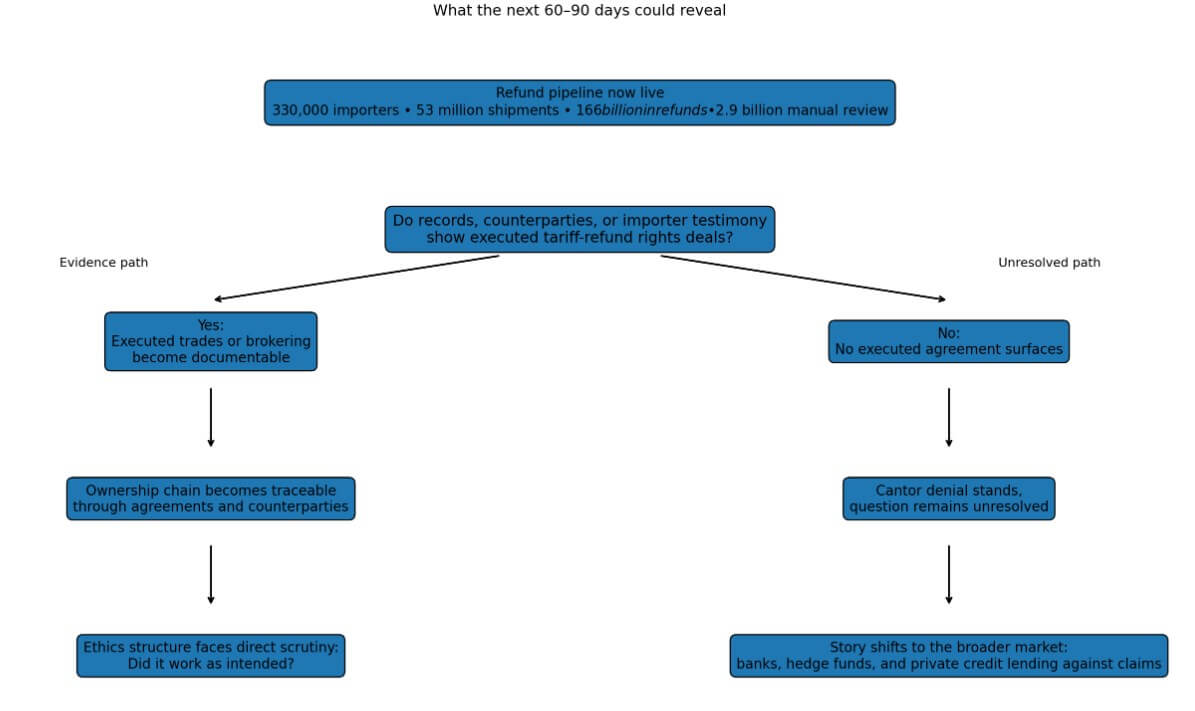
The alternative path sustains Cantor’s denial. If no executed agreement emerges, the operational story shifts to the broader repayment financing market, consisting of commercial banks, hedge funds and private credit funds that now openly lend against claims, with no reported connection to Cantor or the Lutnick family.
In that version, the company’s reported 2025 market exploration counts as an open accusation, and the live story becomes the maturation of rate claims as a bankable asset class, with Lutnick’s role carrying an unresolved ethical dimension.
In that version, the Commerce Secretary remains at the center of a policy he publicly advanced that was overturned by a federal court, creating a nine-figure reimbursement market that his former firm reportedly sought.
The portal’s launch noted that restitution rights are now part of an ongoing federal payment pipeline, that the secondary market has already been repriced to reflect that certainty, and that the government is on a published timeline to distribute $166 billion.
What congressional investigators asked for in 2025 and 2026 is now flowing through an active, documented market.