

In a proactive move, Quantus, Midnight, and seven other blockchain firms have come together to establish the Quantum Alliance. The primary goal of this alliance is to expedite the industry’s preparedness for the post-quantum era.
Christopher Smith, the Founder and CEO of Quantus, emphasized the importance of standardizing post-quantum products that can be easily adopted by the crypto industry as a whole. He envisions creating standardized solutions that can be readily implemented by other blockchain companies as they transition towards post-quantum technologies.
Smith stated, “Our intention with the Quantum Alliance is to streamline the decision-making process involved in developing post-quantum blockchain products and establish industry-wide standards that can facilitate seamless adoption across different platforms.”
The Quantum Alliance’s scope of work will encompass various aspects such as migration strategies, zero-knowledge proofs, wallet security, and chain interoperability. The objective is to create cohesive guidelines that can ensure smooth operations as blockchain networks transition to utilizing post-quantum signatures.
The urgency for accelerated preparations for the post-quantum era has been heightened due to concerns that advanced AI technologies could pose similar threats to quantum computing. As of now, the Quantum Alliance and the BlackRock-backed Bitcoin Security Consortium are the only public groups advocating for a post-quantum blockchain industry. Recently, Coinbase also joined the call for expediting phased migration for Bitcoin to stay ahead in terms of security measures.
The stakes are high, with nearly $2.7 trillion of the crypto market deemed vulnerable to quantum threats, as reported by Migration Fail. Bitcoin has been assigned a ‘D’ rating in terms of quantum readiness, while platforms like Solana and Ethereum have received an ‘F’ rating.
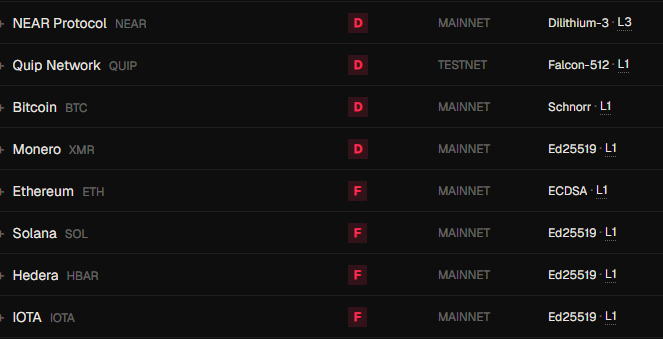
Only a few blockchain networks, including Quantus, have managed to secure an ‘A’ rating by leveraging post-quantum signatures. Tron has announced its readiness to implement a network PQ upgrade on the mainnet by Q4 2026. However, many other platforms are still in the planning or testing phase, with experts warning that a functional quantum computer could become a reality as early as 2028.
The industry faces a looming deadline to become quantum-ready by 2029, although uncertainties persist regarding the adoption of post-quantum schemes for long-term security. While the industry acknowledges the urgency of quantum threats, the timeline for migration remains uncertain, with key figures like Ethereum founder Vitalik Buterin expressing indecision on the best strategies for long-term protection.
$2.7T at risk as firms push for post-quantum migration
According to Migration Fail, nearly $2.7 trillion of the crypto market is vulnerable to quantum threats, prompting a collective effort within the industry to accelerate post-quantum migration strategies. Bitcoin, Solana, and Ethereum have been flagged for their inadequate quantum readiness, with urgent calls for enhanced security measures to mitigate potential risks.
Tron’s proactive stance in deploying a network PQ upgrade underscores the industry’s recognition of the pressing need to fortify blockchain networks against quantum threats. As the countdown to 2029 approaches, the race to achieve post-quantum readiness intensifies, with pivotal decisions on security protocols shaping the future landscape of blockchain technology.
Final Summary
- The formation of the Quantum Alliance signifies a concerted effort to assess and expedite the industry’s transition towards post-quantum technologies
- Recent advocacy from industry leaders like Coinbase underscores the imperative for phased migration strategies to bolster blockchain security