

The average Bitcoin retail investor who has recently discovered crypto may never have considered a stablecoin that provides returns on an inactive balance. That fight, hidden in the Senate negotiations over the CLARITY Act, will matter to them regardless.
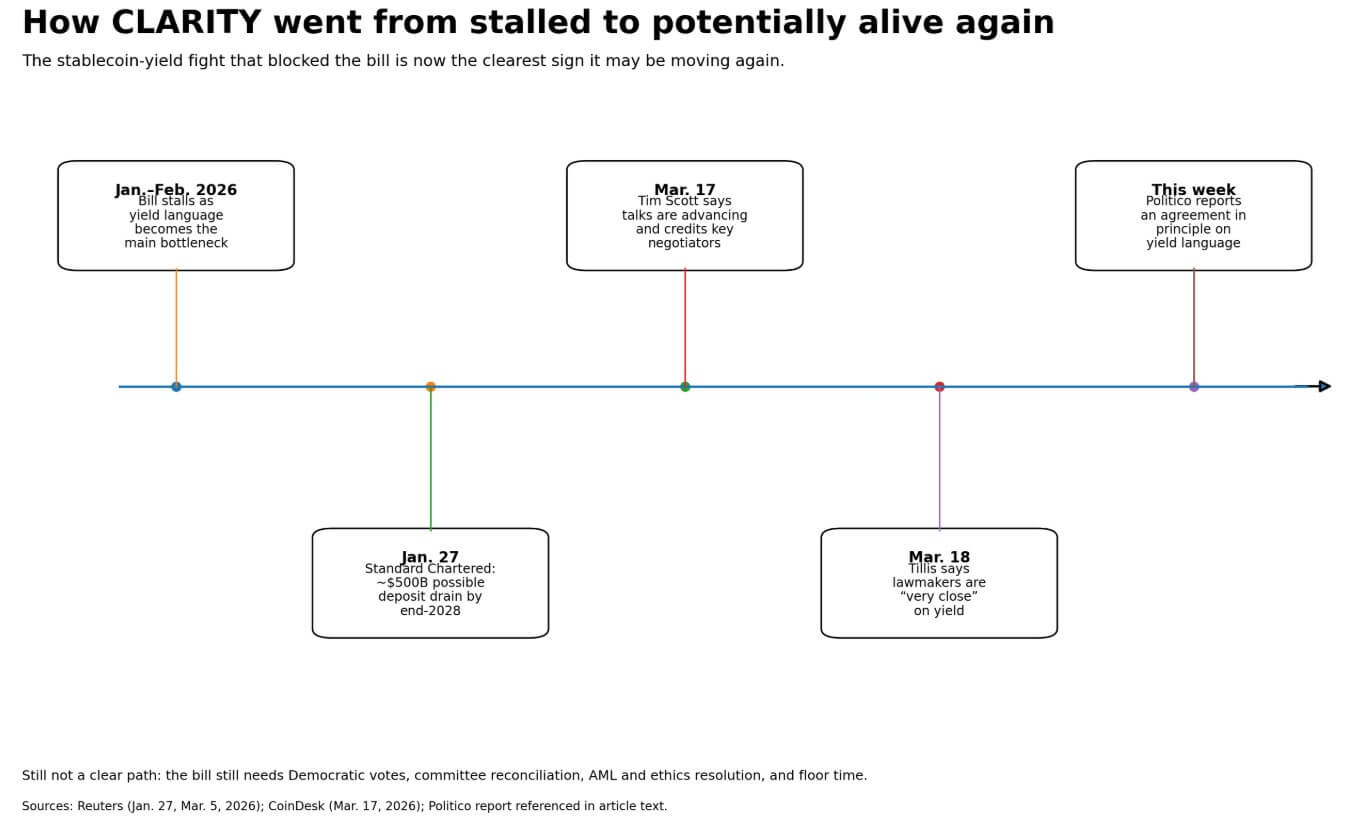
Politico reported this week that senators and White House advisers reached an agreement in principle on the term “stablecoin yield,” which was the main reason the bill had stalled.
The reported deal moves CLARITY from frozen to potentially alive again, which ties directly into Bitcoin’s institutional demand story.
Why this particular fight was the blocker
The CLARITY Act would do something no agency interpretation can: write permanent federal rules governing how crypto exchanges, brokers, dealers and custodians operate, and hand the CFTC formal spot market authority.
SEC Chairman Paul Atkins repeatedly said on March 17 that no action by the Commission can future-proof the crypto rulebook the way legislation can. The message present in both moments was that agency guidance is a bridge and statute is destination.
The stablecoin yield clause became the weak point of the bridge.
Banks warned that crypto companies offering rewards on stablecoin balances could divert deposits from the traditional banking system. Standard Chartered estimated that stablecoins could remove about $500 billion from U.S. bank deposits by the end of 2028.
This stance gave Senate opponents a credible argument for systemic risk, and the bill stalled in February and March despite bipartisan interest in the broader framework of market structure.
Senate Bench Chairman Tim Scott recently said on March 17 that negotiations were making progress, mainly crediting Senators Angela Alsobrooks, Thom Tillis and White House adviser Patrick Witt for the returns.
Tillis said lawmakers were “very close” to an agreement on March 18. The reported agreement in principle is the strongest signal yet that the central bottleneck may be disappearing.
Nevertheless, the bill needs at least seven Democrats in the Senate, faces unresolved disputes over elected officials profiting from crypto ventures and stricter anti-money laundering requirements, must reconcile the Senate’s banking and agriculture bills, and must compete for floor time in a calendar that is steadily shrinking toward the midterms.
Better odds and clear odds are different things.
What Wall Street has already priced
The clearest evidence that CLARITY is a true Bitcoin variable came from Citi in March, when it cut its 12-month Bitcoin target from $143,000 to $112,000.
Citi explicitly said that stalled US legislation had narrowed the space for the regulatory catalysts expected to drive demand for ETFs and broader institutional adoption. The bull case scenario is $165,000, and the recession bear case scenario is $58,000.
The spread between these numbers is partly due to legislation.
JPMorgan’s framing was directive rather than goal-specific. In February, JPMorgan said crypto markets could see a meaningful boost in the second half of 2026 if market structure legislation were passed mid-year, as it would end regulation by enforcement, promote tokenization and put greater institutional participation within reach.
That’s a bank telling customers to look at the Senate calendar as a catalyst for the second half.
VanEck translated policy optimism into observable flow behavior in his January Bitcoin ChainCheck.
The company said Bitcoin’s upside that month partly reflected the optimism of the CLARITY Act, and that optimism coincided with a reversal from $1.3 billion in ETP outflows in the prior 30-day period to $440 million in inflows.
Between January 12 and 14 alone, Bitcoin ETP inflows amounted to $1.66 billion. Policy sentiment moved money in measurable amounts through registered products, with prices rising as a byproduct.
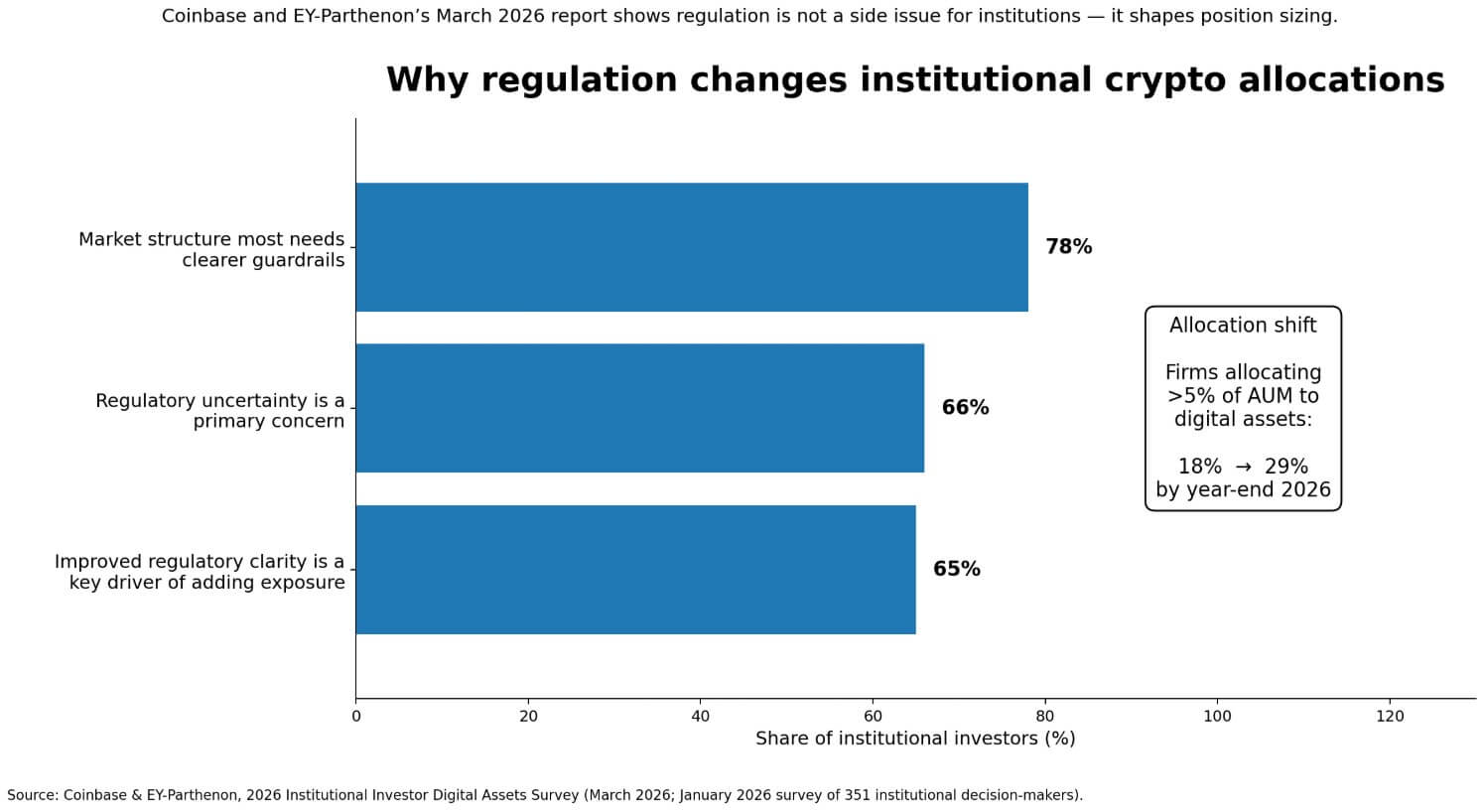
The Coinbase and EY-Parthenon survey among 351 institutional investors in March provides figures on why.
Of companies planning to grow their shares this year, 65% cited improved regulatory clarity as the main driver. In addition, 66% said regulatory uncertainty was their top concern, and 78% said market structure was the area most in need of clear guardrails.
For that cohort, regulation is a size decision. The share of companies dedicating more than 5% of their assets under management to digital assets looks set to rise from 18% to 29% by the end of the year.
Treasury Secretary Scott Bessent made the same point for a mainstream audience when he told CNBC in February that CLARITY would “provide a lot of comfort to the market.”
Grayscale’s 2026 outlook went further, citing a breakdown in legislative progress between the two parties as a downside risk, as regulatory clarity could bring public blockchains deeper into mainstream financial infrastructure.
What investors can expect
The bull case doesn’t need to go through this week. It requires the market to assign higher odds to eventual passage, because Wall Street is pricing the probability rather than the law.
If the compromise on stablecoin rates holds and the Senate bench moves again, the most immediate effect will be a stronger bid for ETF demand, driven by greater institutional comfort, greater platform readiness, and greater custodian confidence.
JPMorgan’s catalyst framing in the second half becomes relevant. Citi’s cut looks too conservative. The Coinbase/EY survey data on the planned 2026 allocation increases becomes a flow story rather than just a survey result.
The bear case only requires that the compromise fray. Ethical disputes, AML requirements or schedule congestion could slow momentum again, even if the returns clause remains in place.
In that scenario, crypto’s legal foundation rests on the interpretive advances of the SEC and CFTC without the regulatory lock-in that Atkins believes only Congress can provide.
Citi’s logic reaffirms itself: the window for a regulatory catalyst is shrinking, and Bitcoin is trading back on macro levels, interest rates and positioning instead of Washington.
The average crypto investor should not expect a compromise in the Senate to move Bitcoin vertically the next morning, because the mechanism is slower and more structural: less regulatory friction over time increases institutional comfort, which supports ETF inflows, market depth, and liquidity.
| Scenario | What’s happening in Washington | What changes for institutions? | What retailers can expect |
|---|---|---|---|
| Bull case: opportunities improve significantly | The Stablecoin Yield Compromise Holds, the Senate Bench Moves Again, and Markets Begin to Assign Higher Odds to an Eventual Passage of CLARITY | Increased confidence in ETF demand, custody, broker/dealer participation, and platform willingness to scale cryptocurrency exposure | Supportive for Bitcoin over time, but no immediate vertical move |
| Base case: progress, but still messy | Negotiations are improving, but the bill remains unresolved and its passage is still uncertain | Institutions view conditions as improving, but are still waiting for clearer legal sustainability before aggressively benchmarking | Bitcoin is getting some regulatory tailwinds, but still trades heavily on macro, liquidity and ETF flows |
| Bear case: compromises fray or get stuck again | Ethical disputes, AML requirements, commission differences or calendar pressure freeze the momentum again | No legal lock-in; institutions remain cautious and rely on existing ETFs and current agency guidance, rather than aggressively expanding their exposure | Bitcoin will trade more on interest rates, macro and positioning than on optimism in Washington |
| What the mechanism actually is | Friction in the legislation is decreasing, even before final passage | Greater legal clarity can improve institutional comfort, confidence in the custody and use of the regulated market infrastructure | The effect is gradual: better ETF flows, deeper liquidity, and a broader market over time rather than a one-day peak |
BlackRock says Bitcoin’s trajectory in 2026 depends on liquidity conditions and the adoption of institutional and wealth advisories, with each individual headline being a secondary input.
Recent ETF flow data makes the same point. US spot Bitcoin ETFs took in $199.4 million on March 17, then returned to outflows of $163.5 million on March 18 and $90.2 million on March 19.
If CLARITY’s odds continue to improve, the effect for the average investor will be a broader, deeper, more institutionally committed market for the asset already in the account.