

Arthur Hayes is still structurally optimistic about Bitcoin. He just doesn’t think this is the time to buy.
Speaking about the coin stories podcast on March 10, the co-founder of BitMEX and CIO of Maelstrom said he would remain patient until a better-known macro catalyst arrives: central bank liquidity. According to Hayes, a prolonged war in Iran and the credit stress that could result from AI-driven economic disruption could eventually force the Federal Reserve to start printing money again, and that, rather than the conflict itself, is the signal he’s waiting for.
“If I had $1 to invest right now, would I put it in Bitcoin? No. I would wait,” Hayes said at the end of the interview. “I think the longer this conflict goes on, the more likely it is that the Fed will have to print money to support the US war machine. And that’s when I’ll buy Bitcoin if the central banks start printing money.”
That distinction was important throughout the conversation. Hayes pushed back on the idea that war is automatically bullish for Bitcoin, arguing that the real transmission mechanism is the expansion of liquidity. “When you say, ‘Okay, war is good for Bitcoin,’ you’re basically saying that war means printing money. Printing money is good for Bitcoin,” he said. “So wait for the money to be printed. Don’t try to time it or you could be wrong.”
Related reading
Arthur Hayes Sees More Bitcoin Pain Ahead
The argument fits into a broader framework that Hayes laid out in the interview: Bitcoin is not so much a clean cut trade as it is a “liquidity alert,” one that is already responding to tightening conditions, credit stress and a lack of new dollar creation. He linked that vision to the rise of AI, which he said could accelerate white-collar job losses, put pressure on private credit and banking risks and force markets to price in a much sharper economic break than many currently expect.
“I think it’s going to happen faster than people think, just because of the exponential nature of how quickly AI improves,” Hayes said. “Only 10 to 20% is needed [job displacement]. And then the leverage in the banking system will do the rest. At some point the market says, ‘Oh, this is worth zero.’”
In that scenario, he said, market recognition of the problem could come long before the full economic damage is visible in the data. Regional banks, retail credits and broader financial stocks could reprice violently, with deposit flight and emergency Fed support following closely behind. That’s the moment that Hayes sees as much more constructive for Bitcoin than the current backdrop.
Related reading
Yet his short-term caution did not extend to Bitcoin’s long-term role. Describing himself as “structurally very, very long” crypto, Hayes argued that the case for non-sovereign money is stronger now than at Bitcoin’s launch. He also warned against shaping the industry around institutional preferences, saying crypto should not reduce itself to a more complicated version of traditional finance.
“Bitco went from zero to whatever $66,000, regardless of the price today, without government support, unclear regulations, hostile banking infrastructure and regulators,” Hayes said. “So why do we go out of our way to gain acceptance from these people who don’t have our best interests at heart?”
He was also dismissive of conspiracy explanations for weak market performance, including claims that market makers are deliberately suppressing Bitcoin’s price. More often, he said, losses are due to poor positioning, poor timing or leverage used by traders ill-equipped for the pace of cryptocurrencies.
For investors frustrated that Bitcoin hasn’t delivered immediate life-changing returns, Hayes’ response was blunt: adjust expectations. “It’s not the market’s job to make you money. It’s the market’s job to take your money,” he said, arguing that long-term compounding is still far more important than trying to extract a six-month windfall.
At the time of writing, BTC was trading at $69,538.
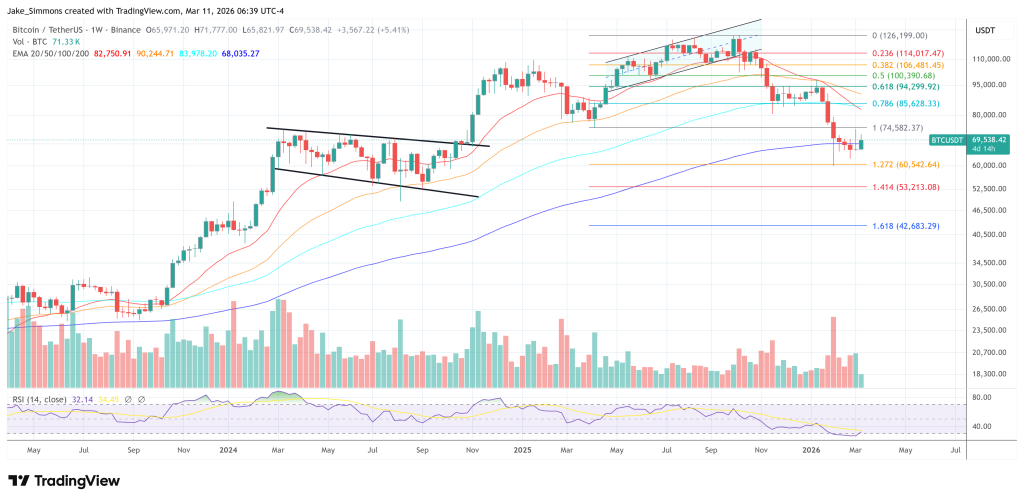
Featured image created with DALL.E, chart from TradingView.com