
Bitcoin has finally wiped out the sell-side liquidity that had built up beneath the market, driving the price into a deep demand zone where stronger buyers are expected to step in. With the downward move now largely complete, attention shifts to whether this level can trigger a meaningful reaction or mark the start of a broader reset.
Why the 100-week SMA remains a proven Bitcoin accumulation zone
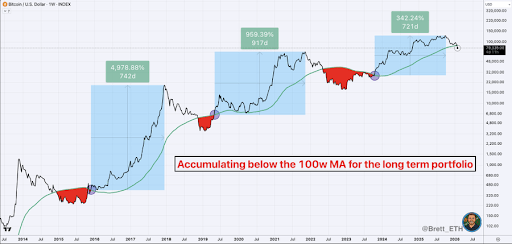
Crypto analyst Brett emphasized that accumulating Bitcoin below the 100-week Simple Moving Average has repeatedly proven to be one of the most reliable long-term investment strategies. According to the expert, this zone has historically seen periods of maximum pessimism, when the risk-reward ratio strongly favors patient buyers rather than short-term traders.
Brett explained that his personal approach consciously avoids pinpointing the exact bottom of the market. Instead, he focuses on steady accumulation by placing buy orders over a wide range between $55,000 and $75,000, backed by daily recurring purchases.
For investors with a more conservative mindset, Brett pointed out that waiting for confirmation can be just as effective. Looking at past cycles, Brett noted that buying after Bitcoin has moved back above the 100-week SMA has consistently produced strong returns. He emphasized that BTC never fell below the 100-week SMA of the previous cycle, reinforcing its importance as a structural support level. Those who followed this strategy in previous market cycles can now expect significant long-term profits.
Breakdown confirmed as key lows failed to hold
According to the latest BTC Heatmap update of Columbus, the market has exactly followed the previously mapped out trajectory. Columbus noted that the inability of local lows to hold, combined with weak tape reactions, indicated that liquidity piled underneath would act like a magnet. The follow-up process was therefore an inevitable consequence of this structural weakness.
In his analysis of the current price action, Columbus highlights that Bitcoin is now trading directly within a cluster of heavier bids around the low $70,000 region. The analyst identifies this particular zone as the first area likely to see a “real reaction” as it represents a significant concentration of buy-side interest. For Columbus, tapping into these deeper pockets was the necessary clearing event to reach this primary demand zone.
Columbus concludes that now that the expected downside has fully played out, the focus now shifts completely to the immediate response of buyers. With liquidity targets met and price at heavy support, Columbus is now closely watching for a definitive response to determine if this level will form the basis for the next part of the trend.