

Arthur Hayes is positioning himself for a liquidity recovery in 2026, arguing that Bitcoin’s weak 2025 was less a referendum on ‘crypto narratives’ than a simple dollar credit narrative. In his latest essay, “Frowny Cloud,” the Maelstrom CIO says he’s adding risk through Strategy (MSTR), Japan’s Metaplanet and Zcash (ZEC) as he expects liquidity in the U.S. dollar to rise after a year in which Bitcoin lagged both gold and U.S. tech stocks.
Hayes frames 2025 is a tricky year for the standard cross-asset shorthand that treats Bitcoin as digital gold or as a high-beta proxy for US technology. According to him, Bitcoin behaved “as expected” under tightening conditions, while gold and the Nasdaq 100 rose for different reasons despite declining dollar liquidity.
Related reading
He argues that gold’s bid is driven by government balance sheets and not retail mania, rooted in distrust of US Treasury exposure after previous asset freeze precedents. “If the American president steals your money, it is immediately zero. Does it matter at what price you buy gold?” he writes, portraying central banks as price-insensitive buyers.
On equities, Hayes leans toward an industrial policy interpretation of AI trading. His claim is that the US and China have effectively treated “winning AI” as strategic, blunting the usual market discipline and helping to explain why the Nasdaq decoupled from its dollar liquidity index in 2025. That difference matters because it sets up its main premise for 2026: Bitcoin needs to increase dollar liquidity to regain momentum.
“Bitcoin and the Nasdaq rise as dollar liquidity increases. The only problem is the recent divergence,” Hayes writes, before returning to the “vicissitudes of dollar liquidity” as the key driver he wants to track.
The three-pillar liquidity pitch
Hayes’ 2026 outlook hinges on a sharp recovery in dollar credit creation. He identifies three channels: a growing Fed balance sheet through Reserve Management Purchases (RMP), commercial bank lending to “strategic sectors,” and lower mortgage rates, catalyzed by policy-driven demand for mortgage-backed securities.
According to him, quantitative tightening disappeared as a dominant headwind in late 2025, with QT ending in December and RMP starting as a new stable buyer. He claims that RMP is growing its balance sheet “at a minimum” by $40 billion per month, and expects this pace to increase as the government’s financing needs increase.
The second phase is the creation of bank credits, which he said will accelerate in the fourth quarter of 2025, with major lenders willing to provide loans where state shares or offtake agreements reduce the risk of default. The third is housing: Hayes points to Trump-backed directives for Fannie Mae and Freddie Mac to commit $200 billion to MBS purchases, arguing that lower mortgage rates could unleash a known wealth effect and, by extension, more credit.
Related reading
He connects the pieces with a simple conclusion: if liquidity turns, Bitcoin must follow. “Bitcoin… and dollar liquidity bottomed out around the same time,” he writes, arguing that the next big leg is less dependent on sentiment than on renewed credit expansion.
MSTR, Metaplanet and ZCash
Describing himself as a “degen speculator,” Hayes says Maelstrom is already “almost fully invested,” but he still wants the “MOAR risk” to offset upside convexity if Bitcoin reclaims higher levels. Instead of using perpetuals or options, he says he is long Strategy and Metaplanet for leveraged exposure through corporate balance sheets.
His timing argument is relative to valuation: he compares each company’s ‘DAT’ to Bitcoin, priced in the relevant currency (yen for Metaplanet, dollars for strategy) and says these ratios are at the lower end of the past two years, having ‘fallen substantially’ from mid-2025 peaks. He adds an important caveat: “If Bitcoin can recapture $110,000, investors will get the itch to go long through these vehicles in Bitcoin. Given the leverage embedded in the capital structure of these companies, they will outperform Bitcoin on the upside.”
He also notes the continued accumulation of Zcash. Hayes argues that the departure of the developers at Electric Coin Company (ECC) is not bearish: “We continue to grow our Zcash position. The departure of the developers at ECC is not bearish. I am confident they will deliver better, more impactful products within their own for-profit entity. I am grateful for the opportunity to buy ZEC from weak hands at a discount.”
At the time of writing, MSTR was trading at $179.33.
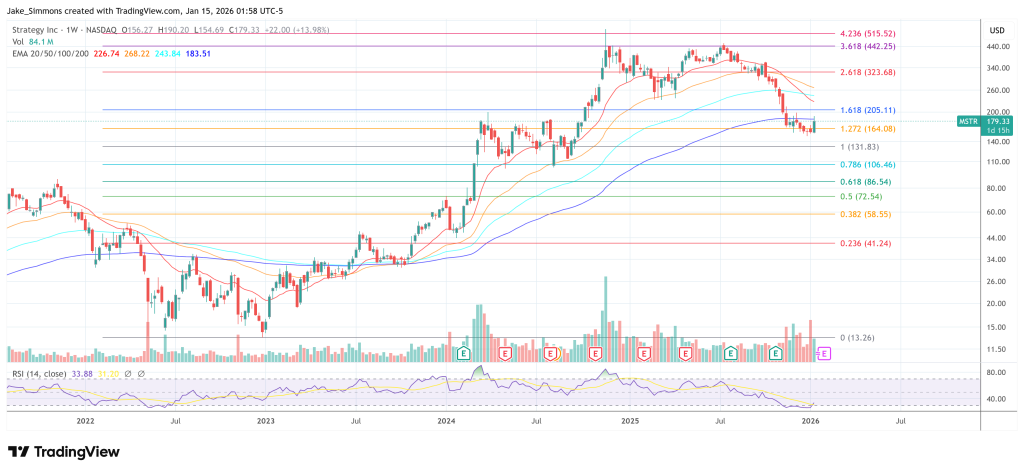
Featured image from YouTube, chart from TradingView.com