

Ethereum co-founder Vitalik Buterin has written and signed the new ‘Trustless Manifesto’, which aims to uphold the core values of decentralization and censorship resistance and push builders to refrain from adding intermediaries and checkpoints for the sake of adoption.
The Trustless Manifesto, also written by Ethereum Foundation researchers Yoav Weiss and Marissa Posner, states that crypto platforms sacrifice trustlessness from the first moment they integrate a hosted node or centralized relayer – explaining that while it feels harmless, it becomes a habit, and with each passing checkpoint the protocol becomes less and less permissionless.
“Trustlessness is not a feature you add after the fact. It is the thing itself,” Ethereum Foundation members said in the manifesto published on Wednesday. “Without this, everything else – efficiency, UX, scalability – is a decoration of a vulnerable core.”
“When complexity tempts us to centralize, we must remember: every line of convenience code can become a bottleneck.”
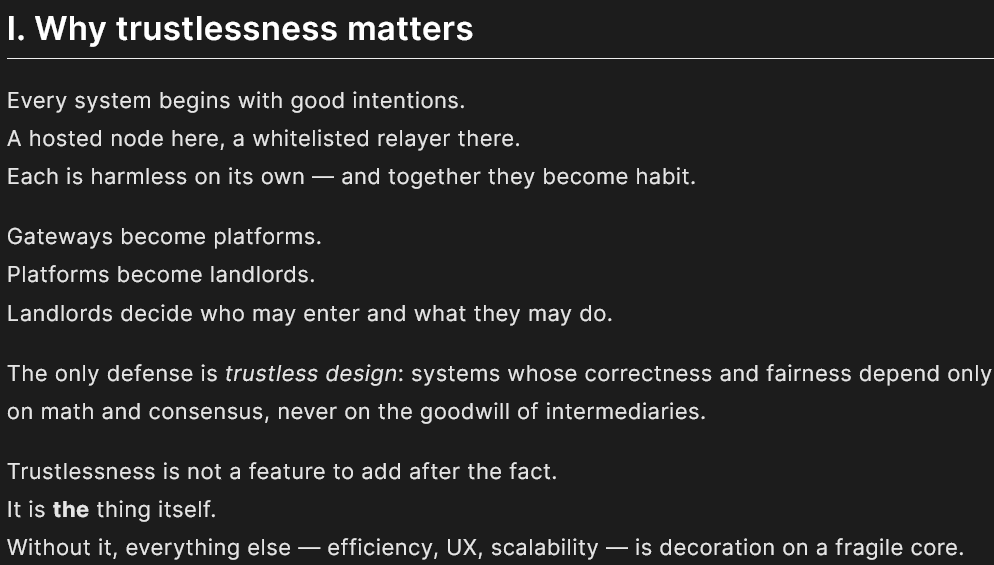
Excerpt from The Trustless Manifesto. Source: Confidencelessness.eth
While the manifesto was not aimed at any particular person or company, some Ethereum layer 2s have been criticized for sacrificing decentralization to focus on scalability to accelerate adoption.
“We measure success not by transactions per second, but by reduced trust per transaction,” Buterin, Posner and Weiss said.
The dependence on middlemen was evident firsthand during the Amazon Web Services crash last month. Coinbase’s Base chain lost approximately 25% throughput when its AWS-hosted sequencer went offline, while Arbitrum and Optimism showed greater resilience and remained fully operational with multi-cloud setups.
Several other contributors in the Ethereum ecosystem signed the manifesto, including Ethereum Foundation member Tom Teman and pseudonymous crypto researcher hitas.base.eth.
Buterin also wants to make Ethereum more cypherpunk
The Trustlessness Manifesto is not the first manifesto Buterin has promoted. In December 2023, he advocated remaking “Ethereum cypherpunk” by promoting zero-knowledge proofs, account abstraction, and other privacy-enhancing encryption solutions.
Ethereum developers joined in amid surging interest from Wall Street
It comes as Ethereum has seen significant institutional adoption of late, starting with the spot Ether (ETH) exchange-traded funds in July 2023 and, more recently, a rising trend of public companies buying the cryptocurrency to strengthen their balance sheets.
However, the Ethereum Foundation and core developers remain focused on achieving Ethereum’s technical roadmap to make the network as decentralized, self-sovereign, and censorship-resistant as possible.