
The multi-billion dollar market for cosmetic items in the popular esports first-person shooter Counter-Strike 2 crashed after an update to the mechanics.
According to an October 8 report from Esports News, the Counter-Strike 2 skin market reached a new high of almost $5.78 billion at the time. A separate Thursday report from Eurogamer said nearly $2 billion was liquidated from this market after a recent game update.
The game’s producer, Valve, has changed the trading system so that players can now convert five low-rarity (hidden level) skins into a knife or a pair of gloves, which were previously extremely rare. That immediately increased the supply of knives and gloves, causing prices to fall, while the value of the hides rose due to renewed demand.
A change by a video game company that led to consequences felt by a large number of players is one of the reasons cited by Ethereum co-founder Vitalik Buterin as inspiration for creating the blockchain.
He explained that he played World of Warcraft from 2007 to 2010, until the company behind the game “removed the damage component from my beloved warlock’s Siphon Life spell.” “I cried myself to sleep and that day I realized the horrors that centralized services can bring. I quickly decided to quit,” Buterin said at the time.
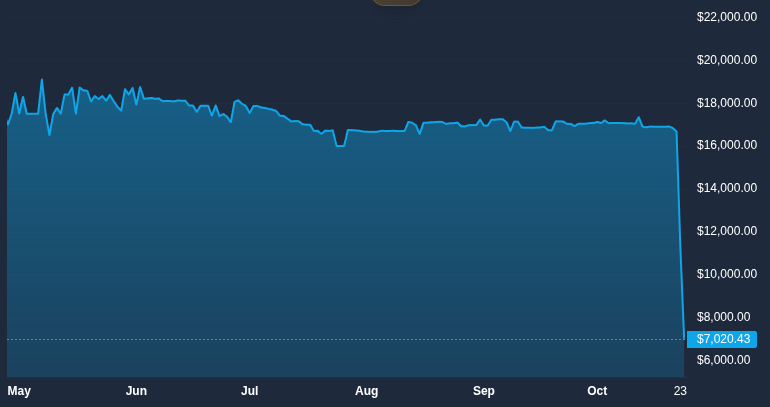
Six-month chart for the price of Counter-Strike 2 cosmetic item Sport Gloves Vice. Source: Price empire
Related: Stablecoins are quietly becoming the hidden engine of gaming: BGA report
Blockchain offers an alternative
While blockchain and non-fungible tokens face widespread opposition from the gaming community, they offer a potential solution to problems like these. Most commonly associated with tradable digital art, NFTs can and are used for any digital goods, such as video game items.
By implementing a smart contract-based digital asset using NFTs, it is possible to provide certainty about what the issuer can and cannot do. Smart contracts can place a limit on the number of NFTs in a series that can be spent, or set permanent rules for converting NFTs across different series.
Still, Martin Kupka, a general partner at crypto gaming consultancy Win Win, told Cointelegraph that using NFTs alone is not enough. “Even if every item were an NFT, the market would have crashed in the same way, as Valve retains full control over the features and usability of the items,” he said, adding:
“As long as a single entity develops and operates a game, it is almost impossible to prevent these types of events.”
Still, he suggests that once a game is big, setting up a community council and making key decisions transparent would benefit all stakeholders.
While Kupka explained that NFTs don’t protect against such scenarios, he said smart contracts could. “That’s the premise of ‘completely on-chain’ games: the core game rules are immutably encoded on a blockchain, preventing one-sided, sudden changes,” he said.
“Once the game is implemented, players can rest assured that the underlying ‘digital physics’ will not change unexpectedly.”
Kori Leon, co-founder of crypto gaming infrastructure Pixelverse, agreed, saying that “smart contracts could have defined clear rules from the start, making any change predictable and transparent.”
Related: After a difficult year, blockchain gaming is seeing a glimmer of hope
Proponents of blockchain in gaming
Catie Romero-Finger, CEO of crypto services firm Babs, told Cointelegraph that the Counter-Strike 2 skin crash is “a harsh reminder that even multi-billion dollar economies can be built solely on borrowed trust.”
“What I see is centralization at play, with the rules changing midstream. Blockchain does not make markets less volatile; instead, it replaces unilateral control with transparent code,” she said.
Nokkvi Dan Ellidason, CEO of crypto gaming infrastructure company Gaimin, told Cointelegraph that the crash “exposed the fundamental flaw of centralized digital economies.” “It’s not a real economy; it’s a corporate store,” he said.
Ellidason said players have just “discovered in real time that their ‘assets’ are just a line item in Valve’s private database, a privilege that can be changed at any time.”
Joana Barros, head of marketing at crypto game My Neighbor Alice, told Cointelegraph that transparency and immutability will be critical as gaming economies continue to grow. “As gaming economies grow into rival markets in the real world, transparency and immutability are not just ‘Web3 buzzwords’, they are fundamental consumer rights,” she said.
Magazine: Gaming giants in talks with Immutable to launch token: Web3 Gamer