

The tide of centralized identity verification is receding. In Web2, it’s often characterized by users surrendering their personal data to powerful platforms, blind to how it’s utilized, secured, or turned into profit.
However, Web3 is ushering in a new paradigm with revolutionary solutions like Ankr Verify that not only empower users with control over their data but also streamline compliance processes for Web3 projects.
In this exclusive interview with Kev Silk, Senior Product Manager at Ankr, we dove into the intricacies of Ankr Verify and how it’s paving the way for a more secure and user-centric future of Web3.
Can you tell us about yourself and how your journey with Ankr started?
Answer: I’ve been involved with blockchain technology since I stumbled upon the Bitcoin white paper in college. The concept of a decentralized currency intrigued me, but it was the underlying technology that truly resonated. As our world becomes increasingly digital, with most transactions happening online, it was clear to me how blockchain could transform imperative industries like finance, real estate and healthcare, but also revolutionize the essence of social contracts.

Kev Silk, Senior Product Manager at Ankr
My professional career began at Gartner. While there, I gained insights into the business benefits of blockchain. However, the more I learned, the more I desired I had to move beyond research and into building within the industry. I wanted to be part of the foundational layer of blockchain, working across various chains and contributing to the development of blockchain infrastructure, which brought me to Ankr. It represented an opportunity to transition from the web2 world to the forefront of blockchain innovation.
If you were asked to describe Ankr quickly, what would you say that encapsulates what Ankr does?
Answer: To fully appreciate Ankr’s role and the value we bring to developers, it’s crucial to understand the core need in blockchain development for dependable, high-quality endpoints and connections across diverse chains. This is precisely where Ankr’s expertise lies.
As a globally distributed blockchain infrastructure company, Ankr is dedicated to providing developers with an unmatched building experience. Our fast and secure blockchain infrastructure is the foundation that enables the creation of superior blockchain applications.
We stand as one of the largest providers of RPC node blockchain infrastructure, with our endpoints serving over 50 million unique IPs each month. Our platform supports more than 45 EVM and non-EVM chains and offers a wide array of developer tools, making us a comprehensive resource in the blockchain space.
Central to our business model is the ANKR token, which functions as the primary means of transaction for our customers. Essentially, Ankr is not just a service provider; we are a dynamic hub of tools for developers, playing an instrumental role in driving the growth and evolution of the web3 industry.
Ankr recently announced the release of its newest product, “Ankr Verify.” Can you share more insight on it?
Answer: Ankr Verify represents our latest innovation, a blockchain privacy authenticator tool that merges traditional web2 KYC protocols with zero-knowledge user identity verification. Put simply, Ankr Verify empowers blockchain applications to establish specific entry policies that users must satisfy. These policies can range from basic criteria like age and citizenship to more nuanced, tailored requirements such as investor qualifications, educational status, specific certifications, or even proof of activity within the chain the application operates on.
The standout feature of Ankr Verify is its capability to enable users to prove compliance with these policies without revealing extraneous personal information. For example, a user can confirm they meet a minimum age requirement, say being over 18, without having to disclose their exact age to the blockchain application they wish to access. This method prioritizes privacy and security, allowing users to engage with blockchain applications while retaining control over their personal data.
How does Ankr verify work?
Answer: Ankr Verify functions through two distinct system flows, catering to both blockchain applications and consumers.
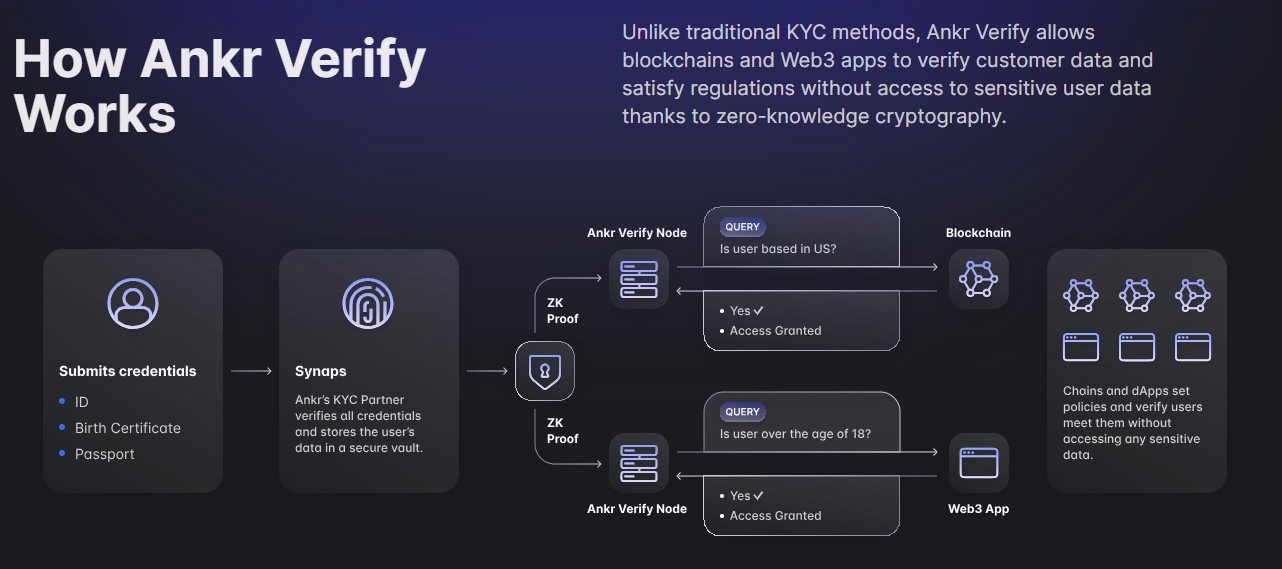
For Blockchain applications:
- Apps access the Ankr Verify dashboard using their wallet.
- They fill out a form with essential information about themselves, such as name and URL.
- Apps then establish specific KYC/AML requirements for their consumers by creating one or more policies.]
- They specify which policies apply to which blockchain networks.
- The Ankr Verify dashboard calculates a periodic cost for these services.
- Apps fulfil this cost periodically through deposits.
- Once this setup is complete, apps are ready to onboard their consumers.
For consumers:
- Consumers begin by creating a Digital Identity (DID) through Synaps.
- On the Synaps UI, they link their wallet address.
- They input personal information typically required in traditional Web2 KYC protocols, like name, gender, age, and citizenship.
- This process creates their DID, linked to their wallet address, with the digital identity’s state stored on a smart contract managed by Synaps.
- With their DID established, consumers can log into the Ankr Verify dashboard using their wallet address, where they can view all credentials forming their current DID state.
- To prove compliance with a specific app or chain policy, consumers submit a “proof request” via the Ankr Verify Server. For example:
- If an application requires users to be over 18, consumers can submit a proof request verifying their age.
- Ankr Verify Servers then verify this proof and validate the public inputs through Synaps’ smart contract.
- Upon successful verification and validation, the proof is recorded on IPFS for public verifiability, and the account address, policy ID, and CID of the proof are logged on-chain.
- Once a wallet address has verified a specific policy for one application, it doesn’t need to repeat this process for the same policy.
What role does digital identity and authentication play in the Web3 ecosystem
Answer: Digital identity and authentication are foundational In the Web3 ecosystem. With the constant use of phones and laptops for internet access, our world increasingly shifts online. In the Web2 environment, every online action contributes to multiple digital profiles. Each platform we interact with compiles its own set of data points, resulting in each individual having several distinct digital profiles. These are controlled and often monetized by the respective platforms, leading to a fragmented and externally-managed digital identity landscape.
A significant shortcoming of the current Web2 environment is how it fragments and externalizes control over these digital profiles. Our data points, spread across various platforms, are used and monetized by these entities. This results in individuals having multiple digital profiles, each controlled and exploited by different platforms for profit.
In contrast, consider the physical world, where each person has one identity that they personally control and manage. Web3 seeks to mirror this in the digital realm, empowering consumers with a consolidated digital identity that they fully control. This digital identity isn’t controlled by any particular platform. Instead, it belongs to the individual, empowering them with complete authority over data access and usage.
Authentication is crucial as it ensures that individuals can verify their identity and access services while maintaining control over their personal information. Ankr Verify plays a vital role in this process. It offers a secure, transparent, and tamper-proof method for users to manage their digital identities. Therefore, Ankr Verify not only enhances user privacy and application security but also empowers users with full control over their digital identities, reshaping our interaction and management of our digital presence.
It’s often said that Web3 mass adoption may not happen unless we make the space safer. What’s your opinion on this?
Answer: I would agree that safety is crucial in Web3, and it’s a term that encompasses several vital areas.
Firstly, there’s the need to protect users from obvious dangers like hacks or deceptive schemes such as rug pulls. To address this, we developed Ankr Verify, a tool specifically designed to enhance user safety and build trust in the blockchain environment. It’s crafted to shield users from these risks, ensuring a safer and more reliable experience.
However, safety in Web3 extends beyond just shielding against external threats. A significant challenge with the current internet, Web2, revolves around how companies use and monetize user data. Web3 promises to change this dynamic, offering a framework where users have control over their personal information. But with greater control comes greater responsibility. Ankr Verify steps in here, easing this responsibility while preserving user control. The product enables users to comply with necessary blockchain application entry requirements without giving up information that is not relevant to the policy, ensuring they don’t need to sacrifice personal details for participation.
Another aspect of safety is protecting blockchain applications from malicious users. With Web3 granting more freedom to consumers, it also poses challenges for blockchain applications in protecting themselves. Ankr Verify enables these applications to establish robust policies which protect them and ensure only legitimate, ethical users are on the platform.
Finally, the importance of regulatory compliance is paramount. For Web3 to achieve broad acceptance, blockchain developers must comply with legal requirements like KYC and AML, which vary based on their operational jurisdictions. Ankr Verify is tailored to simplify this compliance process, aiding blockchain applications in efficiently meeting these regulatory needs. This not only ensures a safer Web3 ecosystem but also fosters a more compliant and trustworthy environment for all users.
For privacy reasons, some DeFi users tend to oppose KYC. How does Ankr Verify the balance between privacy and compliance?
There will always be DeFi protocols that offer an ungated experience to trading crypto assets, so users will always have those options available to them. However, now users will have the choice of more secure DeFi platforms that verify all user identities to prevent rug pulls, hacks, and other vulnerabilities that have separated thousands of users from their assets in the past. Decentralized apps can choose whether they want to employ the benefits of user authentication for their projects. Ankr Verify enables those users who want enhanced security and safety in the DeFi experience while still achieving the permissionless and private experience that is unique to crypto.
Could you elaborate on the collaboration with Synaps for KYC processes and how this partnership enhances Ankr Verify’s approach to user privacy and compliance?
Answer: Our collaboration with Synaps is a cornerstone of Ankr Verify’s commitment to user privacy and compliance. In the absence of a KYC provider like Synaps, Ankr would be forced to store customer data directly. This would contradict our core mission to minimize the exposure of sensitive customer information and reduce the number of entities with access to it.
By partnering with Synaps, and planning to integrate more KYC providers in the future, we ensure that these specialized, trusted, and regulated entities are the only ones to see, verify, or hold user data. This approach significantly enhances user privacy, as the multitude of decentralized apps utilizing Ankr Verify for customer identity verification will never need to directly access or store users’ private information.
Essentially, our partnership with Synaps and other KYC providers means that only organizations dedicated to and regulated for the secure handling of customer data are responsible for its storage. This strategy not only aligns with our commitment to safeguarding user privacy but also ensures strict compliance with data protection regulations, providing a secure and trustworthy environment for both users and developers within the Ankr ecosystem.
How does Ankr Verify enable customizable policy enforcement for businesses and developers within its ecosystem?
Answer: Ankr Verify empowers blockchains and application developers within their ecosystems with highly customizable policy enforcement capabilities. Leveraging our KYC partnerships, they have the freedom to select specific criteria about their customers that need to be verified. This can range from basic attributes like age and nationality to more detailed information such as income level or other verifiable personal details.
The versatility of Ankr Verify lies in its ability to adapt to the unique requirements of each chain or application. Blockchains and developers have complete autonomy in determining the type and number of attributes necessary for users to access their applications. This flexibility ensures that each app can tailor its entry requirements to align with its specific needs and regulatory obligations, providing a secure, compliant, and user-friendly environment within the Ankr ecosystem.