
Cypherpunk Technologies CIO Will McEvoy makes a blunt case for Zcash: the market underestimates ZEC because it still doesn’t have a coherent way to price privacy. In a thread published Tuesday, McEvoy argued that the cut is especially striking as AI-driven surveillance expands and demands for financial confidentiality become easier to justify.
The core of McEvoy claim is simple. “Zcash is the most mispriced asset in crypto because privacy is the most mispriced asset in society,” he wrote. “The market has no real framework for valuing privacy, so it is ignored. Nevertheless, the benefit is asymmetric.”
Why Zcash Might Be ‘Mispriced’
He based that argument on relative size. At the time of his post, McEvoy valued ZEC at $263 with a market cap of $4.4 billion. In contrast, he listed Bitcoin at $1.45 trillion, gold at $34.8 trillion, offshore wealth at $11.3 trillion, stablecoins at $312 billion and Monero at $6.8 billion. It wasn’t so much about direct comparability as it was about scale: in McEvoy’s formulation, Zcash remains “just a rounding error” in any market it could plausibly intersect.
Related reading
This statement runs through every benchmark. Relative to Bitcoin, McEvoy argued that Zcash is still small enough that even a modest revaluation would imply a big move. He wrote that if ZEC reached 0.5% of Bitcoin’s value, it would imply a price of $446, or about 1.7 times higher. At 1%, the implied price rises to $891; at 2%, $1,782; and at 5% $4,456. His summary sentence was as compressed as the valuation case itself: “Zcash is encrypted Bitcoin.”
The offshore wealth equation is sharper. McEvoy described privacy not as a niche preference, but as something people have traditionally paid for on a large scale. “There is $11.3 trillion of offshore wealth,” he wrote. “People pay a premium for privacy. It always has been that way. It always will be that way.” From there, he argued that if Zcash captured 0.1% of that market, the implied price would be $680. At 0.5% this would be $3,402, and at 1% it would be $6,804. “Zcash is a Swiss bank account in your pocket,” he added.
His gold equation extends the same logic to a more traditional store of value frame. “Gold is private. You can hold it. No one knows how much you have,” McEvoy wrote. “Zcash has the same features, but is digital, portable and programmable.” Based on that, he modeled ZEC at $1,048 if it reached 0.05% of the gold value, $2,095 at 0.1% and $10,477 at 0.5%.
Related reading
McEvoy also positioned Zcash in response to the visibility built into much of crypto’s existing payments infrastructure. “Stablecoin transactions are tracked. Portfolios are monitored,” he wrote, before laying out price scenarios based on a ZEC reaching 5%, 10% or 25% of the stablecoin market. These levels implied prices of $939, $1,877 and $4,692 respectively.
He also compared Zcash to Monero. McEvoy argued that Zcash offers “stronger cryptography, optional transparency for compliance, and better scalability,” then drew up a simple table of relative values: parity with Monero would imply $410 for ZEC, double the value of Monero would imply $819, and five times the value of Monero would imply $2,047. “The privacy coin throne has not yet been claimed,” he wrote.
His closing point connected the entire thesis to a broader technological shift. “Artificial intelligence is the offense. Zcash is the defense,” McEvoy said. “AI decrypts all data. Zcash encrypts all data. AI is the surveillance state. Zcash is the sovereign individual. As AI advances, privacy becomes more valuable, not less.”
At the time of writing, ZEC was trading at $244.77.
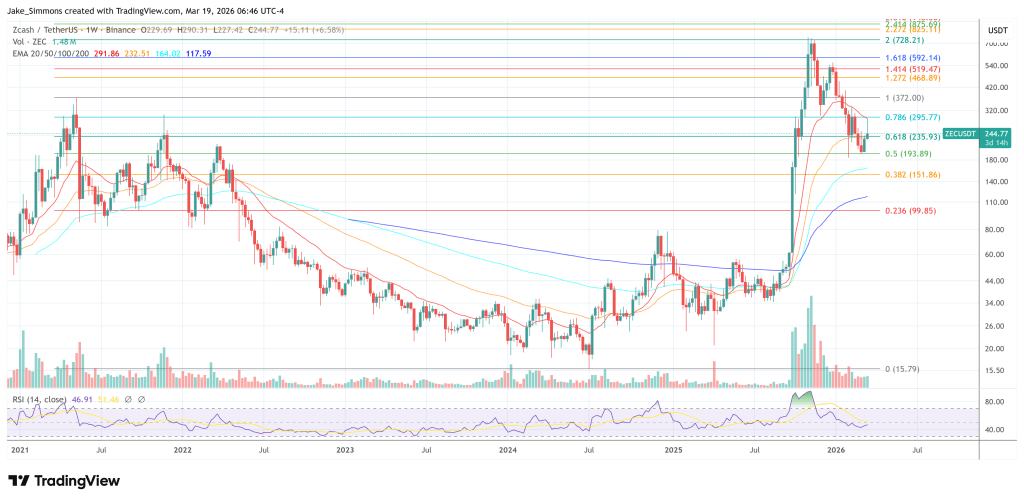
Featured image created with DALL.E, chart from TradingView.com