
XRP is facing one of its most challenging moments in recent months as selling pressure mounts and the broader crypto market enters a risky environment. Bitcoin’s collapse below key psychological levels has dragged altcoins with it, and XRP has not been spared. Analysts are increasingly warning that the market may be entering a bear phase, pointing to tighter liquidity conditions, rising global economic uncertainty and a sharp decline in investor appetite for risky assets.
Related reading
What makes XRP’s situation more vulnerable is the growing number of holders facing unrealized losses. On-chain data shows that many late buyers – especially those who joined after the ETF announcement and during the previous rally – are now underwater as the price continues to fall. This top-heavy market structure puts pressure on holders, amplifying sell-side momentum as fear spreads.
The macro background adds fuel to the fire. As global markets adjust to interest rate volatility, geopolitical tensions and tightening dollar liquidity, capital is flowing out of speculative assets. The price of XRP is now at a crossroads: either it stabilizes at key support zones and absorbs the panic selling, or a deeper correction takes place.
XRP supply in profits signals structural vulnerability
According to new facts from Glassnode, XRP’s market structure is weakening significantly as the latest sell-off unfolds. The share of XRP supply currently in profit has fallen to 58.5%, which is the lowest since November 2024, when XRP was trading at just $0.53. Despite today’s much higher price – around $2.15, almost four times last year’s level – an alarming 41.5% of circulating supply remains loss-making. That represents roughly 26.5 billion XRP underwater.
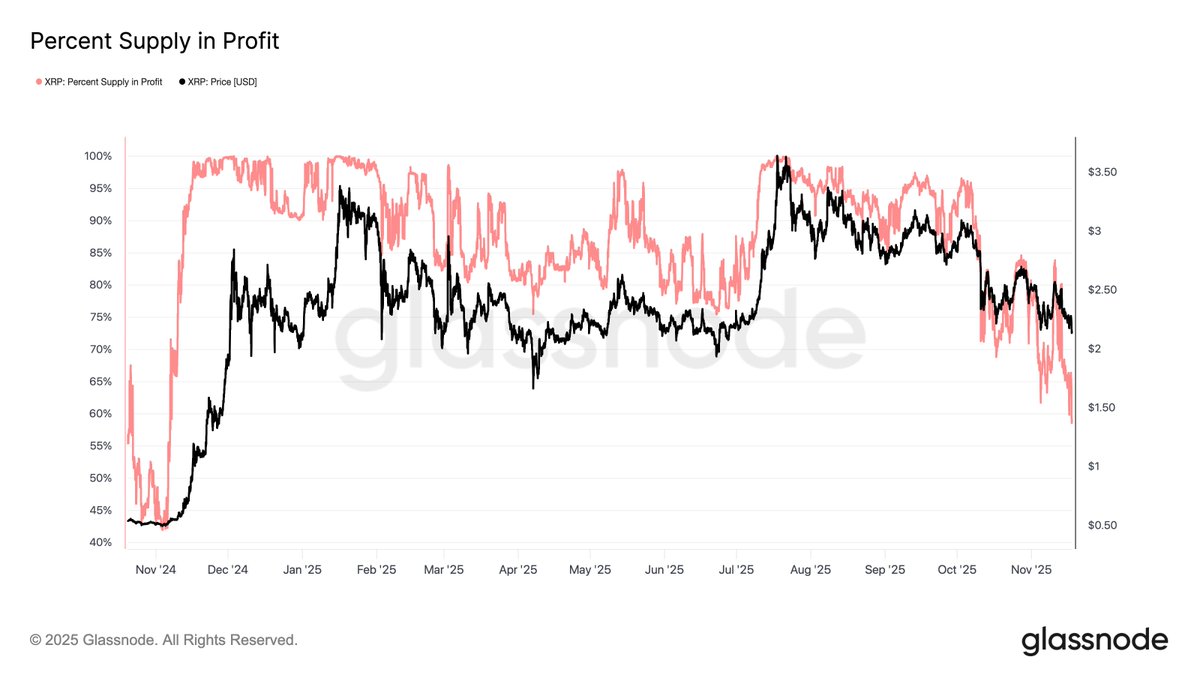
This difference highlights a crucial problem: the market has become top-heavy and dominated by investors who joined the rally late and bought at higher price levels. These holders are now feeling acute pressure as prices recover. Making the distribution of XRP supply more vulnerable and increasing the likelihood of panic-driven selling. Historically, such setups often lead to accelerated downward movement unless strong demand intervenes.
The fact that so much supply is in the red, even at current high prices, suggests that speculative flows, rather than long-term beliefs, fueled the previous surge. As these late buyers suffer losses, selling pressure can increase, creating a vicious cycle of liquidation.
Related reading
XRP Price Analysis: Testing Critical Support Levels
XRP continues to struggle as selling pressure increases, with the chart showing a clear downward trend since early October. The price is now trading around $2.18 and hovering just above a key horizontal support zone that has been tested multiple times throughout the year. Any upswing in this region has weakened, indicating declining buying power and increasing vulnerability to a deeper crisis.

The moving averages reinforce this weakening structure. XRP is trading below the 50-day, 100-day, and 200-day MAs, with all three starting to curl downward. A classic sign of trend deterioration. The failed attempt to reclaim the 50-day MA in early November marked a significant shift as sellers quickly regained control and pushed the price lower. Volume spikes during downturns further confirm that distribution is underway.
Related reading
Furthermore, the lower highs since the September peak indicate that the bulls are losing momentum. Each rally attempt is selling faster, and the rejections near the $2.50-$2.60 region highlight strong resistance from above. If XRP loses the current support band, the next liquidity pocket will be near $1.70-$1.80, where buyers previously defended aggressively.
Featured image of ChatGPT, chart from TradingView.com