
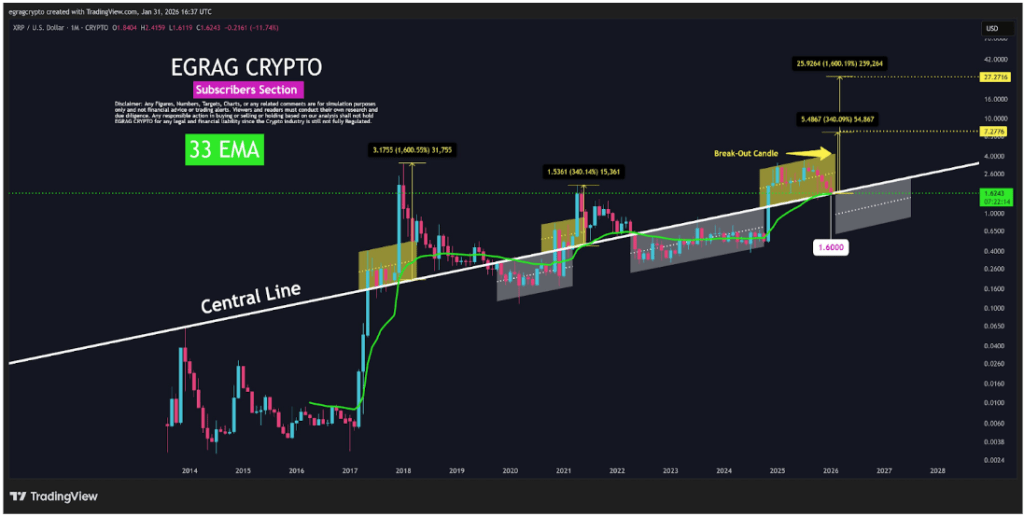
The XRP price was captured last crypto market-wide sell-offand fell to an intraday low of $1.57 in the past 24 hours. The sudden drop highlights XRP’s higher time frame structure, which triggers a break below the 33-month exponential moving average.
According to a technical assessment shared by crypto analyst Egrag Crypto on
Related reading
The 33 EMA interference signal
At the time of writing, XRP is trading around $1.65 again and stabilizing after a fleeting few hours That forced many traders to reassess the broader structure. However, according to technical analysis of At Egrag Crypto, the most recent crash, XRP broke slightly below the 33 EMA on the monthly candlestick timeframe.
Egrag based the recent price action on one critical condition: a confirmed monthly close below $1.60 and the 33 EMA. According to the analyst, such a close would represent macro-bearish confirmation based on historical structure, and not sentiment or opinion.
The chart he shared shows how XRP has respected the 33 EMA as a long-term trend reference over multiple cycles, with violations often preceding extended correction phases. As shown in the chart below, XRP price has been trading above the 33-EMA since early 2025, even during periods of corrections. However, XRP is now trading dangerously close to this EMA, and there is now a risk of a breakdown.
XRP price chart. Source: @egragcrypto On X
What this means for the price structure of XRP
There is a risk that XRP can transition to a macro bear structure. At the same time there is enough reason to suggest an upward leap for the cryptocurrency. A key point in Egrag’s analysis is its historical performance showing that XRP’s strongest upward expansions did not require a clean bull market environment.
Therefore, there are two historical analogues of how XRP may develop from its current range around $1.60. The first is a repeat of the 2021-style move. This move, measured from similar structural conditions, would imply an upside expansion of around 340% with a price target around the $7 region.
The second is a repeat of the 2017 cycle. A comparison with the 2017 cycle predicts a much larger structural expansion of around 1,600%, which would align with the $27 zone indicated in the chart above. In both cases, the rallies came from oversold conditions and compression ranges, rather than strong bullish macro confirmation as many would expect.
Related reading
According to the analysis, a breakdown below $1.60 could still trigger panic selling and reinforce fear narratives of a macro bear market, but those same conditions were previously the zones where late sellers exited just before volatility extended upwards.
Featured image from Unsplash, chart from TradingView